
1. SKUKUZA AIRPORT LIES INSIDE KRUGER NATIONAL PARK
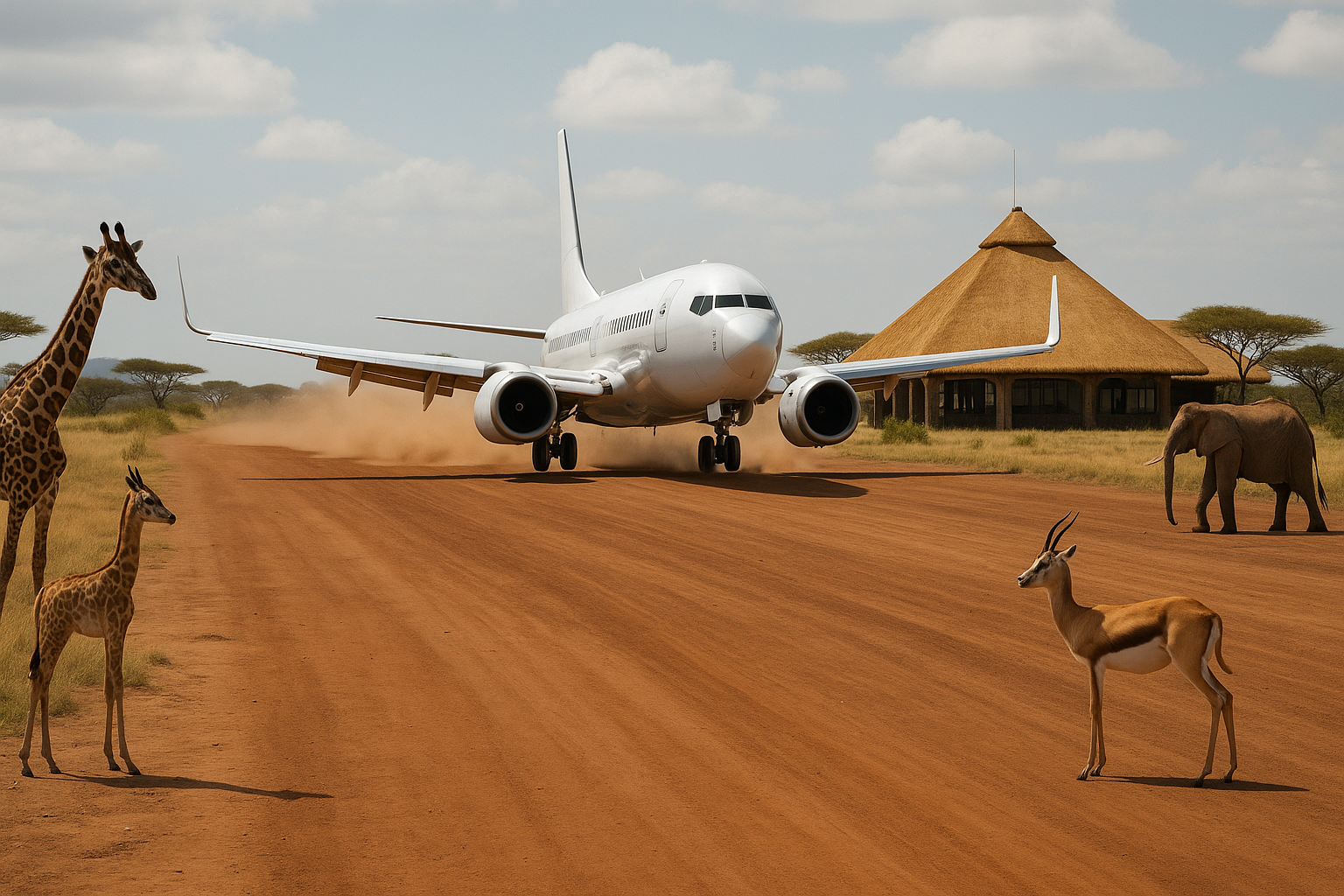
Discover Skukuza Airport, Africa's unique wildlife gateway. A thatch-roofed terminal in Kruger National Park where safaris begin on arrival.
Skukuza Airport is super special because wild animals like lions and elephants often walk across its runway! It's built right inside Kruger National Park, looking like a fancy bush camp, not a typical airport. When you land, you might see giraffes or buffalo, making your trip a real safari from the start. They even charge a fee to help protect the animals, showing how much they care about nature. It's a place where planes wait for animals, proving that nature is truly in charge.
What makes Skukuza Airport unique?
Skukuza Airport is unique because it's the only international-spec airport where wildlife, including elephants, buffalo, and lions, frequently share the runway and surrounding areas. It blends into its Kruger National Park environment with local aesthetics and design, prioritizes conservation through passenger fees, and even has animal movement protocols for aircraft.
Get Cape Town news in your inbox
Stay updated with the latest stories from the Mother City.
When the Descent Becomes a Game Count
The moment the aircraft noses through the scattered alto-cumulus, Johannesburg’s glass towers are replaced by an endless copper rug of mopane. Passengers stop scrolling; window shades snap up. A 2.1 km grey slash appears only after the captain banks hard, an asphalt thread stitched into the granite-green patchwork of Kruger. No tower, no jet-bridge, no blast fence - just giraffe periscoping above the canopy and two white-backed vultures riding the thermals curling off the hot surface. Tyres kiss the ground at 09:07; by then elephant, buffalo and zebra have already been mentally tallied. Welcome to Skukuza, the planet’s only international-spec field where the baggage claim can be upstaged by a hippo yawning in the nearby channel.
From Dirt Scratch to Category Seven in Six Decades
1959: a single-engine Beechcraft Baron drops veterinary supplies onto what is little more than a raked red clearing. The strip dozes for forty summers, its windsock fading to the colour of sun-bleached bone. 2002: SANParks, Airlink and three lodge brands pour R 48 million into a radical brief - build a transport node that behaves like a bush camp, not a mall. Local thatch, eucalyptus poles and Black Impala granite quarried 40 km away must somehow satisfy Category 7 certification. The 650 m² hall they erect breathes like a rondavel, staying eight degrees cooler than the Lowveld furnace outside. Concrete is banished; river-sand terrazzo carries your soles. Railway sleepers stamped “1898” become check-in counters, and the brass scale that once weighed ivory now balances your duffel - history whispering that tourism stepped in only after the guns fell silent.
The Architecture of Disorientation
Copper uplighters throw warm halos onto seed-pod mobiles that twirl in the cross-breeze. Security scanners wear camouflage vinyl, masquerading as field radios. First-timers still ask for “reception,” convinced they have already reached their lodge. The ceiling is a 12-metre cathedral of thatch; the floor exhales the scent of sun-baked reeds. Even the PA system is polite, announcing “the aircraft wishes to leave” rather than ordering passengers to board. You are not in an airport - you have walked into a story that begins with the smell of dust and ends with the roar of a lion beyond the fence line.
Where Buffalo Set the Landing Schedule
Runway sharing protocols
A 1.2 m wire barrier on the western edge is meant only to discourage resident lions from treating warm tarmac as a night-time mattress. Everything else negotiates right-of-way. A southern white rhino nicknamed “Runway Roy” has forced three go-arounds; each episode is filed, not fired upon. Pilots memorize the “big-five grid”: elephant within 150 m of centre-line means power up and circle for twenty minutes. Air-traffic controllers - housed in a modest room above the fire station - track animal movements fed by ranger radios and a motion camera bolted to windsock pole 3. Aircraft wait for fauna; the bush does not wait for aircraft.
The 350 km gold mine
O.R. Tambo swallows more travellers before breakfast than Skukuza greets in a year, yet the 40-minute hop to Kruger is the most lucrative short sector in the region. Airlink’s Embraer E190 lifts off Johannesburg at 10:30, arcs over Mpumalanga’s coal stacks, and touches down at 11:10. In that sliver of time you leapfrog two biomes, three weather fronts and 150 million years of geology. Load factor hovers at 82 %, rocketing to 96 % in September when European holidays sync with the dry-season wildlife jackpot. Modern carbon brakes and reduced-thrust climbs trim fuel burn by 18 % compared with the old Bae-146 jets that blazed the trail.
Conservation paid at the carousel
There is no diplomatic way around the daily R 486 conservation fee - it is collected before you reach the car-hire desk. Multiply by 220 000 seats and tourism pumps R 110 million straight into SANParks’ coffers, bypassing Treasury. An extra R 22 per ticket bankrolls the K9 anti-poaching unit: Belgian Malinois chow, vet bills, helicopter hours. Ranger dog teams have doubled from four to twelve since 2014, and rhino carcasses in the Skukuza section have dropped 56 %, a decline partly credited to aviation-funded reaction speed.
Four Flights, One Apron, Zero Spillage
The choreography of a micro-hub
Skukuza’s arrival screen reads like haiku: Johannesburg, Cape Town, Victoria Falls, Vilanculos. Those four dots knit Kruger into Africa’s richest safari circuit - skip from Table Mountain to leopard-thick Sabi Sand to thundering Victoria Falls without a second customs queue. Only four Code C aircraft fit the apron, so departures are staggered in 40-minute windows and ground turn-around is targeted at 25 minutes - slower only if a cheetah decides to chase guinea fowl past taxiway B. Baggage is walked 40 m by hand, eliminating tractors and therefore diesel spills in a catchment that feeds the Sabie River.
Safari begins at the aircraft stairs
Half the passengers ignore the rental kiosk under the giant sycamore fig and climb straight into open Land Cruisers. The 15 km transfer to Sabi Sabi routinely lasts 90 minutes because the guide diverts to the Sand River pride at golden hour. Guests have cancelled spa appointments - having already tallied the Big Five between runway and lodge gate. The pilot’s landing announcement is replaced by the ranger’s whisper: “Leopard on the termite mound to your left.”
Hidden tech under the thatch
Engineers smuggled 21st-century tricks beneath 19th-century skins. Solar tiles woven into the roof kick out 42 kW, enough to feed runway edge lights and the terminal DC micro-grid. A reed-bed sewage plant polishes 6 000 litres of black water daily, irrigating a lemongrass buffer that elephants dislike. Instead of glycol, bleed-air heaters warm the surface when mercury dips below 6 °C. Fire trucks burn hydrotreated vegetable oil pressed from expired camp cooking oil - a culinary-to-carbon loop that smells faintly of fried onions on startup.
Tomorrow’s Upgrades Without a Single Extra Decibel
The promise of “no expansion”
SANParks’ 2023 tender is adamant: 350 000 passenger annual ceiling, 18 m runway width frozen, no night flights, no duty-free megastore. Innovation therefore aims sideways. A remote digital tower could relocate controllers anywhere with fibre and 12K cameras - handy during marula season when drunken elephants meander across the strip for a week. A second, pint-sized apron 600 m north is pencilled for electric air-taxis being prototyped in Cape Town; the goal is zero-combustion hops to private lodges deep inside the Greater Limpopo Transfrontier Park. Biometric bag-drop will shave processing to five minutes - essential once the 130-seat E195-E2 enters service.
A blueprint for fragile places
Conservationists from Nepal’s Chitwan to Costa Rica’s Osa are taking notes. The recipe is almost childishly simple: park the airport inside the attraction, not beside it; legislate an ecological passenger ceiling; funnel every fare through an open conservation ledger; dress the entire ritual in local aesthetics. Done right, the facility stops being infrastructure and becomes prologue - an antechamber where turbines and bateleurs write the same line across the sky.
So when you next shuffle barefoot through a 200-gate cathedral of glass, remember that 950 km north-east a pilot is easing back the throttles because a breeding herd of buffalo is shambling across the threshold. Inside a thatch-roofed hut a ranger stamps your pass while outside a yellow-billed hornbill studies the luggage cart. Beauty, profit and purpose can indeed share 230 hectares - provided you let the bush draft the rules.
What makes Skukuza Airport unique?
Skukuza Airport is unique because it's the only international-spec airport located directly within a major wildlife reserve (Kruger National Park) where wild animals, including lions, elephants, and buffalo, frequently share, and sometimes dictate, the use of the runway. Its design mimics a bush camp rather than a typical airport terminal, and it actively contributes to conservation efforts through passenger fees.
Do animals often cause delays or interruptions at Skukuza Airport?
Yes, animals frequently cause delays or require changes to flight plans at Skukuza Airport. Pilots and air traffic controllers follow specific "big-five grid" protocols, with aircraft often waiting for animals to clear the runway before landing or taking off. Instances like a rhino nicknamed "Runway Roy" forcing go-arounds are not uncommon, highlighting that nature is indeed in charge.
How does Skukuza Airport contribute to wildlife conservation?
Skukuza Airport significantly contributes to wildlife conservation through a mandatory daily conservation fee charged to all passengers. This fee, amounting to millions of Rand annually, goes directly to SANParks, bypassing traditional treasury routes. A portion of each ticket also funds the K9 anti-poaching unit, which has been instrumental in reducing rhino poaching in the Skukuza section of Kruger National Park.
What kind of architectural style and features can visitors expect at Skukuza Airport?
Visitors to Skukuza Airport can expect an architectural style that blends seamlessly with its natural surroundings, resembling a luxurious bush camp rather than a conventional airport. Features include thatched ceilings, eucalyptus poles, local granite, and river-sand terrazzo floors. Even security scanners are camouflaged, and check-in counters are made from historical railway sleepers, creating an immersive and unique experience.
What are the operational limitations and environmental considerations at Skukuza Airport?
Skukuza Airport operates with strict environmental considerations and limitations. It has a cap of 350,000 passengers annually, a fixed runway width, and no night flights. Innovation focuses on sustainable practices like solar power for lighting and a reed-bed sewage plant. Ground operations are designed to minimize environmental impact, such as hand-carrying baggage to eliminate diesel tractor use and associated spills.
What future upgrades are planned for Skukuza Airport?
Future upgrades for Skukuza Airport focus on enhancing efficiency and sustainability without expanding its physical footprint or increasing noise levels. Plans include implementing a remote digital air traffic control tower, exploring the use of a second, smaller apron for electric air-taxis, and introducing biometric bag-drop systems to speed up passenger processing. These innovations aim to maintain the airport's ecological balance while improving service.

Sarah Kendricks is a Cape Town journalist who covers the city’s vibrant food scene, from township kitchens reinventing heritage dishes to sustainable fine-dining at the foot of Table Mountain. Raised between Bo-Kaap spice stalls and her grandmother’s kitchen in Khayelitsha, she brings a lived intimacy to every story, tracing how a plate of food carries the politics, migrations and memories of the Cape.
View all articles →