
A Cape Town father is walking freely again thanks to groundbreaking surgery
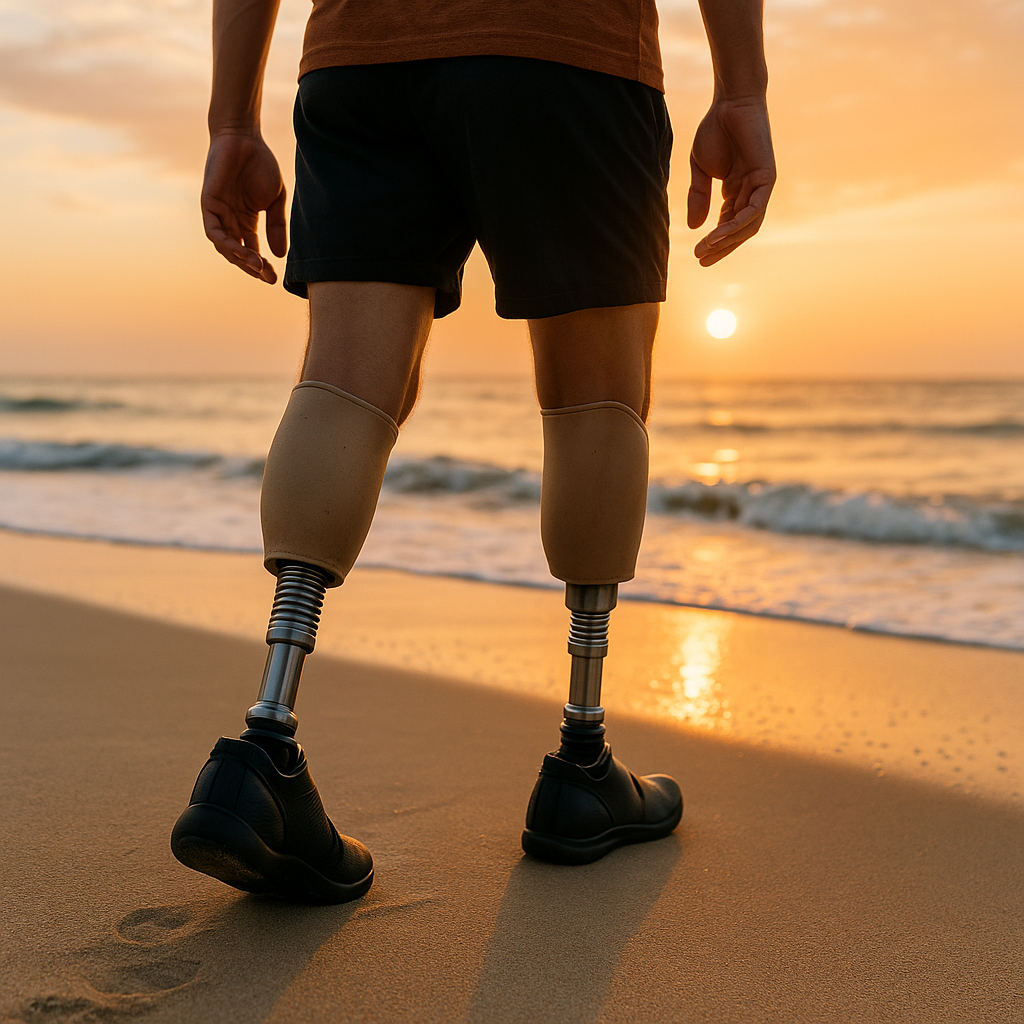
Tashinga Skepa's incredible journey from limb loss to titanium prosthetics, navigating South Africa's evolving landscape of advanced amputee care.
Tashinga Skepa's life changed forever when a car crash stole his legs. Traditional prosthetics were a nightmare, trapping him in pain and limiting his life. But a team of South African doctors and engineers offered him a new hope: osseointegration, a revolutionary surgery that connects titanium implants directly to his bones. Now, with his new 'titanium roots,' Skepa is not only walking freely but also inspiring others and pushing the boundaries of what's possible for amputees.
What is osseointegration in prosthetics?
Osseointegration in prosthetics is a revolutionary technique where titanium implants are surgically fused directly into a patient's bone. This creates a stable, direct connection for prostheses, bypassing traditional sockets. It significantly improves mobility, reduces discomfort, and allows for a more natural range of movement compared to conventional methods.
Get Cape Town news in your inbox
Stay updated with the latest stories from the Mother City.
The Crash That Refused to Be the Final Chapter
The late-winter sun had barely cleared the Helderberg peaks when Tashinga Skepa’s hatchback rolled onto the R44. A delivery van ran the red light at the Strand intersection, slamming into the driver’s side at full throttle. The passenger compartment folded like cardboard; the engine block punched into the foot-well. Hydraulic shears and a 30-minute symphony of metal cutting finally freed him. By the time the helicopter settled on the Tygerberg Hospital roof, both thighs looked as if they had been through a wood-chipper: bones splintered, arteries shredded, muscle swelling at lethal pressure. Thirty-six days of intensive care, seventeen wound clean-outs, and the slow creep of infection later, surgeons levelled their gaze and spoke the word no one wants to hear - guillotine. On 26 September 2018, aged 38, he woke up without legs.
Yet the story does not end on that operating table. It begins again in the narrow corridor where he learned to swing between parallel bars, then in the physiotherapy gym where sweat puddled beneath him in winter, and finally on a sunlit walkway where two carbon-fibre pylons clicked directly into living bone. Between those moments lies a map of South Africa’s public health system stretching its limits, a handful of surgeons betting their reputations, and one man’s refusal to treat terrain as destiny.
The Bucket Years: Learning to Walk Inside a Vice
Conventional sockets returned his height but stole his freedom. Each stride became a wrestling match with a carbon bucket: hike the hips, jam the femoral stumps deeper, pray friction does not blister skin into another abscess. Because both limbs were gone, both hands were busy steering the prostheses instead of carrying a plate, a child’s hand, or simply slipping into a pocket. A walk to the bathroom - eight metres - took eight laborious minutes and left his shirt soaked. Energy meters clocked almost three times the caloric burn of able-bodied gait, yet he covered a tenth of the distance. Weekends meant mapping paving stones like a minefield; one wobble could twist the socket and reopen scars. Invitations piled up on his desk, each “regrets” followed by a single word: terrain.
Behind the scenes, a quiet revolution stirred. Professor Nando Ferreira and Dr Franz Birkholtz had been courting hospitals, universities and health-department accountants since 2019, carving out theatre slots, research funds and procurement codes for “ultra-specialised implantables.” Tygerberg Hospital - serving 3.8 million uninsured citizens - joined forces with Stellenbosch University’s engineers, Mediclinic Stellenbosch’s theatres, and a Dutch non-profit called MoveAgain. Together they formed Team Osseo Stellies, aiming to offer bone-anchored prostheses inside the state purse. By late 2021, the consortium was ready to bankroll its first public-sector candidate; they simply needed the right patient to walk through the door.
Gatekeeping, Drills and the Day Bone Met Metal
Forty-two bilateral amputees answered the call. Only four survived the gantlet: bone density above 90 Hounsfield units, residual femur longer than twelve centimetres, peak oxygen uptake north of 15 ml/kg/min, and Trinity-scale psychological scores in the top quartile. Skepa topped the list at 98 per cent. A mock “day-in-the-life” followed - six hours wearing trial pylons bolted to a temporary abutment while clinicians watched him hop curbs, use a public toilet and hop back on crutches. When the committee projected his name in green, he became the first public patient cleared for bilateral osseointegrated implants in South Africa.
Stage one surgery unfolded on 7 March 2023 in a theatre pressurised to filter every airborne germ. Two orthopaedic surgeons, one vascular plastic surgeon, an anaesthetic team and two infection-control nurses hovered over lengthened incisions. Each femur was reamed to 14 mm and wedged with grit-blasted titanium coated in hydroxyapatite, a lattice that tricks bone into thinking metal is mineral. Muscle flaps were rotated to pad the future stoma site, antibiotic paste was packed around the collar and silver-laced dressings sealed the wound. Post-op X-rays showed alignment within a single degree; the implants, locked inside living marrow, began their silent courtship with bone.
For eight weeks Skepa remained non-weight-bearing, renting a flat across from the hospital. He swallowed 1500 mg of calcium and 4000 IU of vitamin D daily, wobbled on balance boards and watched his periprosthetic density rise 3 per cent on the scanner. Then, on 19 May 2023, surgeons reopened a six-centimetre stoma, bolted on dual-cone adapters and clipped graphite pylons capped by microprocessor knees. Telemetry inside the abutments recorded ground reaction forces at 68 per cent of body weight - safe enough for a maiden 40-metre corridor walk. He completed it that afternoon under the cheers of theatre staff.
Rewiring Identity from the Pelvis Up
Traditional rehab teaches above-knee amputees to lock their pelvis and hike; osseointegration demands the opposite - unlock, glide, trust that titanium will not snap. Mirror therapy, virtual-reality gait drills and EMG biofeedback rewrote the brain’s map of hips that no longer ended in flesh. Week seven delivered a Cape winter squall slicking the hospital bricks; therapists huddled under umbrellas while Skepa traversed the same surface hands-free, a rite once considered impossible for any bilateral amputee. By week eight he ferried takeaway coffees 120 metres back to the prosthetics lab one-handed, counting 9 847 steps a day.
Stoma care became ritual: a pH-neutral scrub followed by a 0.05 per cent chlorhexidine flush he jokes is “brushing the bone’s teeth.” Bluetooth sensors stream cadence metrics; symmetry dips trigger automatic text alerts. Airport security occasionally quizzed the 15-centimetre titanium shadow on the scanner, so he carries a hospital letter in Afrikaans, English and isiXhosa. Static from Cape Doctor winds may snap along graphite pylons, tamed by a grounding sleeve. He now manages an insurance data-capture team, parks anywhere, and dives into mixed-ability beach volleyball where microprocessor knees flip to “run” mode.
The price tag - ZAR 1.05 million - was footed by a public tariff hack: implants bought at NGO cost, theatre time offset by a corporate grant, rehab capped at state rates. A private patient would have paid 2.4 million. Western Cape Health has since ring-fenced funding for five bilateral and ten unilateral cases yearly; a George satellite clinic launches late 2024. Stellenbosch engineers are prototyping a local abutment 35 per cent cheaper than imports while doctoral students chase CRISPR-based infection swabs for percutaneous implants. Skepa’s next horizons: summiting Platteklip Gorge by December, hand-biking the 2025 Cape Town Cycle Tour, and guiding the fifth bilateral cohort through their first stoma shower. The horizon, he says, keeps moving - exactly the way he likes it.
[{"question": "What is osseointegration in prosthetics?", "answer": "Osseointegration in prosthetics is a revolutionary technique where titanium implants are surgically fused directly into a patient's bone. This creates a stable, direct connection for prostheses, bypassing traditional sockets. It significantly improves mobility, reduces discomfort, and allows for a more natural range of movement compared to conventional methods. This method is particularly beneficial for amputees who experience issues with traditional socket prostheses, such as pain, skin irritation, and limited range of motion."}, {"question": "Who is Tashinga Skepa and what happened to him?", "answer": "Tashinga Skepa is an individual whose legs were amputated following a severe car crash on September 26, 2018, when he was 38 years old. After struggling with traditional prosthetics, he became the first public patient in South Africa to undergo bilateral osseointegration surgery, a procedure that has transformed his mobility and quality of life."}, {"question": "What challenges did Tashinga Skepa face with traditional prosthetics?", "answer": "With traditional prosthetics, Tashinga Skepa experienced significant pain and limitations. Each stride was a struggle with a \"carbon bucket,\" leading to discomfort, blistering, and requiring both hands to steer the prostheses. Simple tasks like walking to the bathroom became laborious, and he expended nearly three times the caloric energy of an able-bodied person to cover a fraction of the distance. The terrain was a constant challenge, forcing him to avoid certain activities and map out every step to prevent falls or further injury."}, {"question": "How was osseointegration made accessible in South Africa's public health system?", "answer": "A team led by Professor Nando Ferreira and Dr Franz Birkholtz, in collaboration with Tygerberg Hospital, Stellenbosch University’s engineers, Mediclinic Stellenbosch, and the Dutch non-profit MoveAgain, formed \"Team Osseo Stellies.\" They worked to secure research funds, theatre slots, and procurement codes to offer bone-anchored prostheses within the state budget. The first public-sector candidate's procedure, Tashinga Skepa's, was financed through a public tariff hack, with implants bought at NGO cost, theatre time offset by a corporate grant, and rehab capped at state rates. This innovative approach made the ZAR 1.05 million procedure affordable for public patients."}, {"question": "What was the selection process like for the osseointegration surgery?", "answer": "Out of 42 bilateral amputees who applied, only four met the stringent criteria for the osseointegration surgery. Candidates needed bone density above 90 Hounsfield units, residual femur longer than 12 centimetres, peak oxygen uptake north of 15 ml/kg/min, and top-quartile psychological scores on the Trinity scale. Tashinga Skepa topped the list. A mock \"day-in-the-life\" evaluation, involving tasks like hopping curbs and using a public toilet with trial prostheses, further assessed candidates before final selection."}, {"question": "What are the benefits of osseointegration for Tashinga Skepa and other amputees?", "answer": "For Tashinga Skepa, osseointegration has brought profound benefits, including greatly improved mobility and freedom. He can now walk without pain, carry items, and engage in activities like beach volleyball. The direct connection to the bone provides a more natural feel and control, significantly reducing the energy expenditure compared to traditional prosthetics. This method also allows for a new kind of rehabilitation that focuses on unlocking and gliding, rather than the restrictive movements required by socket prosthetics. Skepa's success is inspiring others, and the program is expanding to offer this life-changing technology to more amputees in South Africa. He is currently able to manage an insurance data-capture team, park anywhere, and even plans to summit Platteklip Gorge and participate in the Cape Town Cycle Tour."}]
Kagiso Petersen is a Cape Town journalist who reports on the city’s evolving food culture—tracking everything from township braai innovators to Sea Point bistros signed up to the Ocean Wise pledge. Raised in Bo-Kaap and now cycling daily along the Atlantic Seaboard, he brings a palpable love for the city’s layered flavours and even more layered stories to every assignment.
View all articles →