
A heritage woven into every stitch
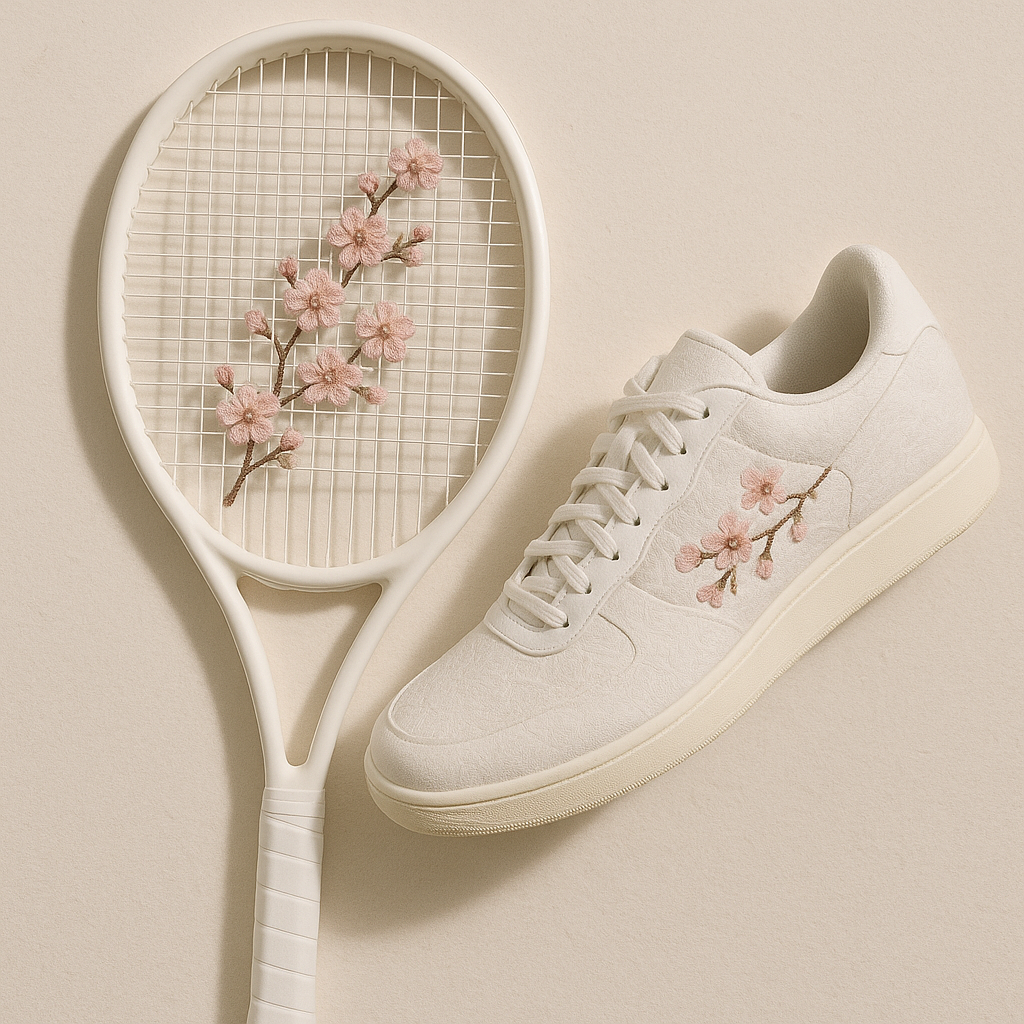
Naomi Osaka redefines tradition at Wimbledon with a white kimono, subtly blending Japanese heritage and personal expression through fashion.
Naomi Osaka's Wimbledon outfit was a beautiful mix of old Japanese style and Wimbledon's strict white rule. Designed with Hana Yagi, it showed how rules can make art even better. The dress, inspired by kimonos, featured tiny cherry blossoms and made Osaka look like a moving sculpture. It proved that tradition can be fresh and exciting, not just old-fashioned.
What is the significance of Naomi Osaka's Wimbledon outfit?
Naomi Osaka's Wimbledon outfit, designed with Hana Yagi, embodies a creative fusion of traditional Japanese design within Wimbledon's strict dress code. Her
Get Cape Town news in your inbox
Stay updated with the latest stories from the Mother City.
When Tradition Meets Tennis's Most Famous Gatekeepers
Wimbledon stands as perhaps the last great citadel of sporting conservatism, its manicured lawns and unbending dress code forming a defensive perimeter against the chaos of contemporary athletic culture. The All England Club's obsession with immaculate whiteness, policed with increasing severity since the 1960s, originally sought to strip away visual noise - to force eyes toward pure athletic achievement rather than corporate branding or personal flamboyance. Yet Naomi Osaka has uncovered an unexpected truth hidden within these rigid boundaries: that severe restriction can unlock creative abundance, that the most constricted canvas may hold the richest possibilities for genuine expression.
Her third-round arrival in the 2026 tournament against Daria Kasatkina embodied this revelation with almost mathematical precision. What emerged from beneath the stands carried the unmistakable DNA of Japanese ceremonial dress - tiered construction, flowing drapery, deliberate imbalance in its traditional engineering - yet executed entirely within Wimbledon's chromatic prison. The cherry blossom, that most emotionally freighted of Japanese cultural emblems, materialised not as loud decoration but as barely-there needlework, its rose tones registering initially as mere surface variation, resolving into discernible floral detail only upon closer observation. Even her coiffure entered this organic vocabulary, styled to evoke the same arboreal reaching.
The significance of this moment extended well beyond mere innovation. Since early 2024, Osaka has cultivated a working relationship with Hana Yagi, a Tokyo designer whose practice spans ancestral weaving techniques and contemporary spatial design. This collaboration has yielded some of the most exhaustively discussed visual moments in modern athletics. Yagi functions less as hired hand than as co-creator in Osaka's extended project of self-translation across cultural contexts. The Centre Court kimono built upon previous experiments, yet it marked a maturation - proof of a creative alliance that had graduated from provocative gesture toward sustained, searching exploration.
The Discipline of Creative Restraint
Osaka's own characterisation of this work carries surprising density. She christened it her "free-robe vibe," an offhand formulation that nonetheless exposes substantial artistic thinking. The terminology admits that she has been recombining foundational pieces rather than fabricating wholly original ensembles for each outing - an approach that resembles limitation yet operates as genuine methodology. Here sustainability transcends environmental obligation to become aesthetic creed: the recognition that selfhood manifests not through endless acquisition but through pattern, repetition, and intelligent transformation.
The market reception of this measured approach proved illuminating. The complete ensemble vanished from availability before her racquet touched ball, indicating that spectators have learned to interpret Osaka's sartorial decisions as cultural artefacts worthy of preservation - significant events that exceed their physical substrate. This appetite functions on several simultaneous levels: the fashion collector's response to scarcity, certainly, but additionally something more precise - the understanding that these items transport meaning past their utilitarian purpose, that they constitute waypoints in an unfolding story binding athletic performance, ancestral inheritance, and lived biography.
The structural logic of kimono construction warrants particular examination. Where Western clothing typically hides its engineering to simulate organic bodily form, traditional Japanese dress foregrounds the conversation between textile and figure - cloth as inhabitable space rather than concealing membrane. The stratified assembly, the calculated asymmetry of sash positioning, the fresh geometries generated by motion: these qualities convert the wearer into mobile sculpture. On Centre Court, where broadcast technology captures every perspective and slow-motion dissection reveals what instantaneous watching cannot, this spatial sophistication achieves exceptional resonance.
From Melbourne to London: Building a Visual Language
The arc of Osaka's 2026 Grand Slam calendar presents a developmental pattern that would satisfy rigorous narrative analysis. Her Melbourne presentation had showcased a gown drawn from medusoid anatomy, apparently remote from the Wimbledon kimono - aqueous biology opposed to ritual heritage, diaphanous movement counterposed to architectural enclosure. Yet Osaka disclosed their shared genesis: both sprang from reading aloud to her daughter Shai, from the intimate domestic sphere of nighttime narratives and picture-book illustrations.
This revelation restructures all prior interpretation. What seemed to be fashion's characteristic raids upon cultural archive and natural taxonomy reveal themselves as something tenderer: a mother's rendering of her child's imaginative universe into public spectacle. The medusa, with its radial equilibrium and perilous loveliness, and the sakura, with its ephemeral bloom and millennia of sedimented significance, initially share space in a toddler's illustrated volume before migrating onto Osaka's physical form. Fashion becomes, by her description, "a diary written in fabric rather than ink" - though even this image insufficiently acknowledges the collective labour involved, the numerous skilled hands required to transmute private recollection into publicly comprehensible statement.
The geographical reach of this undertaking carries weight. These pieces emerge from Japanese ateliers, then traverse oceans to London or Melbourne, bearing their origins in every stitch. Against an industrial landscape of disposable clothing and digital infinite reproducibility, this material commitment to traceable provenance constitutes its own polemical assertion. The garment that materialised at Wimbledon followed a concrete itinerary, preserved concrete connections between artisan and athlete, embodied concrete economic and craft lineages. This escapes the category of theatrical costume - temporary inhabitation of alterity - to approach something nearer to identity as continuous self-fashioning through serial deliberate selection.
Kyoto's Stillness, Centre Court's Speed
Osaka's kimono cannot transplant this experience; the conditions of Centre Court forbid direct replication. Yet it accomplishes something perhaps more compelling: it constructs a transportable variant of that deliberateness, that meditation, that negotiation between material and form witnessed among Kyoto's kimono-clad women. The friction between this quality and tennis's inherent acceleration - projectiles nearing two hundred kilometres hourly, exchanges of explosive force, mass vocalisation responding to millisecond advantage - generates productive contrast that vivifies both terms.
What registers as "heritage worn with pride, not nostalgia" captures the essence of this stance. Nostalgia presumes separation, the melancholic sweetness of irrecoverable past. Pride implies active engagement, continuing negotiation with vital tradition. Osaka's kimono does not lament some vanished Japan; it presents a Japan that persists in creating, adapting, disseminating its visual systems to fresh contexts. The Yagi collaboration, the commercial circulation of these designs, the planetary discussion they provoke: these constitute not tradition's dilution but testimony to its vigour.
The Construction of Spectatorship
Athletic competition provides peculiar conditions for such cultural labour. Unlike fashion's designated weeks in global metropolises, where attention is professionally focused and commercially organised, tennis tournaments distribute concentration irregularly - across matches, across tournament days, between the athletic contest and its ritualised preludes and aftermaths. Osaka has mastered exploitation of these interstitial intervals, recognising that the procession to Centre Court delivers exposure duration unmatched by any catwalk.
Wimbledon's specific prohibitions amplify this opportunity. The whiteness mandate, conceived to suppress visual rivalry with the sport itself, has generated heightened receptivity to silhouette and surface. Deprived of chromatic differentiation, observers attend more acutely to contour, to kinetics, to textile behaviour relative to physique and atmosphere. Osaka's tiered construction, with its multiple planes and shifting interrelations, rewards this attention more abundantly than standard athletic apparel. The kimono becomes an investigation of white's inexhaustible range, its aptitude for registering illumination, shadow, and gesture.
The cherry blossom motif operates within this chromatic confinement with particular ingenuity. Executed in raised embroidery rather than flat printing, the flowers possess dimensional presence, their textured surfaces capturing light distinctly from adjacent material. In motion, they flicker between visibility and concealment, their irregular distribution generating visual tempo that reinforces the garment's structural asymmetry. The coiffure's mirroring of this motif extends the design into occupied space, rendering the body continuous with its adornment in ways Western sport clothing seldom attempts.
This fusion of person and apparel, of biological and cultural signification, perhaps constitutes the profoundest accomplishment of Osaka's Wimbledon undertaking. The "free-robe vibe" ultimately concerns not the garment in isolation but the liberty it facilitates - the room it opens for identity to be enacted without fixation, for ancestry to be embraced without depletion, for maternity and competitive excellence and aesthetic aspiration to coexist in visible, kinetic manifestation.
[{"question": "What is the significance of Naomi Osaka's Wimbledon outfit?", "answer": "Naomi Osaka's Wimbledon outfit, designed with Hana Yagi, is significant because it masterfully blends traditional Japanese aesthetics, such as kimono inspiration and subtle cherry blossom motifs, with Wimbledon's strict all-white dress code. It demonstrates how creative restraint can lead to innovative and culturally rich artistic expression, making tradition feel fresh and exciting."}, {"question": "Who designed Naomi Osaka's Wimbledon outfit?", "answer": "Naomi Osaka's Wimbledon outfit was designed in collaboration with Tokyo-based designer Hana Yagi. Their working relationship, which began in early 2024, is described as a co-creative partnership focused on exploring Osaka's cultural identity through her sartorial choices."}, {"question": "How did Osaka's outfit incorporate Japanese tradition within Wimbledon's rules?", "answer": "The outfit incorporated Japanese tradition through its kimono-inspired tiered construction, flowing drapery, and deliberate asymmetry. Subtle cherry blossom needlework, with rose tones that only resolved into floral detail upon closer observation, adhered to the white rule while still referencing a key Japanese cultural emblem. Even her hairstyle evoked the same arboreal theme."}, {"question": "What did Naomi Osaka call her approach to these designs?", "answer": "Naomi Osaka characterized her approach to these designs as her 'free-robe vibe.' This phrase suggests a methodology of recombining foundational pieces rather than creating entirely new ensembles, highlighting sustainability not just as an environmental obligation but as an aesthetic creed focusing on pattern, repetition, and intelligent transformation."}, {"question": "How does Naomi Osaka's fashion challenge traditional notions of self-expression in sports?", "answer": "Osaka's fashion challenges traditional notions by using Wimbledon's 'chromatic prison' (the all-white rule) as a canvas for profound cultural and personal expression. Instead of succumbing to the limitations, she uses them to unlock creative abundance, turning her outfits into 'a diary written in fabric' that conveys her ancestral inheritance, maternity, and aesthetic aspirations, all while defying the idea that selfhood requires endless acquisition."}, {"question": "What is the broader impact of Naomi Osaka's sartorial choices?", "answer": "The broader impact of Osaka's sartorial choices is multifaceted. Her outfits are seen as cultural artifacts that transport meaning beyond their utilitarian purpose, generating significant market demand. They showcase how tradition can be vigorously adapted to fresh contexts, fostering planetary discussions. Furthermore, they demonstrate how an athlete can leverage the unique conditions of high-profile sporting events, like the procession to Centre Court, to make powerful statements that blend athletic performance, cultural identity, and personal narrative."]

Oliver Daniels is a Cape Town journalist who chronicles the intersection of food, migration and identity in South Africa's kitchens—from wood-fired Gugulethu braai spots to Constantia vineyards. Born and raised on the slopes of Devil’s Peak, he still starts each week with a dawn walk across Table Mountain to catch the first Atlantic light before filing copy.
View all articles →