
Animal rescue inspector Kilwa hit by brick near Mfuleni
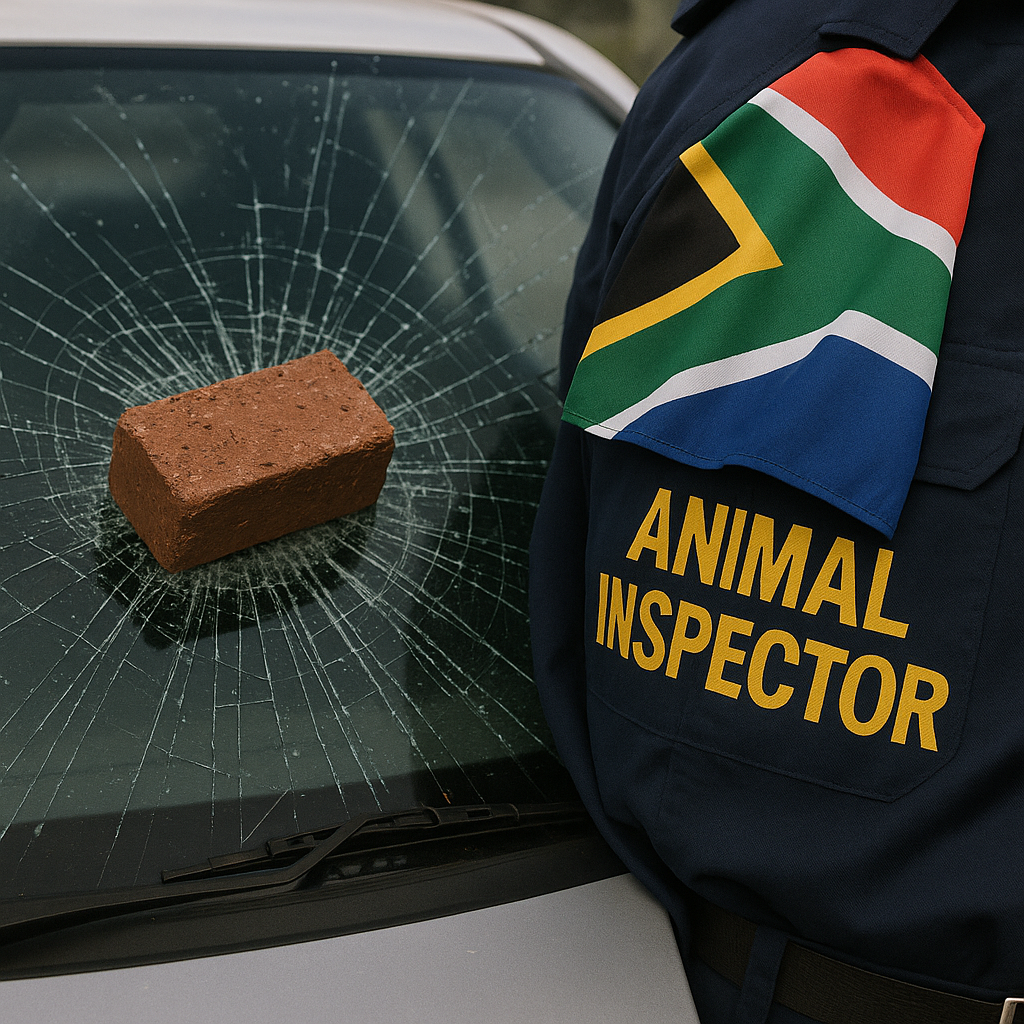
An animal inspector's harrowing encounter with a brick on a South African highway reveals the daily dangers faced by those protecting animals.
In South Africa, brave animal welfare inspectors face danger daily, like Inspector Luyolo Kilwa, whose windshield was shattered by a brick. They work in tough areas with high crime and poverty, encountering dog fighting and disease outbreaks. Despite facing physical attacks, threats, and working with minimal protection, these dedicated individuals continue their vital work. They believe cruelty is a choice, not fate, striving to protect vulnerable animals against all odds.
What challenges do animal welfare inspectors face in South Africa?
Animal welfare inspectors in South Africa face significant challenges, including physical attacks, verbal intimidation, and threats to their property. They often work in dangerous areas with high unemployment, encountering dog fighting syndicates and disease outbreaks, yet are minimally equipped with only basic protective gear.
Get Cape Town news in your inbox
Stay updated with the latest stories from the Mother City.
1. Dawn Detonation on Mew Way
At 05:42 Inspector Luyolo Kilwa’s Hilux crept down the single open lane of the Mew Way off-ramp, nose-to-bumper with early gridlock. Tyre smoke from an overnight protest still hovered like dirty fog; thirty metres ahead a burning tyre hissed in a puddle. Kilwa’s head was already at the shelter: a spaniel with a prolapsed eye scheduled for theatre at eight, three cruelty files to hand to the detective, and a volunteer induction he had promised to chair. He never registered the arm that drew back. Witnesses argue whether the missile was a clay brick or a chunk of paving stone. The impact sounded, he says, “like a shotgun in a cathedral.” Laminated glass burst inward - cubes and blades. One sliver speared his left forearm, slicing through sleeve, skin and fascia. The brick ricocheted across the passenger seat, cracked the dashboard and lodged against the gear-tunnel. Without lifting his right hand from the wheel for more than three seconds, Kilwa clamped the wound, feathered the clutch and let the truck roll until the shouting silhouettes thinned near the Philippi vegetable plots. Only then did he allow the adrenaline to quake through him.
At 06:03 he radioed: “AWS control, Kilwa, I’m hit, vehicle mobile, need clinic standby.”
The duty room inside a repurposed shipping container at Schaapkraal logged the call at 06:03:12, tagged it Code Red and fired off the WhatsApp flare that pings every inspector, driver and manager. By 06:10 mobile-clinic nurse Zaid Philander was barrelling down the N2 emergency lane, hazards flashing, to meet Kilwa beneath a flickering fluorescing tube at Philippi station. The entire response, from brick to bandage, cost twelve minutes.
2. The Terrain That Breeds Stones
Mfuleni lies 35 kilometres from the postcard gloss of the V&A Waterfront, yet unemployment here sits at 38 % and double that among the under-25s. Google’s confident yellow lines shrink to single-lane gauntlets between tin shacks, spaza shops and grey-water trenches where emaciated bitches teach their pups to drink from puddles. The Animal Welfare Society counts 1 800 formal plots and roughly 9 000 free-roaming dogs; parvo is endemic and a dog-fighting syndicate shifts venues weekly. Inspectors share a “red-list” of streets they will not enter without blue-uniformed backup; yesterday Mew Way was not yet inked in.
Kilwa’s only armour that morning was a navy cotton shirt. South Africa’s 600-odd welfare inspectors draw their authority from the 1993 Animal Protection Act - search, seize, arrest - yet carry nothing more offensive than a carbon-copy summons book, a body-worn camera and, if the finance committee approves, a second-hand stab vest bought at security-industry auction. Kilwa’s vest lay wrapped in plastic behind the seat; the straps rub raw when you’re bent double slipping a noose over a terrified boerboel.
3. Viral Minutes and Missing Faces
By 07:15 Kilwa - left hand bandaged, right thumb on the screen - had uploaded three photos of his shattered windscreen and one of the brick. Within sixty minutes the post hit 42 000 impressions, 1 200 tear emojis and a flood of DM offers to pay private hospital fees. A breakfast-radio clip shoved the story between Eskom’s Stage-4 announcement and the Springbok team reveal. Yet no one could name the protest convener; no memorandum surfaced. At midday reporters found only sooty tyres, a soggy board reading “We need houses not promises” and toddlers scooping ashes into yoghurt cups. SAPS opened an docket labelled “public violence” but, without a face, the file already gathers dust.
Meanwhile the brick - 2.8 kg of pitted clay carrying a sooty partial palm print - assumed a second life. Wrapped in evidence plastic, it now anchors adoption contracts on the operations manager’s desk. When an inspector lingers at the mouth of a hostile street, a supervisor jokes, “Kilwa’s brick says reverse.” Inside the wound, a glass dagger had nicked the extensor carpi radialis longus and stopped 4 mm short of the radial artery. Ninety-percent mobility is forecast, but six weeks behind a desk equals 420 lost field-hours while the shelter overflows with 87 dogs, 63 cats, 18 rabbits and an African grey that swears in fluent isiXhosa.
4. Quiet Ledgers and Tomorrow’s Roll-Call
A 2022 council survey shows 61 % of inspectors copped verbal or physical intimidation in the previous year; 14 % needed stitches, bones set, burn units. In 2019 a KwaZulu-Natal colleague took a 9 mm bullet to the thigh while confiscating a fighting dog; docket still open. In 2020 a Port Elizabeth inspector watched her Corolla burn outside a school after she seized 23 starving goats. The psychological barometer reads the same: insomnia, hyper-vigilance, secondary trauma from listening to another starving kitten’s death-rattle.
Yet parallel currents run kindly. A Mitchells Plain vetkoek vendor slips R20 notes into a jam jar marked “Dog doctors.” A Grade-6 class posts 27 hand-drawn get-well cards; one depicts Kilwa as a cape-wearing spaniel. An artist plants an overnight mural in Khayelitsha: a colossal palm lifting a puppy above the caption “Amandla Empilo.” By dawn, someone has ringed the wall with fresh bricks - not to hurl, but as planters for geraniums. South Africa’s welfare story began in 1872, before barbed wire or the vote for women. Inspectors once rode stallions between dusty farms to inspect overloaded dog carts; today they juggle GPS pins and TikTok outrage, still tasked with shielding the vulnerable from the vicious, armed with nothing sturdier than a statute and the stubborn belief that cruelty is optional, not destiny.
Night check: 18:45. Kilwa dozes on the surgeon’s recliner, sling the colour of a clear sky. Outside, inspector Mandy Rhode double-checks each kennel padlock, eyes scanning the fence line for glinting metal. The generator hums; a Jack Russell gives one declarative bark and settles. Above her desk the evidence brick casts a small, rectangular shadow. Dawn will roll out the same tar, the same risks, the same animals. Somehow, so will they.
[{"question": "
What kind of dangers do animal welfare inspectors face in South Africa?
Animal welfare inspectors in South Africa face severe dangers daily. This includes physical attacks, such as being targeted with bricks (as experienced by Inspector Luyolo Kilwa), verbal intimidation, and threats to their property. They often operate in high-crime and impoverished areas where activities like dog fighting syndicates and disease outbreaks are prevalent. Despite these life-threatening situations, they work with minimal protection and equipment.
"}, {"question": "What happened to Inspector Luyolo Kilwa on the N2 morning?
On an N2 morning, Inspector Luyolo Kilwa's vehicle was attacked by a brick or paving stone while he was driving on the Mew Way off-ramp. The impact shattered his windshield, sending glass shards inward and causing a deep laceration on his left forearm. The brick itself landed on his passenger seat, cracking the dashboard. Despite the severe injury and shock, Kilwa managed to drive to a safer location and radio for help, receiving medical attention within minutes.
"}, {"question": "What is the socio-economic backdrop of the areas where inspectors work?
Many areas where inspectors work, such as Mfuleni, are characterized by high unemployment rates, sometimes as high as 38% overall and double that among the youth. These communities often consist of tin shacks, spaza shops, and inadequate infrastructure, leading to unsanitary conditions like grey-water trenches where animals scavenge. This environment contributes to widespread animal neglect, disease outbreaks like parvo, and organized animal cruelty such as dog fighting.
"}, {"question": "What resources and protection do South African animal welfare inspectors have?
South African animal welfare inspectors, while empowered by the 1993 Animal Protection Act to search, seize, and arrest, are minimally equipped. They typically carry only a carbon-copy summons book and a body-worn camera. Protective gear like stab vests are often second-hand and inconsistently available, with some inspectors, like Kilwa, not wearing them due to discomfort or practical challenges during their duties. Their primary 'armour' is their dedication and the legal statute they uphold.
"}, {"question": "How common are attacks against animal welfare inspectors in South Africa?
Attacks and intimidation against animal welfare inspectors are alarmingly common. A 2022 council survey revealed that 61% of inspectors experienced verbal or physical intimidation in the previous year. Furthermore, 14% required medical attention for injuries like stitches or broken bones. There are documented cases of inspectors being shot, having their vehicles burned, and consistently facing severe psychological stress, including insomnia and secondary trauma from their work.
"}, {"question": "What motivates these animal welfare inspectors despite the significant risks?
Despite facing immense personal danger, minimal resources, and psychological toll, animal welfare inspectors are driven by a profound dedication to protecting vulnerable animals. They hold a core belief that "cruelty is a choice, not fate." This conviction, coupled with community support (such as donations from vendors or encouraging messages from schoolchildren), fuels their commitment to shielding animals from abuse and neglect, even as they face the same risks day after day.
}]
Kagiso Petersen is a Cape Town journalist who reports on the city’s evolving food culture—tracking everything from township braai innovators to Sea Point bistros signed up to the Ocean Wise pledge. Raised in Bo-Kaap and now cycling daily along the Atlantic Seaboard, he brings a palpable love for the city’s layered flavours and even more layered stories to every assignment.
View all articles →