
Atlantis wastewater plant earns South Africa’s highest Green Drop honour
Explore Wesfleur: Cape Town's award-winning wastewater plant. See how innovation, data, and community focus set a new standard.
During Cape Town's tough drought, the Wesfleur water plant became a hero. It cleaned 24 million liters of dirty water every day, turning it into fresh water. They did this by using smart science, special filters, and even sunlight to clean the water without harsh chemicals. This amazing effort helped fill up underground water sources, making sure Cape Town had enough water when things were really dry.
How did Wesfleur Wastewater Treatment Works become a water-security hero during Cape Town's drought?
Wesfleur became a water-security hero by transforming 24 million liters of raw sewage daily into reusable water. This involved re-engineering its biology with Bardenpho lanes, chemical-free UV polishing, and recharging local aquifers. These innovations, combined with strict industrial effluent permits, significantly bolstered Cape Town's water resilience during the severe 2015-2018 drought.
Get Cape Town news in your inbox
Stay updated with the latest stories from the Mother City.
1. Silent streets, thunderous drought
Between 2015 and 2018 the Mother City shuddered through the worst drought in recorded history. Lawn sprinklers fell silent, buckets replaced showers, and daily life pivoted on the next drop from the tap. Very few residents ever gave a second thought to where their bath, laundry and kitchen water vanished once it slipped down the drain. Yet forty-two kilometres north, inside Atlantis’ sprawling grid of warehouses and trucking depots, that missing liquid began a second, more valuable career at the Wesfleur Domestic Wastewater Treatment Works - now 38 years old and still re-inventing itself.
Atlantis is a landscape in transition. Rolling dunes fade into lowland fynbos, winter rain tussles with harsh summer gales, and an estimated 70 000 residents - many employed in light manufacturing - share space with one of South Africa’s most over-stressed aquifers. Wesfleur sits exactly where those ecological and social pressures collide, transforming twenty-four million litres of raw sewage every single day into water that quietly props up the region’s fragile hydrological balance.
2. Anatomy of the continent’s toughest trophy
Africa’s most exacting municipal-effluent yardstick is the Department of Water and Sanitation’s Green Drop Certification. Launched in 2009, it rates each plant on ninety-two weighted criteria grouped under six pillars: process control & compliance; monitoring & sampling; maintenance & asset care; management & staffing; sewer network integrity; and future planning. A single Green Drop win is difficult; hanging on to the badge across consecutive audits qualifies a site for Gold Status.
The 2024 assessment cycle examined 995 facilities country-wide. Only fourteen scraped past the 90 % mark, and merely three - Wesfleur, Durban’s Southern Works and eThekwini’s Northern Works - retained their Gold crowns.
3. Re-engineering the invisible factory
3.1 Cutting the contamination at the taproot
Plant managers discovered long ago that the cheapest litre is the one that arrives already cleaner. Since 2014 the City has enforced industrial-effluent permits inside the entire Atlantis catchment, forcing factories to treat their own waste before it reaches the municipal sewer. A textile dye-house now strips colour with an on-site dissolved-air-flotation unit, and a soft-drink bottler neutralises caustic bottle-wash before it ever touches the main line. These upstream efforts chopped average influent COD by 28 % and sulphate levels by 44 %, gifting the biological stages welcome breathing room.
3.2 Re-crafting the biology
The 1986 vintage activated-sludge plant underwent a R130-million overhaul between 2013 and 2016. Two 6 500 m³ bioreactors were converted to five-stage Bardenpho lanes with fixed-film media (IFAS). Mixed-liquor age leapt from 12 to 22 days, locking in nitrification even during 12 °C winter nights. Fine-bubble membrane diffusers replaced power-hungry ceramic domes, slicing blower demand by nearly one-third. An internal nitrate-recycle loop now shoves oxidised nitrogen back upstream for denitrification, cutting total-nitrogen discharge from 28 mg/l to well below the 15 mg/l licence limit.
3.3 Chemical-free polishing
Every litre leaves the secondary clarifiers and passes through continuously backwashed deep-bed sand filters followed by low-pressure UV reactors. The filters knock down 99 % of E. coli and 90 % of suspended solids; UV tacks on another 2-log kill without chlorine or its carcinogenic by-products. Gravity alone drives the tertiary line - no pumps, no extra power, no midnight maintenance crews unclogging macerators.
3.4 From pipe to permeable sand
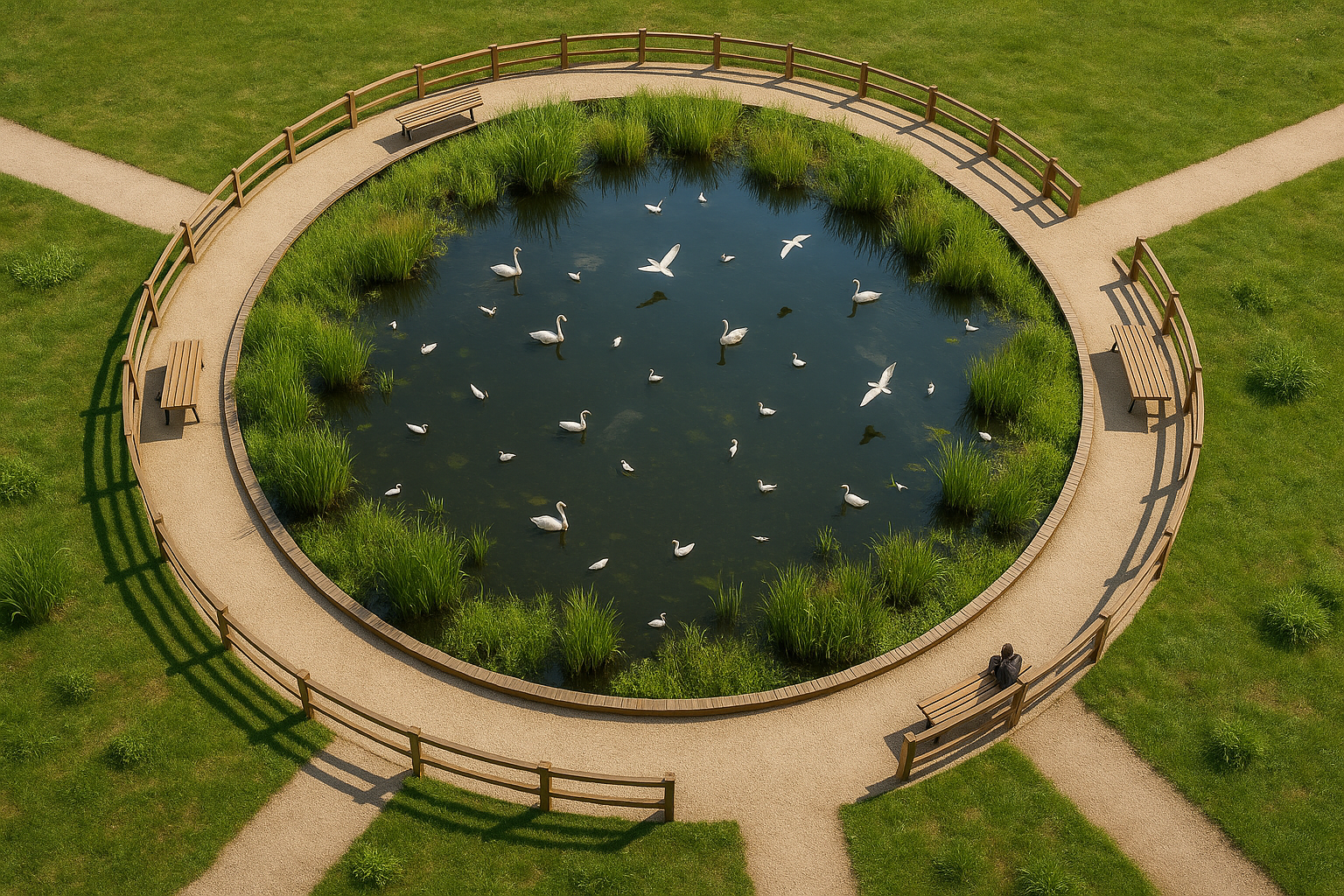
Treated water cascades into a 26-hectare recharge basin ringed with walkways and bird hides. CSIR modelling reveals an average infiltration rate of 420 mm per day in winter. Five surrounding boreholes have regained between 2.5 and 4 metres of water level since 2016. Locals jog the gravel paths; school groups peer through binoculars at flamingos that have no idea they are wading on yesterday’s shower water. The basin is equal parts park, classroom and infiltration engine.
3.5 Data as working language
An ISO/IEC 17025 certified lab on site runs seven-day composite sampling for COD, BOD₅, ammonia, nitrates, phosphates, micro-contaminants and emerging pollutants. Results leap onto the national IRIS portal every 30 minutes via SCADA. Each morning the 38-person team meets for a fifteen-minute stand-up; yesterday’s trend graphs glow on a wall-mounted LED screen. Anything drifting out of spec triggers a root-cause hunt within 24 hours.
4. Minds, budgets and the next frontier
4.1 Humans at the centre
Sivenathi Mabuya, 38, began as a trainee in 2005 and now steers process strategy. Johan Coetsee, 61, ex-navy technician, keeps the plant alive with a 3-D-printed spare-parts library that trimmed blower-bearing lead-time from twelve weeks to eight days. Ayesha Bester, 27, Water Research Commission bursary holder, proved that the filtration chain removes 84 % of plastic fibres larger than 100 µm. The trio and their colleagues captured the 2023 SANI-Excellence award for “Most Improved Municipal Team”.
4.2 Funding stitched from many pockets
Retrofits drew on a blended model: 45 % City capital budget, 35 % from the continent’s first municipal Green Bond issued in 2017, and 20 % through a 15-year concessional loan from the Development Bank of Southern Africa at 3.3 %. A R0.55 per kilolitre “aquifer protection levy” on Atlantis households is ring-fenced for borehole monitoring and wetland upkeep. In FY 2023/24 the plant posted its first operating surplus - thanks to energy savings and diverted potable-water purchases.
4.3 Resilience baked into concrete and code
UCT climate projections warn of 5 % less winter rain but 15 % more extreme storms. Wesfleur responded by doubling storm-flow capacity, fitting variable-frequency drives on return-sludge pumps, and raising electrical switchgear one metre above the 1:100-year flood line. A 120 kWp rooftop PV array, commissioned in 2022, covers 18 % of electrical demand and can island the plant for six hours - enough to shrug off load-shedding or Eskom-related wildfire outages.
5. Multiplication and the road ahead
The playbook rehearsed at Wesfleur is already echoing across the metro: Zandvliet Works is installing identical IFAS Bardenpho trains; Bellville’s incoming sludge-thickening line borrows Wesfleur’s polymer recipe; a mobile SCADA dashboard created by Coetsee is populating fourteen pump stations city-wide. In effect, the plant is a real-time 24-MLD demonstration site; its lessons are being modularised into 60-, 80- and 100-MLD packages for rapid roll-out.
Emerging contaminants are the next horizon. Green Drop criteria still ignore pharmaceuticals and PFAS, but Wesfleur is already two steps ahead. A 2023 pilot with granular activated carbon stripped 82–97 % of diclofenac, carbamazepine and sulfamethoxazole. Co-funded by the Swiss-South Africa Joint Research Programme, a full-scale GAC contactor is scheduled for 2025, guaranteeing compliance if legislation tightens.
Sludge, once a disposal headache, now fuels a 1 MW biogas boiler that keeps digesters at 37 °C without electric heaters. Process heat, power and prospective micro-turbine electricity generation close an elegant water-energy-waste loop, while a nearby cement kiln eyes dried sludge as low-carbon clinker feedstock.
Every Wednesday, thirty high-school visitors arrive for “Water Wednesday”. Armed with miniature sampling kits, they measure pH and dissolved oxygen while a touchscreen kiosk follows a hypothetical flush from a local suburb to the clear water in the recharge basin. Over 4 000 learners have passed through since 2021, seeding a new generation of water professionals - four current apprentices first showed up on those school buses.
Daily dashboards track energy intensity (0.57 kWh/kl against a national 0.9–1.1 kWh/kl), sludge volume index (<120 ml/g), mean choke-free sewer uptime (47 days versus the city average of 12), and operator training levels (78 % already sit at NQF Level 5 or higher, heading to 90 % by 2026). Non-revenue treated water stands at zero - every litre is reused for aquifer recharge or park irrigation.
Blueprint for copy-and-paste expansion
- Establish a robust influent-character baseline.
- Package blended finance - Green Bonds outperform if sustainability metrics are transparent.
- Retrofit in phased shutdowns using night-shift bypasses and portable aerators to avoid service gaps.
- Drive the data culture before pouring more concrete; dashboards win operator hearts faster than shiny pipework.
- Treat the community as co-owner, not spectator - recharge wetlands double as safe public assets.
From drought-stricken suburb to continental benchmark, Wesfleur has quietly rewritten Cape Town’s relationship with the flush.
[
{
"question": "### How did Wesfleur become Cape Town's water-security hero during the drought?",
"answer": "Wesfleur Wastewater Treatment Works transformed 24 million liters of dirty water daily into fresh, usable water. They achieved this through advanced biological re-engineering, special chemical-free filtration methods like UV polishing, and by recharging underground water sources. This innovative approach significantly bolstered Cape Town's water supply during the severe 2015-2018 drought."
},
{
"question": "### What innovative technologies and processes did Wesfleur implement?",
"answer": "Wesfleur implemented several cutting-edge processes. These include re-engineering its biology with five-stage Bardenpho lanes, utilizing fine-bubble membrane diffusers for energy efficiency, and employing chemical-free polishing with continuously backwashed deep-bed sand filters and low-pressure UV reactors. They also focused on upstream contamination control by enforcing industrial effluent permits."
},
{
"question": "### How did Wesfleur ensure the quality and safety of the treated water?",
"answer": "The plant maintains rigorous quality control through an ISO/IEC 17025 certified onsite laboratory that conducts seven-day composite sampling for various pollutants. The treated water undergoes extensive filtration and UV disinfection to remove 99% of E. coli and other contaminants. This ensures the water is safe for aquifer recharge, which further purifies it naturally."
},
{
"question": "### How did Wesfleur contribute to the replenishment of underground water sources?",
"answer": "After treatment, water cascades into a 26-hectare recharge basin, allowing it to naturally infiltrate the ground. CSIR modeling shows an average infiltration rate of 420 mm per day in winter. This process has led to a significant increase in water levels (2.5 to 4 meters) in five surrounding boreholes since 2016, effectively replenishing the Atlantis aquifer."
},
{
"question": "### What recognition has Wesfleur received for its achievements?",
"answer": "Wesfleur is one of only three facilities in South Africa to retain its Gold Status in the Department of Water and Sanitation's Green Drop Certification, Africa's most exacting municipal-effluent yardstick. The team also captured the 2023 SANI-Excellence award for 'Most Improved Municipal Team'."
},
{
"question": "### How is Wesfleur planning for future water security and sustainability?",
"answer": "Wesfleur is actively addressing future challenges by doubling storm-flow capacity, installing variable-frequency drives, and raising electrical switchgear to mitigate climate change impacts. They are also exploring advanced treatments for emerging contaminants like pharmaceuticals and PFAS, with a full-scale granular activated carbon contactor scheduled for 2025. Furthermore, they are closing the water-energy-waste loop by using sludge to fuel a biogas boiler and generating electricity from solar PV."
}
]

Kagiso Petersen is a Cape Town journalist who reports on the city’s evolving food culture—tracking everything from township braai innovators to Sea Point bistros signed up to the Ocean Wise pledge. Raised in Bo-Kaap and now cycling daily along the Atlantic Seaboard, he brings a palpable love for the city’s layered flavours and even more layered stories to every assignment.
View all articles →