
Birthday hike turns into rescue operation on Table Mountain
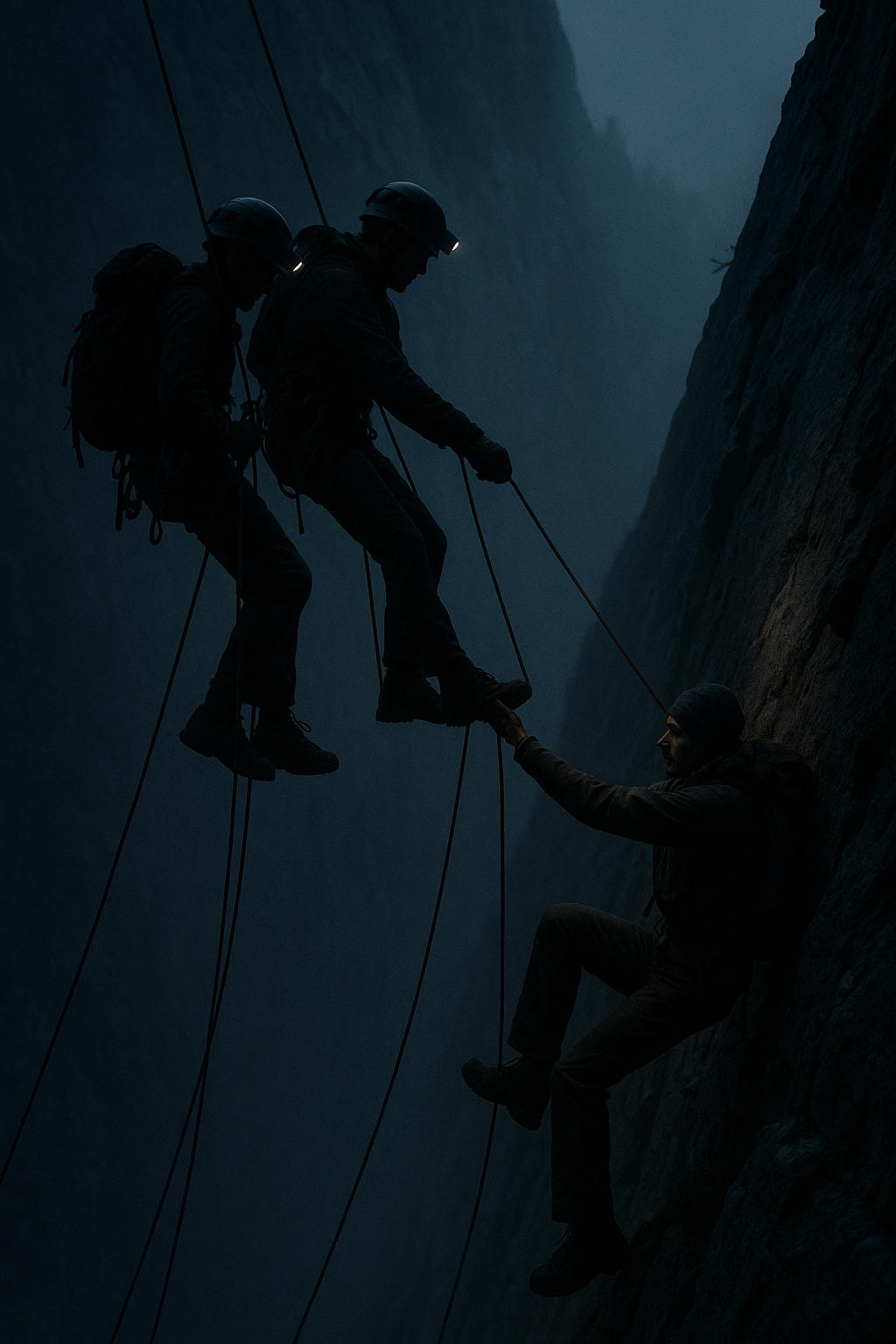
A thrilling account of a night rescue on Cape Town's Table Mountain, showcasing seamless coordination and swift action.
One evening, a young photography student got stuck on Table Mountain in the dark. She had gone up too late with not enough supplies. Luckily, a brave rescue team, using special ropes, headlamps, and the cable car, found her. They gave her warm clothes and hot tea, then guided her safely down the mountain. This story shows how important it is to be prepared and how amazing rescuers are.
How can hikers ensure safety on Table Mountain after dark?
To ensure safety on Table Mountain after dark, hikers should carry 1.5 liters of water, a headlamp with spare batteries, a wind-shell, and depart no later than 14:00 in winter. Utilizing emergency location markers and the what3words app for precise positioning can also significantly aid rescue efforts.
Get Cape Town news in your inbox
Stay updated with the latest stories from the Mother City.
The Mountain That Never Sleeps
Table Mountain rises like a single granite slab punched out of the Atlantic, its summit plateau 1 086 m above the froth of the cold Benguela current. At dusk its western face glows rose-gold, and the shadow it casts can crawl more than twenty kilometres across Cape Town’s bowl of twinkling lights. Photographers love the drama, but the same cliffs, smooth gullies and polished plates that sell postcards also swallow daylight in minutes.
On Saturday 15 June, a 22-year-old photography student from Chengdu stepped off the Lower Cable Station at 17:30. Winter sun still felt warm, wind hardly stirred, and she scribbled her name in the India Venster register with a cheerful 23 °C recorded beside it. Her kit was classic “day-tripper”: 500 ml water x2, half a sandwich, a phone power bank already blinking two lonely LEDs. She had not grasped that India Venster faces due west; once the sun slips behind the Twelve Apostles ridge, colour drains from the rock and every foothold turns the same shade of grey.
By 18:20 she had edged past the tilted slab locals call the “Diving Board,” but the final 150 m to the upper cable cars is a one-way catwalk known as Fountain Ledge. Granite there has been glossed by centuries of south-easterly grit; head-on it looks like a ballroom floor, sideways it is barely boot-wide. Retreating downward in darkness, without chalk marks or head-torch, is statistically more dangerous than climbing onward. She crouched, hugged her pack to the wall and watched the last amber stripe fade to cobalt.
The Call-Out: From One Bar to Full Response
At 18:57, with battery at 4 % and GPS scatter ±35 m, she dialled the City’s emergency line – 021 480 7700. The operator bridged her to Wilderness Search & Rescue (WSAR), a coalition of police K9, Metro high-angle unit, Mountain Club volunteers and climbing physicians. A voice-note on WhatsApp squeezed out one final coordinate ping before the screen died.
David Nel, WSAR duty controller and rope-access instructor, triggered the night-roster at 19:05. He cross-checked the girl’s last grid with the cableway’s last planned car: 20:00. Fountain Ledge lies 800 m north-west of the top station – eight minutes of technical descent for rescuers, but a 90-minute haul for ground teams pushing up through the China Venster gully, a chute clogged with hatchback-sized blocks. Nel invoked the 2015 Memorandum of Understanding that allows the cableway to stay open after hours; management agreed instantly.
Liezl van der Merwe, TMAC duty manager, rang in off-duty winch operator Daniella Peters and cabin tech Luvuyo Mxube. Wind on the summit was 11 km/h, well inside the 25 km/h limit; tension sensors were recalibrated; trauma bag, spinal board and spare harnesses were stowed. Two crews boarded Car 1: Team Alpha (Nel plus two climbing doctors) would drop from the summit, while Team Bravo (Metro vertical pair) would exit at the 600 m “hibernation bay,” a mid-station shelf that gives direct access to India Venster’s middle tiers.
On Rope: A Ballet in the Dark
Car 1 glided upward, floor silently rotating to keep weight balanced. At 19:31 the cabin halted 30 m below the top station; rescuers cracked the door and belted a practiced “Hello-o-o!” into the void. The Swiss-style “Yodel Test” bounced back a faint female reply – alive, orientated, roughly 40 m down and slightly north.
Using permanent eye-bolts installed after a 2009 paraglider snag, the team rigged twin 60 m Beal Joker ropes to a quad-point, redundancy-checked anchor. Head-torches stayed on low-burn to save batteries for a long night. Rock was still exhaling daytime warmth; updrafts carried wafts of fynbos resin as the doctors leap-frogged forward, each always locked to bomber gear.
Two metres short of the victim they met the crux: a sloping ramp that terminates in a 2 m drop guarded by a single, rusted 1970s piton. Nel looped a deviation sling, bounce-tested to 4 kN, then swung onto a ledge no wider than a yoga mat. The student sat in self-arrest, knees hooked through pack straps to keep gravity from claiming her. Core temp 34.8 °C – chilly but safe. They wrapped her in an insulated jacket, cracked chemical heat packs, and poured 250 ml of sweet rooibos from a Jetboil Flash that boiled water in 100 seconds flat. A fresh Petzl Reactik+ head-torch replaced her dying phone light; brightness auto-jumped from 30 to 200 lumens when she turned to thank them.
Up and Out: The Last Car Down
At 20:10 she was clipped into a short-rope tandem. Every runner was extended with 60 cm alpine quickdraws to cut drag and prevent a pendulum if she slipped. The 80 m scramble, nominally grade “3B,” felt like “4C” with a nervous novice in the dark. Thirty-two minutes later she stepped onto the timber decking of the upper station where space blankets, auxiliary heaters and hot chocolate laced with electrolytes waited. Oxygen saturation 97 %, pulse 88 bpm – stable.
Team Bravo radioed “all clear” after sweeping the hibernation-bay path. At 21:15 Car 1 began its final descent with one passenger wrapped in a donated cable-way fleece, camera strap still around her neck, SD card intact. Operation closed – no injuries, only frayed nerves.
The Invisible Safety Net
Cableway: More Than a Tourist Ride
Built in 1929 and rebuilt with Swiss rotating cabins in 1997, the Table Mountain Aerial Cableway carries 1.2 million sightseers a year, yet its after-hours life as an aerial ambulance rarely makes headlines. Each 65-seat cabin can swallow a full spinal board plus two rescuers; 5 200 kg payload allows a Stokes litter, hydraulic spreaders and a defibrillator the size of cabin luggage. A 600 kVA diesel generator kicks in during South Africa’s rolling blackouts – vital because load-shedding often peaks at sunset, prime time for call-outs. Since 2011 the cableway has logged 67 post-closing deployments: lightning strikes, cardiac arrests, even a helicopter abort in 2018 when pea-soup fog forced an Agusta A109 to hover-winch a rescuer 90 m below the aircraft.
Weather Factory in the Sky
Table Mountain manufactures its own climate. Moist south-easterlies slam into the eastern buttresses and condense into fog within twelve minutes; temperature can plummet 8 °C in half an hour. Forecasts may read “clear,” but the plateau disagrees. Rescuers therefore treat the cableway as a moving command post: it offers line-of-sight comms, shelter and a platform where doctors can begin care 1 000 m above sea level without lugging gear up a gully.
Prevention: Hard Signs and Soft Tech
Four Pillars of After-Dark Safety
Night operations on the Cape Fold Belt rest on four legs: solid intel, mechanical lift advantage, efficient rope systems and psychological first aid. Saturday’s mission aced each, but crews stress avoidance over extraction. India Venster’s start board now shouts: 1.5 L water, head-lamp with spare cells, wind-shell, and departure no later than 14:00 in winter. Trail registers reveal that 30 % of hikers ignore the cut-off – that identical 30 % generates most rescues.
Reflective Plates and Three Words
To shave ambiguity, WSAR and the City have bolted nine “emergency location markers” onto India Venster. Each 10 × 5 cm titanium plate carries a retro-reflective QR code and a four-letter/number combo that nails position to a 1 m² national grid. Night-readable by head-torch, the code sliced GPS scatter from ±35 m to ±3 m during March 2024 field tests. Funding came from a Rotary grant; volunteers installed plates at dawn so the cableway kept running for tourists.
Digital back-up arrives via the free what3words app. Three-word addresses plug straight into Cape Town’s dispatch software; in May 2024 trials, average search time dropped from 1 h 42 min to 47 min when callers supplied ///word.word.word instead of “somewhere on the big rock.” Meanwhile, WSAR’s monthly “HikeSafe” pop-ups lend spare head-torches, swap expired batteries and let visitors rehearse escape routes in Oculus VR headsets – a concept borrowed from Hong Kong’s “VR Gorge Experience.”
Gear That Went Up the Mountain
Team Alpha’s load-out shows how light modern rescue has become:
- Petzl Avao Bod Fast harness with 15 kN rear haul point
- 60 m Beal Joker 9.1 mm unicore dry rope (28 % dynamic elongation)
- Micro-traction progress-capture pulley for 3:1 Z-rig hauls on single anchors
- Petzl e+LITE head-torch – 45 lumens for 10 h, waterproof to 1 m
- Blizzard Survival 3-layer reflective bivvy, palm-sized when vacuum-packed
- Jetboil Flash: 500 ml boil in 100 s at 1 000 m
Total weight: 3.1 kg – precisely the heft of the DSLR plus 70-200 mm lens the student almost refused to leave behind.
Quiet Helpers and Silver Linings
Unsung Hands on the Hill
Hardware and data tell only half the story. Kitchen staff brewed extra thermoses; security guards herded late tourists away from darkened ramps; an off-duty Mandarin-speaking guide translated calming phrases over a crackling cell speaker. Their combined competence created a lattice strong enough to hold a stranger above a 200 m void.
Lessons in the Dark
For the visitor from Chengdu, a birthday trek meant to harvest golden-hour pixels ended instead with the soft metallic clunk of closing cable-car doors and a slow glide through a tunnel of southern stars. She kept every image on her SD card, but the mountain kept something too: a reminder that its beauty is inseparable from its appetite for haste. Walkers who leave the Lower Cable Station after lunch are well advised to remember the granite slab does not read Instagram captions; it reads shadows, wind speed and the spare batteries you forgot to pack.
[{"question": "
What essential items should hikers carry for after-dark safety on Table Mountain?
", "answer": "Hikers should carry at least 1.5 liters of water, a headlamp with spare batteries, and a wind-shell. It's also recommended to utilize emergency location markers and the what3words app for precise positioning."},{"question": "
What is the recommended latest departure time for winter hikes on Table Mountain?
", "answer": "In winter, hikers should depart no later than 14:00 (2:00 PM) to avoid being caught on the mountain after dark, as daylight can disappear very quickly."},{"question": "
How does the Table Mountain Aerial Cableway assist in night-time rescues?
", "answer": "The cableway serves as an 'aerial ambulance' after hours, allowing rescue teams to quickly access higher elevations. Its cabins can transport medical equipment and injured individuals, and it has a robust power supply to operate during outages, which are common at sunset."},{"question": "
What advanced technologies are used to improve rescue efficiency on Table Mountain?
", "answer": "WSAR and the City have installed nine emergency location markers (titanium plates with QR codes) on India Venster for precise positioning. Additionally, the free what3words app allows callers to provide exact locations, significantly reducing search times."},{"question": "
What are the four pillars of after-dark safety on Table Mountain?
", "answer": "Night operations on Table Mountain rely on four key pillars: solid intelligence, mechanical lift advantage (like the cableway), efficient rope systems, and psychological first aid for victims."},{"question": "
What is the primary message rescuers want to convey to hikers?
", "answer": "Rescuers strongly emphasize prevention over extraction. They stress the importance of being prepared, carrying essential gear, adhering to recommended departure times, and respecting the mountain's rapidly changing conditions to avoid needing rescue in the first place."}]
Aiden Abrahams is a Cape Town-based journalist who chronicles the city’s shifting political landscape for the Weekend Argus and Daily Maverick. Whether tracking parliamentary debates or tracing the legacy of District Six through his family’s own displacement, he roots every story in the voices that braid the Peninsula’s many cultures. Off deadline you’ll find him pacing the Sea Point promenade, debating Kaapse klopse rhythms with anyone who’ll listen.
View all articles →