
Cape team trains to rescue entangled whales
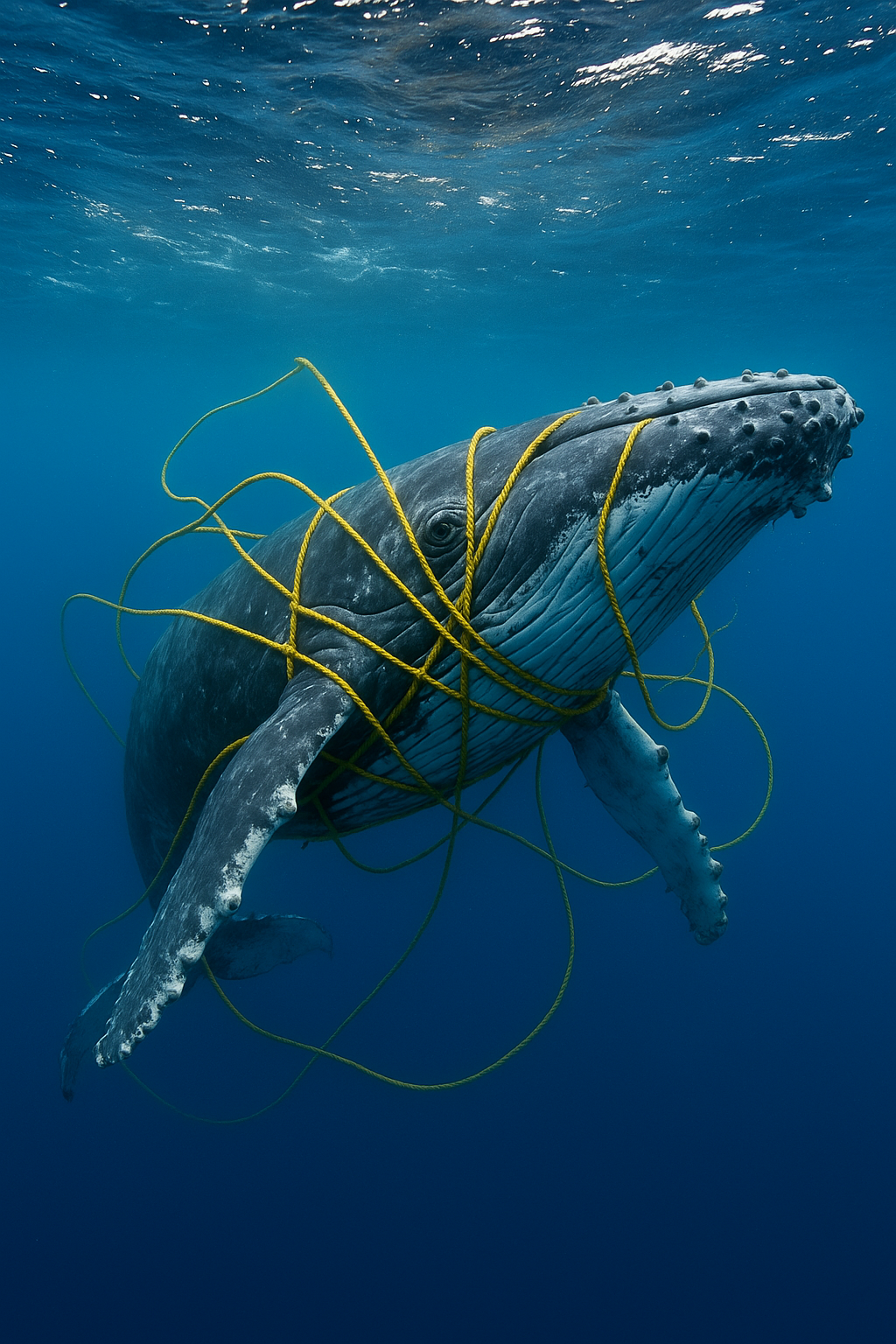
Discover how South Africa's marine megafauna, from whales to dolphins, face a silent threat from fishing gear entanglement.
In South Africa, a special bootcamp teaches people to save whales tangled in fishing gear. They use a giant pretend whale to practice cutting ropes underwater. This is super important because many whales, especially southern right whales, are getting caught in fishing lines, which can hurt or even kill them. This training helps protect these amazing ocean giants from invisible dangers, giving them a chance to swim free and live. It's a race against time to mend the ocean for these magnificent creatures.
What is South Africa's whale rescue bootcamp?
South Africa's whale rescue bootcamp is an intensive training program that equips individuals with the skills and knowledge to disentangle whales from fishing gear. The course, developed by the International Whaling Commission, uses realistic simulations, including a 14-meter pontoon whale dummy, to prepare rescuers for the challenging conditions at sea. It's a critical effort to protect whale populations, especially southern right whales, which are recovering from near extinction but face new threats from entanglement.
Get Cape Town news in your inbox
Stay updated with the latest stories from the Mother City.
The Bottleneck of Life
Between the rust-red cliffs of Cape Point and the whale-bone beaches of De Hoop, the African landmass shoves its continental shelf into a pinch only a few nautical miles wide. The squeeze turns the tepid corridor into a rush-hour lane for oceanic titans. Every June, southern right whales stomp on the brakes, abandoning Antarctic krill buffets to wallow in sun-lit sandy coves where they will sing bass notes loud enough to ring through entire hemispheres while they calve and court. Hot on their wake, humpbacks sprint toward East-African breeding lagoons, breaching in silver slow-motion. Resident Bryde’s whales thread the chaos year-round, gulping down sardine clouds pumped skyward by the icy Benguela upwelling.
The drama sounds idyllic until you learn what hangs beneath the postcard. Lobster pots squat on the 50-metre contour like a minefield, each tied to a rope thick enough to moor a yacht. Painted buoys polka-dot the surface, yet the real danger lurks in the water column: a vertical trip-wire that can clothesline a 40-ton mammal doing ten knots. Contact turns a healthy migrant into a tow-truck. Rope saws through blubber, flippers or even the blowhole; calves starve because nursing becomes impossible; infections turn wounds into craters. Some animals vanish without witness, sinking with a trap that outweighs a grand piano.
Globally, fisheries lay enough fixed rope each year to circle Earth four times. South Africa’s armada is modest - about 1,350 seasonal rock-lobster boats - yet its whales are anything but expendable. By 1935, commercial harpoons had reduced southern rights to fewer than one hundred. A League-of-Nations moratorium and later CITES listing allowed the population to claw back to roughly 12,000, a comeback celebrated in textbooks. More whales, however, equal more chances for collision. From 1999 through 2019, the University of Cape Town’s Whale Unit confirmed 82 entanglements along the Western Cape; scientists concede the real toll could be ten times higher because most corpses are scavenged within hours and living victims are spotted only when they break the surface within sight of land.
Classroom of the Swell
Opposite the tourist shark-cage hub of Kleinbaai, a converted crayfish harbour has become the unlikely campus for an emergency profession. In May 2024 the Dyer Island Conservation Trust and Marine Dynamics Academy ran the latest edition of a course first stitched together by the International Whaling Commission in 2012. Lead instructor Mike Meyer - soft voice, grey prophet’s beard, propeller scar on his forearm - opened day one with a blunt object lesson: a 30-metre coil of 18-millimetre rope and a 45-kilogram concrete block. “Meet your whale,” he told the trainees before ordering them to anchor the line. The instant tug-of-war against deadweight gave rookies a visceral taste of the physics they would soon confront at sea.
Rescue protocol sounds almost gentle on paper: idle the engine, approach at 45 degrees from the rear, stay just beyond fluke-sweep, extend a carbon-fibre pole tipped with a crescent blade, snip the rope closest to the animal, back away. Reality is a heaving waltz between swell, surge and panic. When tangles cluster around the peduncle or wedge between baleen plates, the crew clips an inflatable buoy to the line, turning the whale into a temporary surface marker while they regroup. Every motion is choreographed: the skipper anticipates the next breath, the pole operator times the blade to wave period, the grappler hooks trailing line without yanking the sensitive rostrum.
The final exam arrives in the shape of “Holly,” a 14-metre black-tarpaulin pontoon rigged with strain gauges and remote-control tugs. Meyer yanks hidden ropes, jerking the dummy into sudden dives that mimic seven-minute disappearances. Radio crackle - “Target logging, two o’clock, distance 80” - sends chase boats throttling. Only when the line parts, the buoy pops and a green-smoke canister spits across the wave tops is the animal ruled free. Among those who passed were veterinary pathologist Dr Loraine Shuttleworth, more accustomed to the silence of necropsy tables, and 26-year-old Kira Matiwane, whose childhood memory of a putrid whale on Monwabisi Beach once convinced her “the sea was broken.” She now calls the certification her first toolbox for mending it.
From Ghost Gear to Hope on a Key-Ring
Innovation does not stop at the waterline. Up the slipway, a corrugated shed overlooks swaying kelp fronds where Wilfred Chivell and his son Dickie feed kilometres of retrieved rope into a guillotine. Thirty-centimetre offcuts, heat-sealed and tagged, become neon key-rings hawked to visitors for 50 rand. Scan the QR code and you land on a live map of reported entanglements; tourists turn into spotters, uploading tail-fluke photos that algorithms compare to a catalogue of callosity patterns. The initiative, nicknamed “Rope for Hope,” has already financed two extra cutting poles and a 4K drone able to read whale ID marks from 120 metres up.
Engineers at Stellenbosch University are testing an acoustic-release lobster pot whose buoy stays submerged until a skipper transmits an encrypted ping. Pilot runs in False Bay slashed ghost-gear by 72 percent, yet fishers push back: each unit costs 18,000 rand, eight times a conventional setup, and poachers could harvest unattended gear before the legal owner arrives. The standoff spills into seaside taverns from Lambert’s Bay to Struisbaai. Meyer preaches incremental pragmatism: a 300-kilogram weak-link of biodegradable hemp spliced every 20 metres would let nine out of ten entangled whales snap free for roughly two rand a pot. “We don’t need moon-shot tech,” he argues; “we need a regulation forcing every boat to clip in that weak-link.”
Twilight Reunion
Evening paints the horizon tangerine as a real humpback surfaces 300 metres abeam of the training flotilla. Catalogue HB-134 - “Zipper” - bears propeller scars that ladder her left flank like a zipper’s teeth. She once towed 80 metres of West Coast rope until this same rescue team severed it off Dyer Island in 2019. Beside her swims a calf whose dorsal fin still droops like damp cardboard, weeks old and buoyant with innocence. Engines cut. Silence expands, broken only by the metallic scent of whale breath. Mother and calf exhale, roll, and disappear into copper light, leaving behind a single orange strand of practice rope drifting harmlessly on the swell - a thin line separating a haunted past from a coast that may yet learn to host its giants without snaring them.
What is South Africa's whale rescue bootcamp?
South Africa's whale rescue bootcamp is an intensive training program designed to equip individuals with the skills and knowledge necessary to disentangle whales from fishing gear. Developed by the International Whaling Commission, the program uses realistic simulations, including a 14-meter pontoon whale dummy, to prepare rescuers for the challenging conditions they will face at sea. This initiative is crucial for protecting whale populations, particularly southern right whales, which, despite recovering from near extinction, are increasingly threatened by entanglement.
Why is whale rescue training so important in South Africa?
Whale rescue training is vital in South Africa due to the unique geographical 'bottleneck' off its coast, where various whale species, including southern right whales, humpbacks, and Bryde's whales, congregate. This area is also heavily populated with fishing gear, particularly lobster pots with ropes that can ensnare these massive animals. Entanglements can lead to severe injuries, starvation, infection, and even death. With fisheries deploying enough fixed rope globally to circle Earth four times annually, and despite South Africa's 'modest' fishing fleet, the risk to its recovering whale populations is significant. The training helps mitigate this threat, ensuring the survival of these magnificent creatures.
What are the main challenges faced by whales in South African waters?
The primary challenge whales face in South African waters is entanglement in fishing gear, especially ropes from lobster pots. These ropes can act as 'vertical trip-wires,' clotheslining whales and causing deep cuts that can saw through blubber, flippers, or even the blowhole. Entanglement can lead to nursing mothers being unable to feed their calves, severe infections from wounds, and in many cases, death. The sheer volume of fishing gear, even from relatively small fleets, poses a substantial threat to whale populations, many of which are still recovering from historical whaling.
How does the whale rescue bootcamp simulate real-life rescue scenarios?
The bootcamp provides highly realistic simulations to prepare trainees for sea. One key exercise involves a 30-meter coil of 18-millimeter rope and a 45-kilogram concrete block, allowing trainees to experience the immense deadweight they'd be up against when encountering an entangled whale. The final exam utilizes 'Holly,' a 14-meter black-tarpaulin pontoon rigged with strain gauges and remote-control tugs. This dummy whale can simulate sudden dives and movements, forcing trainees to practice precise rescue protocols, including approaching at a 45-degree angle, using carbon-fibre poles with crescent blades to cut ropes, and coordinating with chase boats, all while managing the unpredictable conditions of swell and surge.
What innovations are being developed to prevent whale entanglements?
Innovation to prevent whale entanglements extends beyond direct rescue. The 'Rope for Hope' initiative reclaims retrieved fishing rope, turning it into key-rings with QR codes that link to a live map of reported entanglements. This encourages tourists to become spotters and upload whale photos for identification. Furthermore, engineers at Stellenbosch University are developing acoustic-release lobster pots, where buoys remain submerged until activated by an encrypted ping from a skipper, dramatically reducing ghost gear. Another pragmatic solution proposed is the mandatory use of a 300-kilogram weak-link of biodegradable hemp spliced into fishing ropes every 20 meters, which would allow most entangled whales to break free for a minimal cost.
How effective are current whale rescue efforts and prevention strategies?
Whale rescue efforts, as demonstrated by the bootcamp, are highly effective in directly saving entangled whales, such as 'Zipper,' a humpback previously rescued by the team. However, the true scale of entanglement is likely ten times higher than confirmed sightings, as many victims vanish unnoticed. Prevention strategies like the 'Rope for Hope' initiative are effective in raising awareness and gathering data for identifying whales and entanglement hotspots. While innovative solutions like acoustic-release lobster pots show great promise (slashing ghost-gear by 72% in pilot runs), their high cost currently limits widespread adoption. Simpler, cost-effective regulations, such as mandating biodegradable weak-links in fishing gear, are advocated as immediate, impactful steps to significantly reduce entanglements.

Chloe de Kock is a Cape Town-born journalist who chronicles the city’s evolving food culture, from township braai joints to Constantia vineyards, for the Mail & Guardian and Eat Out. When she’s not interviewing grandmothers about secret bobotie recipes or tracking the impact of drought on winemakers, you’ll find her surfing the mellow breaks at Muizenberg—wetsuit zipped, notebook tucked into her backpack in case the next story floats by.
View all articles →