
Cape Town Launches Environmental Conservation Project
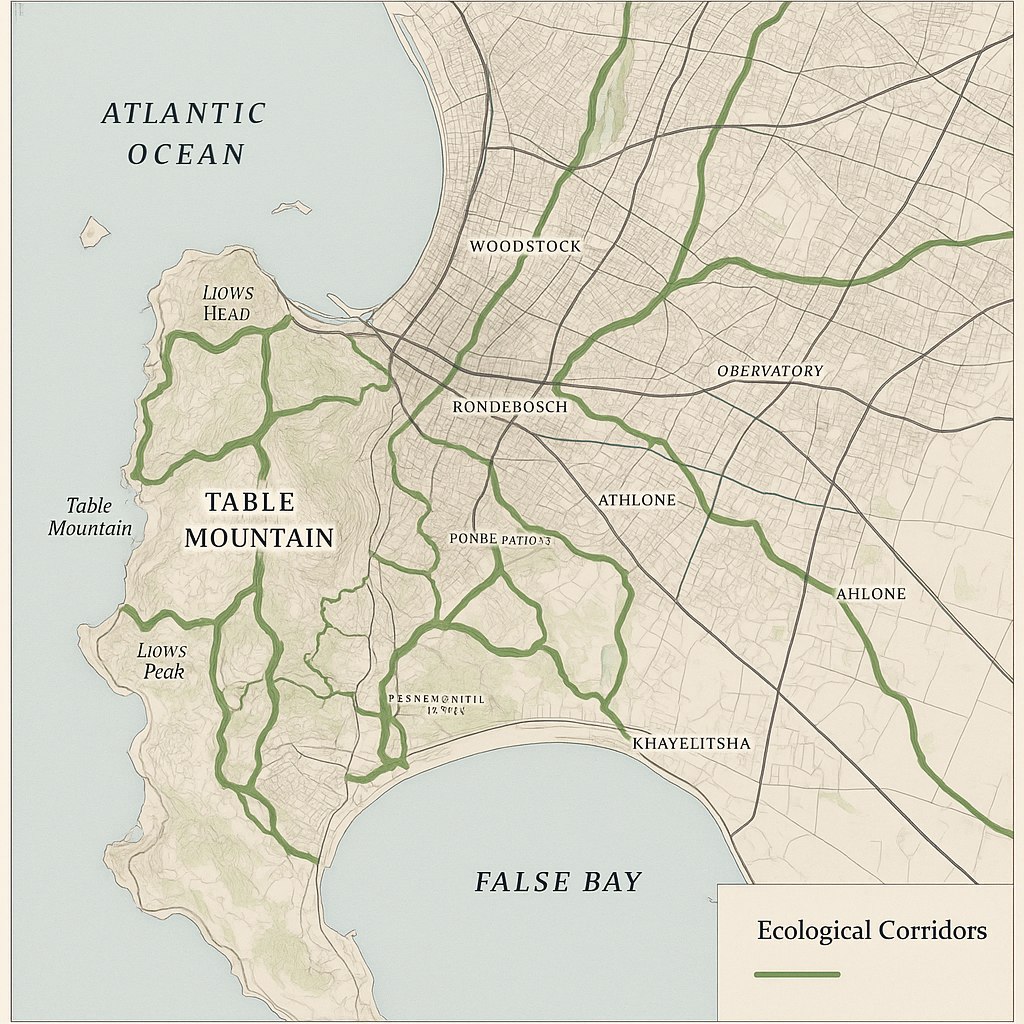
Cape Town's community-driven conservation project revolutionizes urban biodiversity, creating green corridors & restoring ecosystems.
Cape Town has ongoing biodiversity conservation and spatial planning efforts to make nature part of city life. They focus on connecting green spaces, bringing back special fynbos plants and ocean homes, and getting local people involved. This city has tons of amazing plants and animals, more than most countries! These efforts help animals move around safely and clean up the coast, making sure everyone helps protect this wild urban paradise.
What are Cape Town's Biodiversity Conservation Efforts?
Cape Town has biodiversity conservation and management initiatives, including the BioNet framework and spatial planning efforts to integrate ecological stewardship into urban life. These focus on establishing interconnected green corridors, restoring fynbos and marine habitats, and empowering local communities in conservation efforts across this hyperdiverse urban environment.
Get Cape Town news in your inbox
Stay updated with the latest stories from the Mother City.
From Concrete Jungle to Living Landscape
Cape Town stands at the forefront of a radical transformation in how cities worldwide can nurture the natural world thriving within their borders. The Mother City has ongoing biodiversity conservation and spatial-planning efforts, including the BioNet framework and biodiversity management reporting, establishing a template for metropolitan areas seeking harmony between expanding populations and fragile ecosystems. These initiatives reject the old paradigm of walling off nature from human activity, instead weaving ecological stewardship into the fabric of daily urban life across one of Earth's most biologically rich municipal territories.
Few cities rival Cape Town's ecological significance. Nestled within the Cape Floristic Region - the most compact yet species-dense of the planet's six floral kingdoms - the metropolis harbors greater botanical variety within its limits than many nations can claim across their entire territory. Table Mountain National Park alone shelters upward of 2,200 distinct plant species, numerous species restricted exclusively to these slopes. When combined with the extraordinary marine habitats where Atlantic and Indian Ocean waters mingle along the city's shores, this creates what scientists describe as a "hyperdiverse urban environment" - a rare convergence demanding both celebration and vigilant guardianship.
Project leaders have abandoned outdated preservation tactics that depended on rigid separation between wilderness and civilization. They have adopted what specialists call "socio-ecological systems thinking," acknowledging that Cape Town's natural wealth developed alongside human societies across thousands of years. The indigenous Khoisan communities shaped these lands through intricate fire management and selective gathering practices, preserving the iconic fynbos landscapes that draw visitors today. This deep historical connection guides modern efforts to enlist residents as engaged caretakers rather than mere recipients of conservation benefits.
Blueprint for Ecological Connectivity
Green Arteries Through the Metropolis
The initiative's core strategy involves reimagining Cape Town's vegetated spaces as an interconnected network serving wildlife movement. Planners have pinpointed essential ecological corridors - green threads weaving through neighborhoods, ranging from substantial waterways like the Diep River system threading northern suburbs to surprisingly slender ravines in the central city bowl that enable small mammals and birds to traverse developed areas.
These corridors tackle habitat fragmentation, which ecologists consider the gravest menace facing urban wildlife. Roads, construction, and farming sever natural territories into disconnected fragments, trapping animal populations in genetic isolation that leads to inbreeding and disappearance. Cape Town's green pathways function across multiple dimensions, accommodating everything from minute pollinator journeys to seasonal travels of larger creatures including the elusive Cape leopard, whose appearances on camera traps in mountainous city margins have astonished researchers.
Reclaiming the Fynbos
The initiative pledges to eliminate dense invasive growth across significant areas - an operation of breathtaking operational complexity. Manual removal teams, recruited extensively from nearby townships through the project's job creation component, labor across precipitous terrain amid summer temperatures surpassing 35°C and winter downpours with biting winds. Following clearance, sites undergo methodical rehabilitation, with native species cultivated in community nurseries and installed according to advanced models accounting for soil chemistry, slope orientation, and projected climate changes.
Healing the Urban Coastline
Cape Town's conservation scope stretches past land borders to embrace the abundant marine habitats washing against the city. The efforts have enlarged marine protected zones and deployed novel shoreline management recognizing land-sea process interdependence. River mouth management, vital for sustaining the estuarine nurseries supporting fish populations, now coordinates with upstream watershed rehabilitation. Sediment replenishment programs using matching materials preserve natural coastal dynamics in developed sectors, while "living shoreline" initiatives substitute rigid seawalls with restored dune and wetland systems offering wildlife habitat alongside storm energy absorption.
The marine emphasis particularly targets kelp forest recovery - these underwater realms of remarkable productivity sustain diverse fish communities and capture carbon at rates matching terrestrial woodlands. Previous deterioration from contamination and excessive harvesting drastically reduced these forests, but focused rehabilitation efforts yield encouraging outcomes, with experimental installations showing promising survival rates in appropriate locations.
People at the Center of Protection
Rewriting Conservation's Social Contract
The initiative's human dimension sets it apart from standard environmental programs and confronts historical injustices embedded in South African nature management. During apartheid, conservation frequently meant forced displacement and exclusionary practices that linked environmental protection with land theft. The current effort directly addresses this inheritance through community co-management structures transferring genuine decision-making power to local participants.
Many neighborhood conservation committees now operate citywide, with membership ensuring demographic representation including substantial youth and female involvement. These bodies control local rehabilitation priorities, job distribution, and observation activities. They engage in metropolitan governance through a Biodiversity Forum convening quarterly and holding formal advisory standing in municipal planning procedures.
Cultivating Environmental Citizenship
Educational programming stretches from elementary classrooms to adult learning opportunities. Cape Town students now complete field-based biodiversity experiences annually, with curriculum connections ensuring these encounters reinforce classroom instruction in biological sciences, geography, and social studies. Adult education programs have certified many "biodiversity champions" - community members serving as local knowledge resources, guiding walks, maintaining rehabilitation sites, and guiding newcomers.
Knowledge Systems for Lasting Impact
Tracking Progress, Guiding Action
The initiative maintains among the most thorough urban biodiversity monitoring systems internationally. Community science applications enable residents to document species sightings, with artificial intelligence assisting identification and verification. Professional observation teams carry out systematic evaluations of vegetation health, water conditions, and key animal populations. Resulting information feeds an accessible dashboard tracking advancement against defined targets and enabling adaptive management - modifying interventions according to observed results rather than fixed timetables.
Research collaborations with University of Cape Town, Stellenbosch University, and global institutions including Stockholm Resilience Centre produce new understanding about urban ecology and its practical application. Current research priorities encompass predicting how climate change will shift fynbos species distribution within city boundaries, developing fire management protecting both ecological functions and buildings, and investigating mental wellness advantages of urban nature contact in a society recovering from pandemic stresses.
The observation system has already produced notable discoveries. Camera networks have recorded caracal returning to areas they had abandoned for generations, proving that connectivity restoration enables wildlife recolonization. Vegetation assessments reveal quicker-than-expected recovery in certain cleared locations, indicating rehabilitation protocols can be streamlined to cut expenses. Meanwhile, some wetland systems display troubling water quality patterns, prompting targeted responses in upstream watersheds.
Building Financial Resilience
The project's economic framework combines municipal budgets, national government resources through South Africa's expanded public works initiative, corporate contributions, and innovative instruments including biodiversity credits and green bonds. The city has created a dedicated Biodiversity Trust receiving developer payments, carbon offset revenues, and charitable gifts, securing extended financing for maintenance continuing past political and budgetary cycles.
Global recognition has drawn substantial external investment. The efforts obtained initial seed resources from the Global Environment Facility and subsequently earned designation as a flagship effort under the UN Decade on Ecosystem Restoration. These distinctions bring technical support and reputational standing that enable additional resource attraction.
The economic structure explicitly tackles fairness issues, with benefit-sharing arrangements ensuring neighborhoods bordering conservation areas receive preference in hiring and purchasing. This approach acknowledges that conservation achievements ultimately rest on local supporters who experience both the advantages and restrictions of environmental safeguarding.
Embedding Nature in City Governance
Most consequentially, the biodiversity initiatives have been woven into Cape Town's official planning mechanisms, guaranteeing their persistence past present administrative leadership. The city's Spatial Development Framework has been revised to acknowledge ecological infrastructure as essential to urban operation, comparable to transportation and water networks. Development proposals now require standard biodiversity impact evaluation, with corridor maps supplying the reference for determinations.
This incorporation represents an evolution in South African environmental planning, where forward-thinking policies have often encountered implementation obstacles. The biodiversity efforts' achievement in anchoring conservation in routine governance procedures offers guidance for other South African cities and for urban centers globally facing parallel challenges of swift expansion and ecological deterioration.
What are Cape Town's Biodiversity Conservation Efforts?
Cape Town has biodiversity conservation and management initiatives, including the BioNet framework and spatial planning efforts to integrate ecological stewardship into urban life. These focus on establishing interconnected green corridors, restoring fynbos and marine habitats, and empowering local communities in conservation efforts across this hyperdiverse urban environment.
Why is Cape Town's Biodiversity so significant?
Cape Town is located within the Cape Floristic Region, which is the most compact yet species-dense of the planet's six floral kingdoms. The city harbors greater botanical variety within its limits than many nations, with Table Mountain National Park alone housing over 2,200 distinct plant species. This, combined with extraordinary marine habitats, makes it a "hyperdiverse urban environment."
What are the core strategies of the efforts?
The core strategies include reimagining Cape Town's vegetated spaces as an interconnected network for wildlife movement (green corridors), reclaiming and restoring significant areas of fynbos by eliminating invasive growth, and healing the urban coastline by enlarging marine protected zones, managing river mouths, and restoring kelp forests.
How do the efforts involve local communities?
The initiatives actively involve local communities by establishing many neighborhood conservation committees with diverse representation, including youth and women. These committees control local rehabilitation priorities and job distribution. Additionally, they offer extensive educational programming from elementary school to adult learning, certifying many "biodiversity champions" to serve as local knowledge resources.
How are the efforts' progress monitored and sustained?
The initiatives maintain one of the most thorough urban biodiversity monitoring systems internationally, utilizing community science applications and professional observation teams. Data feeds an accessible dashboard, enabling adaptive management. They are financially sustained through municipal budgets, national government resources, corporate contributions, biodiversity credits, green bonds, and a dedicated Biodiversity Trust, alongside global recognition and external investment.
How are the efforts integrated into city governance?
The biodiversity initiatives are woven into Cape Town's official planning mechanisms. The city's Spatial Development Framework has been revised to acknowledge ecological infrastructure as essential, and development proposals now require standard biodiversity impact evaluations. This ensures their persistence beyond current administrative leadership and offers a model for other urban centers.

Oliver Daniels is a Cape Town journalist who chronicles the intersection of food, migration and identity in South Africa's kitchens—from wood-fired Gugulethu braai spots to Constantia vineyards. Born and raised on the slopes of Devil’s Peak, he still starts each week with a dawn walk across Table Mountain to catch the first Atlantic light before filing copy.
View all articles →