
Cape Town’s first MyCiTi electric bus arrives as City prepares for 2027 rollout
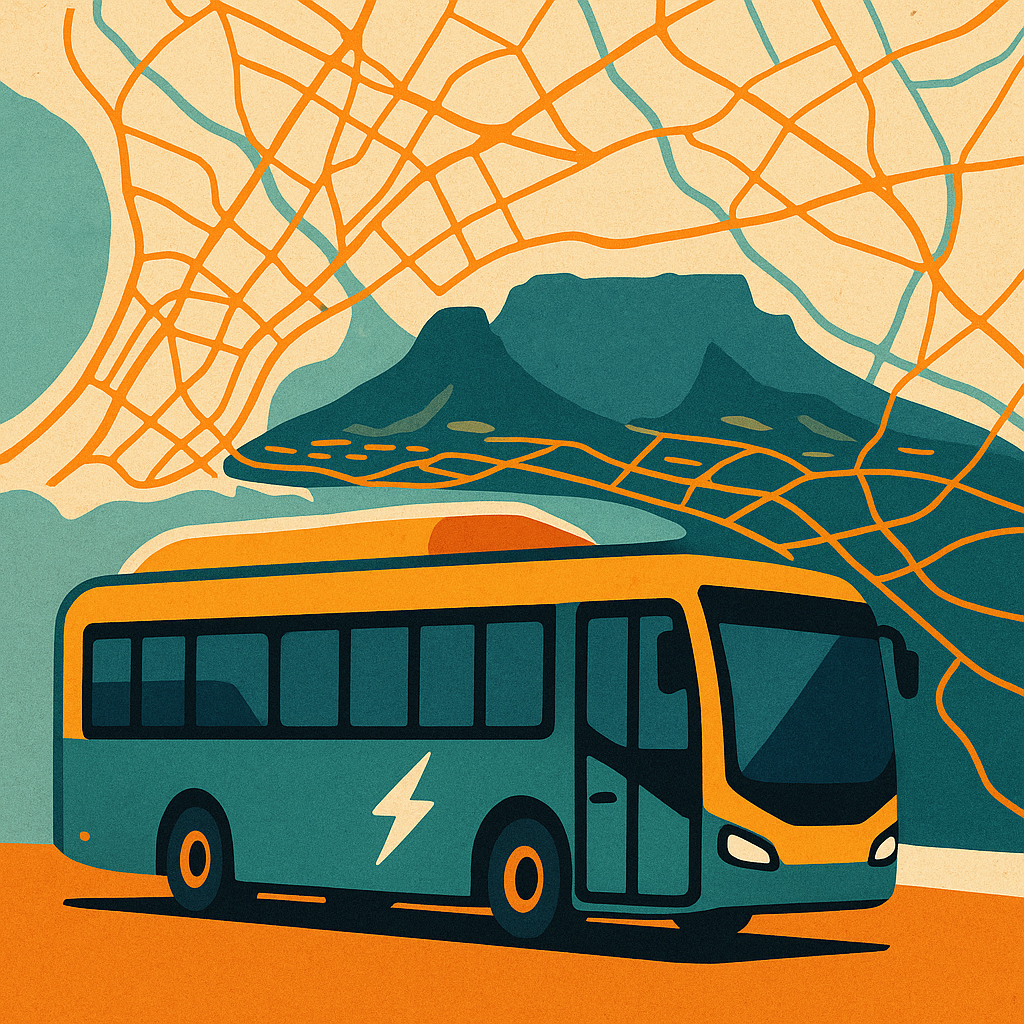
Cape Town launches its first electric MyCiTi bus, pioneering sustainable public transport. Testing rigorous routes, focusing on efficiency & local industry.
Cape Town is trying out new electric buses to make the city cleaner and save money. They're testing a special bus on tough roads to see how it handles hills and heat. This project helps the environment by cutting down on dirty fumes and could even make the city's transport system earn money. Plus, it's creating new jobs and skills right in South Africa, building a brighter, quieter future for everyone.
What is the main goal of Cape Town's MyCiTi e-bus experiment?
Cape Town's MyCiTi e-bus experiment primarily aims to reduce the metro's dependence on fossil fuels and cut carbon emissions. It also seeks to lower operational costs through electric vehicles, potentially making the public transport system cash-positive, and to leverage early adoption for future carbon tax benefits and local economic development.
Get Cape Town news in your inbox
Stay updated with the latest stories from the Mother City.
The First Spark: Prototype Hits the Road
Cape Town’s commuter landscape changed the moment a whisper-quiet Volvo BZRLE rolled out of the depot, painted in MyCiTi livery and powered only by electrons. At twelve metres, the bright-red prototype looks like any other articulated city bus until its batteries hush the familiar diesel growl; that silence signals the start of a deliberate drive to cut the metro’s dependence on fossil fuels. Engineers have begun a months-long stress test, shuttling the vehicle across the city’s steepest climbs, fastest arterials and salt-sprayed coastal strips before a larger order is signed.
The timing is no accident. Worldwide, municipalities are being squeezed between carbon-reduction pledges and shrinking subsidies, and Cape Town claims it can tackle both headaches at once. International case studies suggest that lifetime running costs for an electric bus can drop by as much as seventy percent once diesel, oil and gearbox repairs are stripped out; if the city can replicate even half of that saving, the decade-old MyCiTi network could become one of the few African public systems to run at a cash-positive, instead of cash-draining, rhythm.
Yet the symbolism reaches further than balance sheets. Transport emissions make up a fifth of the metro’s carbon footprint, and buses are the easiest lever to pull. By choosing an electric platform, Cape Town is also betting that future national carbon taxes will penalise diesel fleets, so early movers will dodge tomorrow’s penalties while today’s grants are still on the table.
Hill, Heat and Highway: A Laboratory on Wheels
What makes the Cape Town trial unusual is the torture track picked for evaluation. Hospital Bend, a spaghetti stack of flyovers that climbs more than eighty vertical metres in under two kilometres, is famous for cooking clutches and boiling radiators. The N2 corridor then forces sustained 100 km/h driving into a headwind, while Camps Bay throws humid, salt-laden air across the chassis. Polkadraai’s stop-start suburban pattern and Jip de Jager’s roller-coaster profile complete a circuit that would drain many European-spec batteries before lunchtime.
University of Cape Town researchers ride with clipboards and laptops, logging every kilowatt-hour, every temperature spike, every instance of regenerative braking that pushes power back into the pack. Their data will calibrate a local performance model, because a bus that survives Cape Town’s gradients and summer southeaster will probably cope anywhere on the continent. Lessons from Shenzhen and Santiago showed that pilots on gentle test loops led to nasty surprises once full passenger loads, air-conditioning and steep hills joined the daily routine.
The partnership with Volvo also specifies that the same bus must carry a crush-load of seventy seated and forty standing passengers while the air-con runs at full blast; anything less invalidates the range numbers. Drivers swap at two-hour intervals so that micro-analysis of energy consumption can be linked to individual driving styles and traffic conditions, a granularity that will inform later training programs when dozens of vehicles hit the road at once.
Building Bodies, Building Skills: Local Value in a Global Supply Chain
Although the under-frame and battery arrive from Sweden, the body is fabricated in Gauteng to Cape Town’s low-floor, wide-door design, meeting a 65 percent local-content clause negotiated by the city. The aluminium ribs, fibreglass panels and fire-proof composites are shipped by truck to the metro’s depot, where engineers mate them to the imported rolling chassis. The arrangement keeps foreign exchange exposure within Treasury limits while incubating know-how that could feed a continent-wide market.
Morocco’s success in building Europe’s electric Renaults proves that African plants can hit global quality metrics, and Addis Ababa’s recent 1,200-bus procurement from China shows how large the African order book could become. By insisting on domestic bodywork now, Cape Town hopes to anchor a supply chain that includes seat stitchers, battery re-conditioners and software tuners, industries that could outlive any single municipal contract.
Accessibility standards are baked into the same specification: kneeling suspension, level boarding at 330 mm above the pavement, and a wheelchair bay that can swallow two chairs side-by-side. Because the city treats electrification as a complete service upgrade rather than a like-for-like drivetrain swap, first-time riders will board a quieter, cleaner, easier-to-use vehicle even before they notice the absence of diesel fumes.
From One to Forty: Depot Design and Driver Habits
Charging strategy can make or break an electric fleet, so the pilot explores three parallel tracks: overnight slow-charge at the depot, rapid top-ups at route terminuses, and a hybrid model that adds midday boosts only on peak days. Hospital Bend’s descent can regenerate up to 18 percent of the energy used on the climb, so drivers are taught to anticipate traffic lights and avoid abrupt braking, skills that maximise the free electron harvest.
The central-city site identified for the 2027 depot sits on reclaimed land near the harbour, hemmed by heritage warehouses and 132 kV power lines. Rather than trench new cables through cobblestoned streets, engineers plan container-size chargers mounted on skids that can be craned into place, a Lego-brick approach that reduces civil works and keeps heritage authorities happy. Similar plug-and-play hubs may sprout at other terminals, letting the network expand without waiting for years of substation upgrades.
A six-week driver boot-camp converts fifteen-year veterans of diesel double-deckers into electron whisperers. Sessions cover single-pedal driving, pre-trip battery health checks, and passenger communication when the bus needs an unscheduled ten-minute charge. Simulator tests show that drivers who master regenerative anticipation can stretch range by 12 percent, the margin between finishing a shift and calling for a rescue tow.
Funding, Fleets and the 2027 Horizon
National Treasury’s public-transport grant will bankroll the first 38 vehicles, scheduled to enter scheduled service in July 2027 on the high-volume spine linking Mitchells Plain and Khayelitsha to Wynberg, Claremont and the CBD. The corridor moves 35,000 passengers a day - enough to stress-test charging cycles, but not so large that a technical failure would paralyse the network. Success here unlocks a second tranche of 120 buses, the number city planners believe can justify a purpose-built solar-supplemented depot near Philippi.
Yet municipal budgets remain hostage to national allocations. Cape Town’s AA+ credit rating gives it room to issue green bonds, but only if Treasury guarantees the standby facility - an irony not lost on councillors who have watched conditional grants shrink in real terms since 2016. To hedge the risk, officials are courting climate funds managed by development banks, arguing that South Africa’s carbon-reduction NDCs cannot be met without decarbonising public transport.
By 2030, the full MyCiTi build-out envisages 2.3 million passenger trips a day across 43 routes. If battery prices continue their 8 percent annual slide, the business case for electric traction will overtake diesel even without subsidies somewhere around 2028, according to internal models. That crossover point could arrive sooner if new solid-state packs, already sampling in South Korea, commercialise at the kilowatt-hour targets promised for 2026.
The Continental View: Africa’s Electric Bus Race
Cape Town is not alone on the continent. Kigali has ordered forty electric buses from a Rwandan start-up that assembles packs using locally mined cobalt, while Nairobi’s BRT line will trial solar-supplied charging stations. Yet South Africa’s manufacturing depth and financial markets give it advantages: the country already builds 6,000 diesel trucks and buses a year, and its banks have experience with asset-backed green bonds. If Cape Town can standardise specifications with other metros - eThekwini wants 200 electrics by 2029, Tshwane 120 - it could aggregate an order book large enough to attract a full knock-down plant.
The minibus-taxi sector, which moves 68 percent of South Africa’s commuters, remains the elephant in the room. Owners typically buy second-hand vehicles and drive them until the wheels fall off; convincing them to switch to electric requires a financing model that replaces fuel savings with lease payments. Cape Town’s analysts are watching a pilot in Bogotá where battery-leasing cooperatives let drivers pay per kilometre, insulating them from upfront costs and residual-value risk. If that template works, Cape Town could retrofit 30,000 minibuses before 2040, dwarfing the environmental benefit of the MyCiTi shift.
Meanwhile, battery second-life applications promise to stretch public value even further. Once packs drop to 80 percent capacity, they can power 200 rural homes for four hours nightly, extending the grid without new coal stations. The municipality has already earmarked two former landfill sites for container-size storage yards that could absorb the first 150 buses’ retired batteries, creating a circular energy economy that starts every morning with commuters boarding a silent red bus on Adderley Street.
What is the main goal of Cape Town's MyCiTi e-bus experiment?
Cape Town's MyCiTi e-bus experiment primarily aims to reduce the metro's dependence on fossil fuels and cut carbon emissions. It also seeks to lower operational costs through electric vehicles, potentially making the public transport system cash-positive, and to leverage early adoption for future carbon tax benefits and local economic development.
What type of electric bus is being tested and what are its key features?
The electric bus being tested is a 12-meter Volvo BZRLE prototype, painted in MyCiTi livery. It is designed to be whisper-quiet and is powered entirely by batteries. The body is fabricated in Gauteng, South Africa, meeting a 65% local-content clause, and features a low-floor, wide-door design with kneeling suspension and a wheelchair bay for enhanced accessibility.
How is Cape Town testing the durability and efficiency of the e-bus?
The e-bus is being stress-tested on a challenging circuit that includes Hospital Bend (steep climbs), the N2 corridor (sustained high-speed driving), Camps Bay (humid, salt-laden air), Polkadraai (stop-start suburban patterns), and Jip de Jager (roller-coaster profile). University of Cape Town researchers are logging data on energy consumption, temperature, and regenerative braking to calibrate a local performance model. The bus must also carry a full crush-load of 70 seated and 40 standing passengers with the air-conditioning running at full blast to validate range numbers.
What are the economic and environmental benefits Cape Town anticipates from this experiment?
Cape Town anticipates significant environmental benefits through reduced transport emissions, which currently constitute a fifth of the metro's carbon footprint. Economically, the city expects substantial savings in lifetime running costs (potentially up to 70% compared to diesel buses), which could make the MyCiTi network cash-positive. Additionally, the project aims to foster local economic development by building local manufacturing capacity for bus bodies and creating new jobs and skills in industries like battery re-conditioning and software tuning.
How is Cape Town addressing the charging infrastructure and driver training for the new e-bus fleet?
A multi-pronged charging strategy is being explored, including overnight slow-charging at the depot, rapid top-ups at route terminuses, and a hybrid model with midday boosts. Drivers undergo a six-week boot-camp to learn skills like single-pedal driving and regenerative braking, which can extend the bus's range. For future depots, movable, container-sized chargers are planned to minimize civil works and adapt to urban constraints.
How does Cape Town's e-bus initiative fit into the broader African context for electric transportation?
Cape Town is part of a growing trend in Africa, with other cities like Kigali and Nairobi also exploring electric buses. While these cities have their own initiatives, Cape Town leverages South Africa's existing manufacturing depth and financial markets. By standardizing specifications with other South African metros like eThekwini and Tshwane, Cape Town aims to aggregate a large enough order book to potentially attract a full knock-down plant for e-buses. The city is also observing pilot projects for electric minibus taxis, such as Bogotá's battery-leasing cooperatives, which could significantly impact the continent's dominant informal transport sector.

Hannah Kriel is a Cape Town-born journalist who chronicles the city’s evolving food scene—from Bo-Kaap spice routes to Constantia vineyards—for local and international outlets. When she’s not interviewing chefs or tracking the harvest on her grandparents’ Stellenbosch farm, you’ll find her surfing the Atlantic breaks she first rode as a schoolgirl.
View all articles →