
City defends marine outfalls after latest coastal water quality results
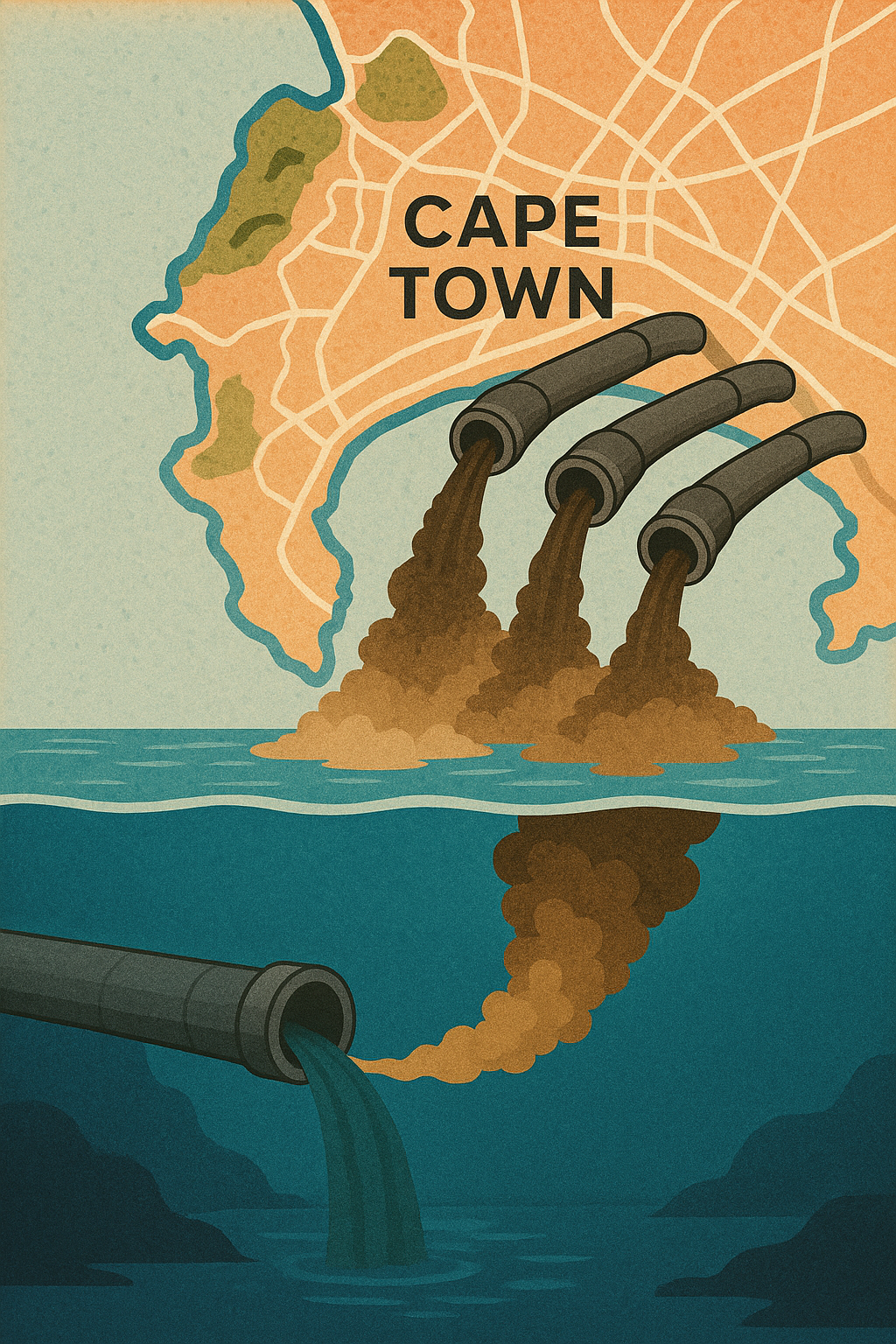
Cape Town's submarine outfalls stir debate. Is it "stable compliance" or "stable pollution"? The next 5 years will decide.
Cape Town is having a big fight about dumping 55 million liters of dirty water into the ocean every day. City bosses say it's mostly safe, but others worry about pollution like tiny plastics and diseases. The city needs to decide if it will keep dumping or find new ways to clean and reuse all its water. This choice will change how 4.8 million people live and could affect the beautiful beaches everyone loves.
What is the debate surrounding Cape Town's deep-sea discharge?
Cape Town is divided over its deep-sea discharge of 55 million litres of wastewater daily. While officials cite 98% compliance with bacterial limits, critics highlight stable pollution and emerging contaminants like microplastics. The city faces a choice: invest in cleaner ocean disposal or transition to a circular-water economy by 2030, impacting 4.8 million residents and coastal tourism.
Get Cape Town news in your inbox
Stay updated with the latest stories from the Mother City.
Beneath the Surface: What the Data Really Says
Cape Town’s trio of underwater discharge lines - Camps Bay, Green Point and Hout Bay - sit 30 m under the Atlantic, yet the uproar they create reaches every corner of the peninsula. April’s 2026 permit session delivered a fresh batch of numbers that officials hail as “steady compliance” and critics brand “stable pollution.” One fact both sides accept: the coming five years will determine whether the city keeps its social licence for ocean disposal or becomes the first major African metropolis to shut the valves for good.
Between January and March 2026, boats and contracted divers pulled 477 samples at 50 m, 200 m, 500 m and 1 000 m rings around each diffuser. Spring and neap tides, upwelling pulses and the peak tourist season were all captured. Of 1 908 bacterial readings for faecal coliforms and enterococci, 98 % sat under the national recreation limit of 100 cfu/100 ml. Every spike sat inside the legislated mixing band, where dilution still tops 200:1 within 120 seconds. Viral coliphage and emerging chemicals - PFAS, diclofenac, sunscreen ingredient benzophenone-3 - were clocked for the first time in the low ng/L range, a concentration CSIR models rate as “no observable risk.”
Outside Scrutiny, Inside Numbers
To blunt claims the City marks its own homework, auditors rotate every three years. The latest pair - Swiss certifier SGS and the Council for Geoscience - bolted data loggers straight onto the risers while streaming chain-of-custody seals to a public Dropbox. Their tallies were rosier than the municipality’s: Camps Bay 98.5 % compliance against 91.9 %, Green Point 100 % versus 88.1 %, Hout Bay 100 % versus 96.8 %. The gap arises from different lab techniques; external teams deploy qPCR for bacterial genes, a faster probe that can ignore chlorine-stressed cells still able to grow on City-run m-FC agar plates.
When Instagram Turns Brown
Cape Town boasts 42 Blue Flag beaches, and a single dirty wave can torpedo brand value. During the December 2025 scorcher, a rust-coloured swirl off Camps Bay hit social media under #PooPoint. Officials countered within 17 minutes, using chlorophyll charts to show the tint came from a harmless algal bloom, yet the hashtag pulsed for three days. Since then, volunteers under the banner “Surfers & Scientists” have released low-cost drifter buoys loaded with turbidity and temperature chips. Their live dashboard now feeds directly into permit meetings; early cross-checks show citizen buoys shadow the plume’s thermal blob within eight metres of professional ADCP rigs, accuracy that stunned even senior engineers.
Fixing the Hidden 3 000 km Grid
Tourists rarely grasp that the sea pipes are merely the tail end of a 3 000 km sewer web. Green Point’s shaft, sunk in 1978, reaches 68 m below the promenade; concrete spalling and sulphide attack have whittled its safety factor to 1.4, razor-thin above the legal floor. January 2026 saw the ink dry on a R 480 million rehab: duplex-steel valves, on-shore biofilters for smell control and variable-frequency drives able to trim flow when heavy surf slashes natural dilution. A cofferdam keeps the line live; effluent veers through a curved 1.6 km bore beneath the seafront and out to a back-up riser by Mouille Point lighthouse. The tourism board demanded this no-closure clause after the 2020 Muizenberg pump fiasco cost beach traders an estimated R 120 million in turnover.
Nine Roads, One Winner
By 2030 Cape Town will host another 1.2 million people, nudging daily wastewater to 1 800 ML - think 720 Olympic pools. The outfalls were never sized for that freight. In 2024 the City launched NEWS (New Effluent Water Strategy), pitting 60 technologies - from algal raceways to forward osmosis - against 22 metrics: energy draw, carbon tally, land appetite, brine fate and public buy-in. The long-list is down to nine, and by September 2026 a single portfolio will hit council. Front-runners: (a) high-rate activated sludge plus anaerobic membrane bioreactor at Green Point, harvesting 85 % of the water and enough biogas for 8 000 homes; (b) granular activated carbon plus ozone to strip trace organics so the flow can irrigate 2030 FIFA training pitches; (c) a 40 km under-sea line to the Bengal current, 12 km out at 120 m depth, where dissolved oxygen stays above 8 mg/L year-round, paired with pelagic fish-cages for nutrient reuse. Each path carries a R 12–18 billion price tag, payable via a JSE-listed green bond and a 5 % water-bill surcharge starting 2027.
Microplastics: the Next Permit Battle
Marine biologists at the University of Cape Town quantified micro-fibre fallout inside the effluent, netting 13 000–28 000 particles/m³ - 60 % polyester, 20 % tyre crumbs. That equates to 1.3 trillion plastic specks released daily. Concentrations fade to background 400 m away, yet black mussels picked up enrichment factors of 3–5 in their tissues. A microplastic addendum now rides on the discharge permit, and suppliers are trialling 0.1 mm drum screens plus dissolved-air flotation as a retrofit.
After-Dark Heat Maps
In February 2026 a fixed-wing drone with a FLIR T1020 infrared camera flew 90 minutes past dusk, the sweet spot for sea-surface temperature contrast. Infrared clips traced a 2 °C warmer plume stretching 1.8 km southeast of Camps Bay - almost double the 1 km Cornell model prediction. Katabatic winds rolling off Table Mountain in autumn damp surface turbulence, letting the buoyant effluent linger. Engineers will fold the revised dispersion ratios into the next permit due December 2027.
DNA in the Crowd
In Hout Bay, residents crowdfunded an eDNA survey to see whether the diffuser alters fish assemblages. A pocket-sized MinION sequencer picked up human Bacteroides signatures and 30 % more nematode species within 500 m - possible markers of organic enrichment. Although the ecological hit remains “minor” under national guidelines, the group will sample quarterly and invites school classes to annotate the open dataset, turning drama into a living STEM lesson.
Trust, Tariffs and the Blue Drop
Coastal tourism pumps roughly R 40 billion into Cape Town coffers each year. Starting October 2026, an online “blue drop” dashboard - think Green Drop for sewage plants - will refresh every Monday with E. coli and enterococci counts from ten beaches, colour-coded stop-light style. A red flag triggers WhatsApp alerts to 1 400 surfers, 200 tour operators and provincial health officials. The blueprint replicates San Diego’s “Now-Cast,” credited with cutting bather sickness by 34 % in year one.
Courtrooms, Constitutions and Countdowns
Environmental-justice outfit “Watershed” has served a 280-page notice to sue unless microplastic and eDNA metrics are baked into the next permit. Lawyers lean on Section 24 of the Constitution and the 2022 eThekwini precedent that gave Durban 36 months to revamp its southern pipe. If the case lands, Cape Town may confront a court-imposed timetable, accelerating spending by three to five years ahead of the September roadmap.
The Unheard Voices
Artisanal lobster divers and coastal traditional healers rarely appear in permit forums. Interviews by Safe Seas reveal divers shun Camps Bay reef for the first hour after the nightly pump cycle, claiming catch quality dives - anecdotes that echo lower CPUE inside the mixing band. Healers harvest Ecklonia maxima and Laminaria pallida for medicinal poultices and note texture shifts since 2022, aligning with new thermal plume charts. The City has pledged broader representation by July.
Art, Anxiety and the Periscope
On the Green Point promenade, artists have bolted a 3 m solar-powered kaleidoscope, “Confluence,” that gazes toward the submerged outfall and splays coloured light whenever live bacteria spike. Staff now peek at the colour wheel before opening their inboxes. Kitsch or catalyst, the gadget keeps the hidden pipe glaringly present in public imagination.
Every fresh data dump nudges Cape Town toward a fork in the road: pour billions into deeper, cleaner ocean disposal, or pivot to a fully inland circular-water economy that reuses every drop. The permit forum reconvenes in August, armed with microplastic baselines, eDNA triggers and a citizen-science heat map. Whatever the September roadmap decrees, 4.8 million residents - and the Atlantic surf that frames their lives - won’t wait long for the next revelation.
[{"question": "
What is the core issue regarding Cape Town's deep-sea discharge?
","answer": "Cape Town is facing a significant debate over its practice of discharging 55 million liters of wastewater into the ocean daily. While city officials claim high compliance rates with bacterial limits, critics are concerned about potential pollution from microplastics, emerging contaminants, and pathogens. The city must decide whether to continue this practice or invest in advanced wastewater treatment and reuse, impacting 4.8 million residents and its vital tourism industry."},{"question": "What does the data say about the safety of the current discharge?
","answer": "Recent data from January to March 2026 indicates that 98% of bacterial readings for faecal coliforms and enterococci were below national recreation limits. External auditors even reported higher compliance rates. However, emerging contaminants like PFAS, diclofenac, and benzophenone-3 were detected at low, though currently assessed as 'no observable risk,' levels. Microplastic fibers were found in the effluent at significant concentrations, raising concerns about their accumulation in marine life."},{"question": "Are there independent monitors verifying the city's data?
","answer": "Yes, to ensure transparency and address claims of self-assessment, auditors rotate every three years. Swiss certifier SGS and the Council for Geoscience conducted independent monitoring, often showing even better compliance rates than the city's internal reports, partly due to different lab techniques. Additionally, citizen science groups like 'Surfers & Scientists' deploy drifter buoys to monitor plumes, and their data is now being integrated into permit meetings."},{"question": "What infrastructure challenges does Cape Town face with its wastewater system?
","answer": "The deep-sea outfalls are just the end point of a vast 3,000 km sewer network. Some infrastructure, like the Green Point shaft, is aging and requires significant rehabilitation due to concrete degradation and sulphide attack. The city has allocated R480 million for upgrades, including new valves, biofilters for odor control, and flow management systems, ensuring continuity of service even during repairs to avoid disruptions to tourism."},{"question": "What are Cape Town's future plans for wastewater management?
","answer": "By 2030, Cape Town anticipates a significant increase in wastewater volume. The city's New Effluent Water Strategy (NEWS) is evaluating 60 different technologies to find new ways to manage wastewater. Leading options include advanced treatment for water reuse (e.g., for irrigation or even potable water after extensive treatment), high-rate activated sludge with anaerobic membrane bioreactors to produce energy and water, or a much longer undersea pipeline to a deeper part of the ocean. These transformative projects are estimated to cost R12–18 billion."},{"question": "What legal and environmental pressures is Cape Town facing?
","answer": "Environmental justice organizations like 'Watershed' are threatening legal action, citing Section 24 of the Constitution and a precedent set in Durban, demanding that microplastic and eDNA metrics be included in future discharge permits. Citizen-led eDNA surveys in areas like Hout Bay are also indicating potential ecological impacts. The city is under pressure to address these concerns, with a 'blue drop' dashboard planned to provide real-time water quality information to the public and stakeholders, and broader representation for marginalized voices like artisanal fishers and traditional healers.","tags": ["Cape Town", "wastewater", "deep-sea discharge", "pollution", "microplastics", "water reuse", "environmental impact", "infrastructure", "citizen science", "regulation", "legal challenges"]}]
Hannah Kriel is a Cape Town-born journalist who chronicles the city’s evolving food scene—from Bo-Kaap spice routes to Constantia vineyards—for local and international outlets. When she’s not interviewing chefs or tracking the harvest on her grandparents’ Stellenbosch farm, you’ll find her surfing the Atlantic breaks she first rode as a schoolgirl.
View all articles →