
City of Cape Town wants fewer cars on the road, but what will it take?
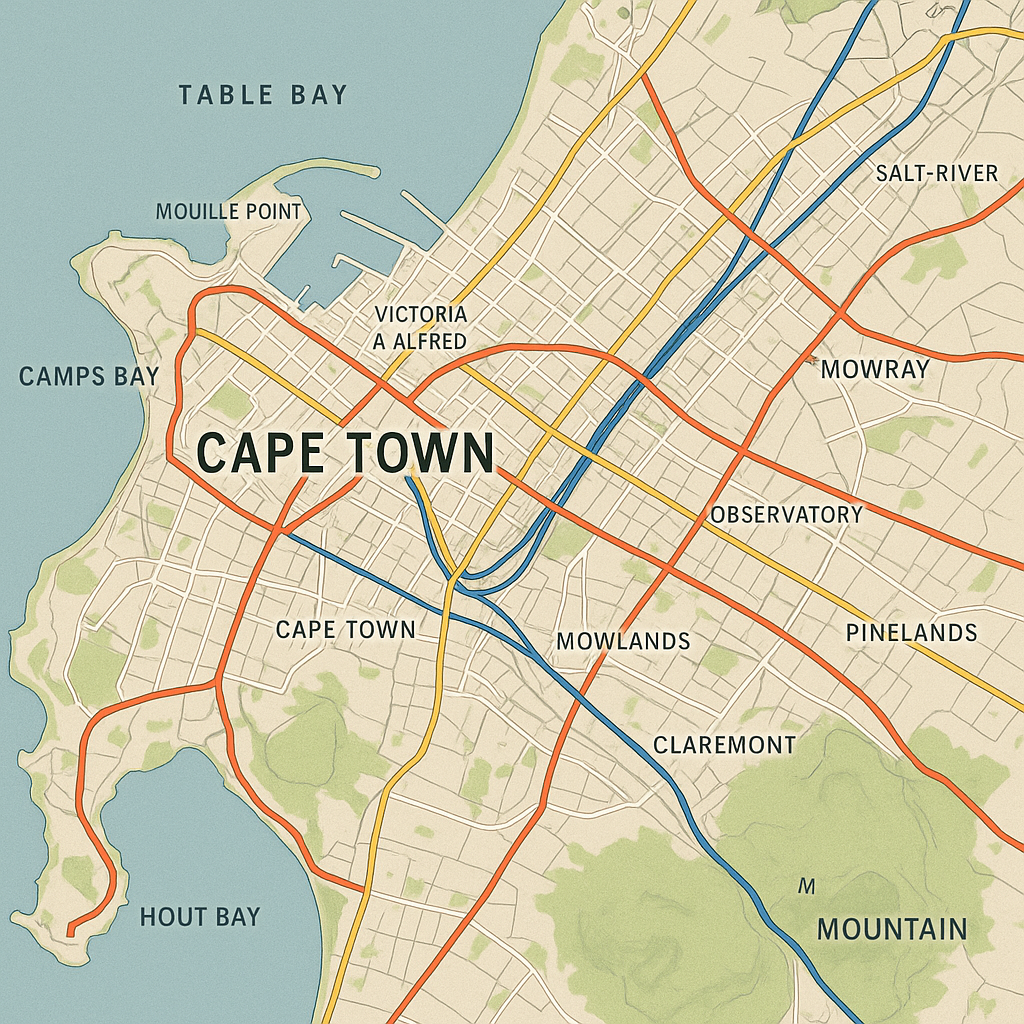
Cape Town rethinks urban transport to reduce private cars. Addressing apartheid's legacy, congestion, and climate change for a sustainable future.
Cape Town is trying to change how people move around the city. Right now, many people spend too much time and money traveling because of old city plans. Cars cause a lot of traffic and pollution, hurting the economy and the air. The city wants more people to walk, use bikes, or take public transport, but this means fixing sidewalks and making buses and taxis better. It's a big puzzle that includes housing and climate change, but leaders know they must act to make the city better for everyone.
What challenges does Cape Town face in transforming its urban mobility?
Cape Town faces significant challenges in urban mobility transformation, including historical spatial injustices from apartheid, severe traffic congestion with substantial economic costs, high greenhouse gas emissions, inadequate pedestrian infrastructure, and issues with informal transit. These are compounded by an affordable housing crisis and increasing climate vulnerabilities affecting transport infrastructure.
Get Cape Town news in your inbox
Stay updated with the latest stories from the Mother City.
The Spatial Legacy and Its Contemporary Burden
Recent coverage from Eyewitness News announcing initiatives to decrease private automobile usage on Cape Town's streets marks something far beyond standard traffic bulletins. This development indicates a critical turning point for South Africa's second-biggest city, where decades of sprawling suburban growth, historical spatial injustices, and escalating environmental constraints now force a complete reconsideration of urban circulation patterns.
To grasp present-day mobility struggles, one must examine the persistent impact of apartheid-era city planning. Following the Group Areas Act of 1950, government authorities systematically relocated large numbers of Black and Coloured residents to far-flung townships including Mitchells Plain, Khayelitsha, Nyanga, and Gugulethu, while concentrating employment opportunities in historically white neighborhoods near the city bowl and Atlantic seaboard. This geographic violence established what urbanists now describe as residential satellites or sleeping quarters distant from workplaces, condemning inhabitants to grueling daily journeys that devour both family time and household budgets.
These historical wounds manifest in striking contemporary statistics. The typical Capetonian worker now spends roughly 43 minutes traveling one direction to their job, while residents of informal settlements frequently endure particularly lengthy journeys each way. The distribution of travel methods across the city exposes deep infrastructural inequality: affluent communities rely predominantly on personal automobiles, while a significant portion of the metropolitan population depends upon minibus taxis, municipal buses, and informal transit arrangements that remain disjointed, unpredictable, and frequently hazardous for commuters.
Gridlock, Emissions, and the MyCiTi Experiment
Cape Town's road infrastructure, much of which was constructed according to automobile-centric design philosophies, now buckles under traffic volumes that strain the system's capacity. The N1, N2, and N7 highways suffer severe bottlenecks during rush periods, with congestion cascading into arterial routes throughout the region. According to industry reports, this gridlock drains substantial resources yearly from the economy through squandered productivity and wasted fuel consumption.
Beyond financial losses, ecological consequences mount with increasing urgency. South Africa's transport sector is reported at about 12%–13.3% of national GHG emissions, with road transport dominating transport-sector emissions; the urban private-vehicle share is not established by the sources reviewed. Cape Town's distinctive topography - wedged between Table Mountain and the Atlantic Ocean - generates temperature inversion phenomena that trap airborne contaminants, particularly during winter months when atmospheric conditions stabilize. The municipal Air Quality Management Plan identifies automobile exhaust as a principal source of particulate matter and nitrogen dioxide concentrations, with several monitoring stations recording levels that surpass World Health Organization health guidelines.
Walking, Informal Transit, and the Invisible Majority
An often-neglected aspect of Cape Town's mobility landscape involves those who navigate without any mechanical conveyance whatsoever. Walking serves as a primary travel mode for a significant portion of all trips throughout the metropolitan region, yet pedestrian infrastructure receives strikingly disproportionate public investment. Municipal sidewalks, where they exist at all, frequently terminate without warning, present dangerous surface conditions, or force foot travelers into direct conflict with high-speed vehicular traffic.
The "Open Streets" movement, initiated by local activists and endorsed by city officials on selected Sundays, temporarily shutters major thoroughfares to motorized vehicles, uncovering substantial latent demand for secure public space. These temporary interventions demonstrate how dramatically street configuration shapes social interaction and physical activity patterns. The stark contrast between such experimental closures and ordinary conditions highlights the structural prioritization of vehicle throughput over human-scaled urban design.
The minibus taxi industry, often criticized for aggressive operational practices, actually represents an extraordinarily efficient utilization of road space when measured by passengers per vehicle. A fully occupied taxi transports fifteen people within approximately the same road footprint as a single-occupancy private automobile. The challenge lies not in eliminating this mode but in improving its safety, reliability, and connection to broader networks - while simultaneously developing viable alternatives for those currently compelled toward car ownership by insufficient public options.
Connecting Housing, Climate, and Future Mobility
Any credible effort to diminish vehicle dependence must address Cape Town's affordable housing emergency. The city's spatial development framework designates "transit-oriented development" as a priority, yet property values near MyCiTi corridors have skyrocketed, displacing lower-income households to peripheral locations where transport expenses consume excessive portions of family resources. The phenomenon of "transport poverty" - where families cannot afford both adequate shelter and adequate mobility - afflicts growing numbers of Capetonians. Successful international models, from Curitiba's coordinated land use and transit planning to Vienna's social housing construction along transport corridors, demonstrate that genuine accessibility requires active intervention in housing markets. Cape Town's inclusionary housing regulations, which mandate affordable units in new developments, represent initial steps in this direction, though implementation obstacles and developer opposition have constrained their effectiveness.
Beyond emissions reduction, Cape Town's transport infrastructure faces intensifying climate vulnerabilities. Recent drought periods exposed dependencies extending beyond water systems to mobility patterns, as households in outlying areas suffered compounded hardships from both water restrictions and transport costs. Projected increases in extreme heat events will affect outdoor waiting conditions for public transit users and asphalt integrity, while rising sea levels threaten coastal transport infrastructure including the vital N2 corridor.
Current policy discussions therefore unfold within a context of multiple overlapping imperatives: economic efficiency, environmental sustainability, social equity, and climate resilience. No single intervention can resolve these challenges simultaneously, but the emerging consensus around reducing private vehicle dependence suggests municipal leadership recognizes that maintaining current trajectories proves unsustainable. Transportation planners have long understood that expanding road capacity induces additional demand - the realization that "you cannot build your way out of congestion" represents genuine intellectual advancement in urban governance. Whether this insight translates into sustained political commitment and fiscal investment will determine whether Cape Town emerges as a model for African urban sustainability or merely another cautionary example of opportunity squandered.
What are the main goals of Cape Town's urban mobility transformation?
Cape Town aims to shift away from car-centric travel towards more sustainable modes like walking, cycling, and public transport. This transformation seeks to reduce traffic congestion, lower greenhouse gas emissions, improve air quality, enhance economic productivity, and address historical spatial injustices by making the city more accessible and equitable for all residents.
How does apartheid-era planning still impact Cape Town's transportation today?
The Group Areas Act of 1950 forced large numbers of Black and Coloured residents to townships far from economic centers, creating a legacy of long, expensive commutes. This historical planning resulted in residential areas being geographically separated from workplaces, leading to significant travel times for many residents, particularly those in informal settlements, and a heavy reliance on fragmented public transport for much of the population.
What are the economic and environmental costs of traffic congestion in Cape Town?
Traffic congestion in Cape Town imposes substantial economic costs annually due to lost productivity and wasted fuel. Environmentally, South Africa's transport sector accounts for about 12%–13.3% of national greenhouse gas emissions, with road transport dominating transport-sector emissions. The city's unique topography also traps pollutants, leading to air quality issues that often exceed WHO guidelines.
What role does walking and informal transit play, and what are their challenges?
Walking is a primary mode of transport for a significant portion of all trips in Cape Town, yet pedestrian infrastructure is severely underfunded and often dangerous. Informal transit, particularly minibus taxis, efficiently moves large numbers of people but faces criticism for aggressive practices and a lack of integration with broader transport networks. The challenge is to improve their safety, reliability, and connectivity.
How are housing and climate change connected to Cape Town's mobility challenges?
Cape Town's affordable housing crisis exacerbates transport issues, as rising property values near transit hubs displace lower-income residents to peripheral areas, increasing their commute times and costs (transport poverty). Climate change also poses risks, with increased heat affecting public transport users and asphalt, and rising sea levels threatening crucial coastal infrastructure like the N2 corridor.
What are the potential solutions and future outlook for Cape Town's urban mobility?
The city is focusing on transit-oriented development and implementing inclusionary housing regulations to integrate housing and transport. There's a growing recognition that expanding road capacity doesn't solve congestion. The future success depends on sustained political commitment and fiscal investment in integrated solutions that prioritize economic efficiency, environmental sustainability, social equity, and climate resilience, drawing lessons from international models like Curitiba and Vienna.

A Russian-Spanish journalist and Cape Town native, channels his lifelong passion for South Africa into captivating stories for his local blog. With a diverse background and 50 years of rich experiences, Serjio's unique voice resonates with readers seeking to explore Cape Town's vibrant culture. His love for the city shines through in every piece, making Serjio the go-to source for the latest in South African adventures.
View all articles →