
Curiosity Cube™ rolls into Cape Town to inspire future scientists
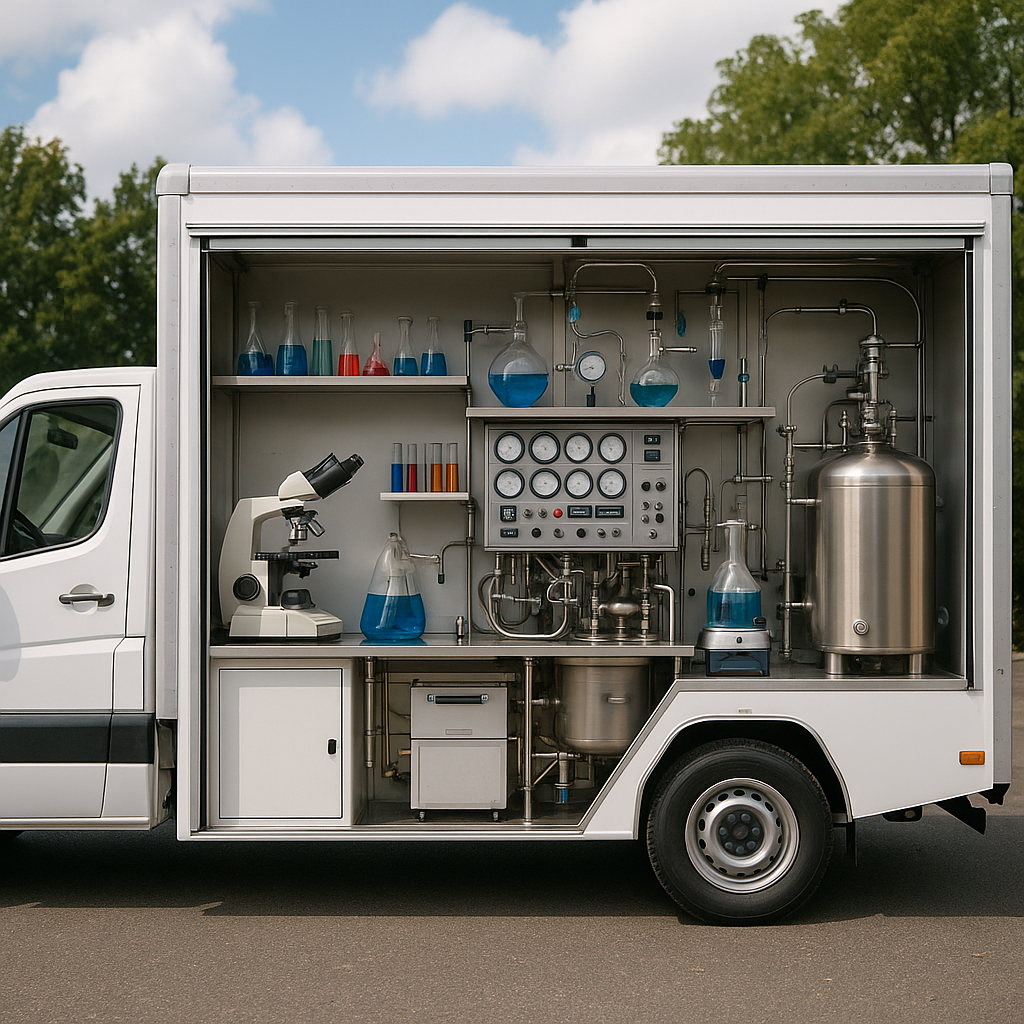
Merck's Curiosity Cube brings a mobile synthetic biology lab to Cape Town, inspiring kids with hands-on STEM activities.
Merck's Curiosity Cube is a super cool, solar-powered lab on wheels that makes science fun for ten-year-olds! It travels around, turning kids into gene engineers with exciting games and robots. They get to learn about DNA and even build things that smell like bananas. This awesome project hopes to make more kids love science and become future inventors, especially in places like South Africa where science learning needs a boost.
What is Merck's Curiosity Cube?
Merck's Curiosity Cube is a solar-powered mobile laboratory that transforms into an interactive classroom, teaching 10-year-olds about gene engineering. It uses hands-on activities, advanced technology like VR, and robotic elements to engage students in science, aiming to ignite interest and improve STEM proficiency in regions like South Africa.
Get Cape Town news in your inbox
Stay updated with the latest stories from the Mother City.
1. Cape Town’s Newest Traffic Stop: A Glowing Classroom That Unfolds Like Paper
Cape Town’s February streets now share space with a seven-metre luminous trailer that looks like a food truck crossed with a spaceship. Instead of burgers or vintage jeans, its cargo is pipettes, PCR cyclers and dozens of palm-sized robots waiting for lines of code written by primary-school fingers. The solar panels on the roof and sides feed lithium-iron-phosphate packs under the floor, giving the rig three full cloudy-day autonomy and the 20-amp jolt the portable PCR oven needs every four minutes. A graphene super-capacitor bank handles the surge while an atmospheric-water unit pulls up to thirty litres a day from the city’s humid air, cooling the cyclers and filling a hand-wash station whose grey-water keeps a living wall of metal-sniffing moss alive. Inside, shoes come off - partly to protect optics, partly to erase the old classroom map of “front” and “back” rows. Benches sense a child’s height and glide up or down so that every shoulder is level with the same horizon of possibility.
The project is Merck’s Curiosity Cube™, only its second visit to Southern Africa after debuting in Gauteng in 2019. Between 18 and 27 March it will park first at Elkanah House Preparatory’s Sunningdale campus and then at the Cape Town Science Centre in Observatory, running 90-minute sessions for Grades 4–7 drawn from a quiet waiting list of 42 schools. TIMSS 2021 shows fewer than three in ten Grade 6 learners in the region reach minimum science proficiency; the cube tries to flip that statistic before streaming decisions at age 15 lock many out of maths core. Every component locks down with Formula-One quick releases - fold-out aluminium decks triple usable floor space in ten minutes - because the articulated Mercedes tractor has to be on the N7 before dawn on 28 March, bound for rural farm schools along the West Coast.
2. Four Islands, One Question: Can You Build a Living Sensor?
Each workshop begins with a neon scrawl under the transparent floor: “Can you build a living sensor?” From there learners spin through four islands. At the DNA bar-coding bench they pulverise freeze-dried fynbos, coax pigment with dish-soap and ethanol, and walk out wearing a micro-vial of visible white genetic threads. Next, magnetic tiles representing codons snap together on a light table to programme baker’s yeast to smell like ripe bananas; a shoe-box bioreactor in the corner bubbles the real aroma as proof the pathway works. Cubelets - robotic cubes that click like Lego - form station three: kids arrange red sensor blocks beside green actuator blocks to build a light-seeking rover, a physical mirror of the genetic circuit they just stitched. The last stop straps a VR headset over their eyes, shrinking them to ribosome scale to race the clock and match tRNA anticodons to an mRNA ribbon; speed and accuracy push their avatar up a live leaderboard projected on the wall.
Postgraduate volunteers from the University of Cape Town’s Synthetic Biology Centre - home of Africa’s first home-grown CRISPR-Cas kit for under-resourced labs - guide every step. Ncumisa Mdlankomo, an M.Sc. candidate from Khayelitsha, translates the Python that drives the automated pipetting arm into isiXhosa each Saturday. “When promoter and codon come out in your own tongue, the subject stops feeling like a foreign country,” she laughs, admitting she never held a micropipette until second-year university. Community-service bursary hours are satisfied long before the last school bell, yet most students stay to solder or code; the smell of banana yeast has become an unofficial recruitment tool for next year’s honours cohort.
3. Data, Sunlight and a Moss Wall That Turns Colour When the Soil is Sick
While learners build, the cube quietly harvests data. Every DNA barcode, VR completion time and hand-wash event uploads overnight via Starlink to an open dashboard where education researchers watch for correlations between early exposure and Grade 10 subject choice. Early patterns already unsettle old assumptions: kids who stumble over abstract fractions often ace the spatial Cubelets course, suggesting a hidden pipeline of future bio-engineers missed by standardised maths tests. Conversely, top maths scorers sometimes freeze when asked to iterate a biological design under time pressure, hinting that innovation prizes cognitive variety over raw calculation. UCT has already rewritten its first-year engineering syllabus to include more open-ended biodesign jams; the faculty calls it “filter repair.”
Corporate cash underwrites seventy percent of the US $1.2 million annual global circuit; South Africa’s leg received top-ups from the Department of Science and Innovation’s MINTEK unit and a local biotech VC firm. Critics call the arrangement soft talent harvesting ahead of Merck’s 2026 African vaccine-formulation campus outside Cape Town. Teachers shrug: “We haven’t had a working centrifuge since 2019,” one natural-science head shrugs. “If branding plants pipettes, plant away.” Meanwhile, a 72-year-old grandmother who spent four decades sewing labels watched her granddaughter code a colour-sorting robot during a Thursday twilight session for parents. “I never knew my phone held a lab,” she laughed, adjusting a VR headset over her hijab. Pilot data now track “STEM resilience” - the odds a learner stays in science when family pressure points toward immediate wage labour.
4. Seeds, QR Codes and the Long Bet on 2030
By the time the trailer rumbles out of the Science Centre car park, 1 800 learners will have stepped inside. Each leaves with a literal seed - CRISPR-edited Arabidopsis that sprouts in two weeks - and a QR code to a moderated online hangout where they can upload microscope selfies, ask why their moss wall turned pink, or receive a video reply from a post-doc in Boston who once stood on the same LED-lit square of carbon-fibre floor. South Africa’s National Development Plan wants 450 000 new STEM graduates by 2030 just to keep GDP breathing; only 40 % of 2019 matrics even wrote maths and a mere 15 % broke 60 %. The cube intervenes at ten, the last year before “maths literacy” becomes an exit lane.
Wall posters showcase local heroes: Dr Janice Limson, who engineered maize to warn of aflatoxin, and Dr Tamsin Quinn, who 3-D-prints human bone at Stellenbosch. VR narrators flip between English, Afrikaans and isiXhosa; when a Langa learner tops the tRNA speed chart, her customised avatar - not a generic cartoon - plants the flag. Internal metrics show girls who rate themselves “not good at science” on pre-visit surveys lift their confidence score by 34 % afterwards, double the gain seen in boys. Negotiations are underway to create a “roving ambassador” stipend for alumnae who, after matric, return to mentor the next cohort - ensuring the glowing box that folds like origami keeps rolling, keeps unfolding, and keeps rewriting what a classroom, a scientist and even DNA can look like through ten-year-old eyes.
What is Merck's Curiosity Cube?
Merck's Curiosity Cube is an innovative, solar-powered mobile laboratory designed to engage 10-year-olds in science, particularly gene engineering. It unfolds from a seven-meter trailer into an interactive classroom, utilizing advanced technology like VR headsets, robotics, and hands-on experiments to make learning about DNA and biology exciting and accessible. It aims to boost STEM proficiency and inspire future scientists, especially in regions where science education needs reinforcement, such as South Africa.
Where has the Curiosity Cube been deployed in Southern Africa?
The Merck Curiosity Cube made its second visit to Southern Africa, initially debuting in Gauteng in 2019. In February and March of 2023, it was deployed in Cape Town, parking at Elkanah House Preparatory's Sunningdale campus and the Cape Town Science Centre in Observatory. Following these urban stops, it was scheduled to travel to rural farm schools along the West Coast.
What kind of activities do children participate in inside the Curiosity Cube?
Workshops in the Curiosity Cube are structured around the question, "Can you build a living sensor?" Children rotate through four interactive stations. They engage in DNA bar-coding by extracting genetic material from fynbos, program baker's yeast to smell like bananas using magnetic codon tiles, build light-seeking robots with Cubelets, and use VR headsets to match tRNA anticodons to mRNA ribbons in a race against time. These activities are designed to be hands-on and engaging.
How does the Curiosity Cube address the educational needs in regions like South Africa?
The Curiosity Cube directly addresses the need for improved science proficiency in regions like South Africa, where TIMSS 2021 data showed fewer than three in ten Grade 6 learners reached minimum science proficiency. By targeting 10-year-olds (Grades 4-7), it intervenes before critical streaming decisions at age 15. The program also incorporates local languages like isiXhosa and showcases local scientific heroes to make science more relatable and accessible. It also aims to increase 'STEM resilience' among learners.
How is the Curiosity Cube funded and supported?
Seventy percent of the Curiosity Cube's US $1.2 million annual global circuit is underwritten by corporate cash from Merck. The South African leg received additional funding from the Department of Science and Innovation’s MINTEK unit and a local biotech venture capital firm. Postgraduate volunteers from the University of Cape Town’s Synthetic Biology Centre also provide crucial support as instructors.
What is the long-term impact and vision of the Curiosity Cube project?
The Curiosity Cube aims for a significant long-term impact on STEM education and workforce development. Each learner leaves with a CRISPR-edited Arabidopsis seed and a QR code to an online community for continued engagement. The project collects data to inform educational research, showing correlations between early exposure and Grade 10 subject choices. It aims to contribute to South Africa's National Development Plan goal of 450,000 new STEM graduates by 2030 and has already shown to significantly boost confidence in science, particularly among girls. There are also negotiations for a 'roving ambassador' stipend for alumnae to mentor future cohorts.

Zola Naidoo is a Cape Town journalist who chronicles the city’s shifting politics and the lived realities behind the headlines. A weekend trail-runner on Table Mountain’s lower contour paths, she still swops stories in her grandmother’s District Six kitchen every Sunday, grounding her reporting in the cadences of the Cape.
View all articles →