
Four meteor showers to light up South Africa’s skies
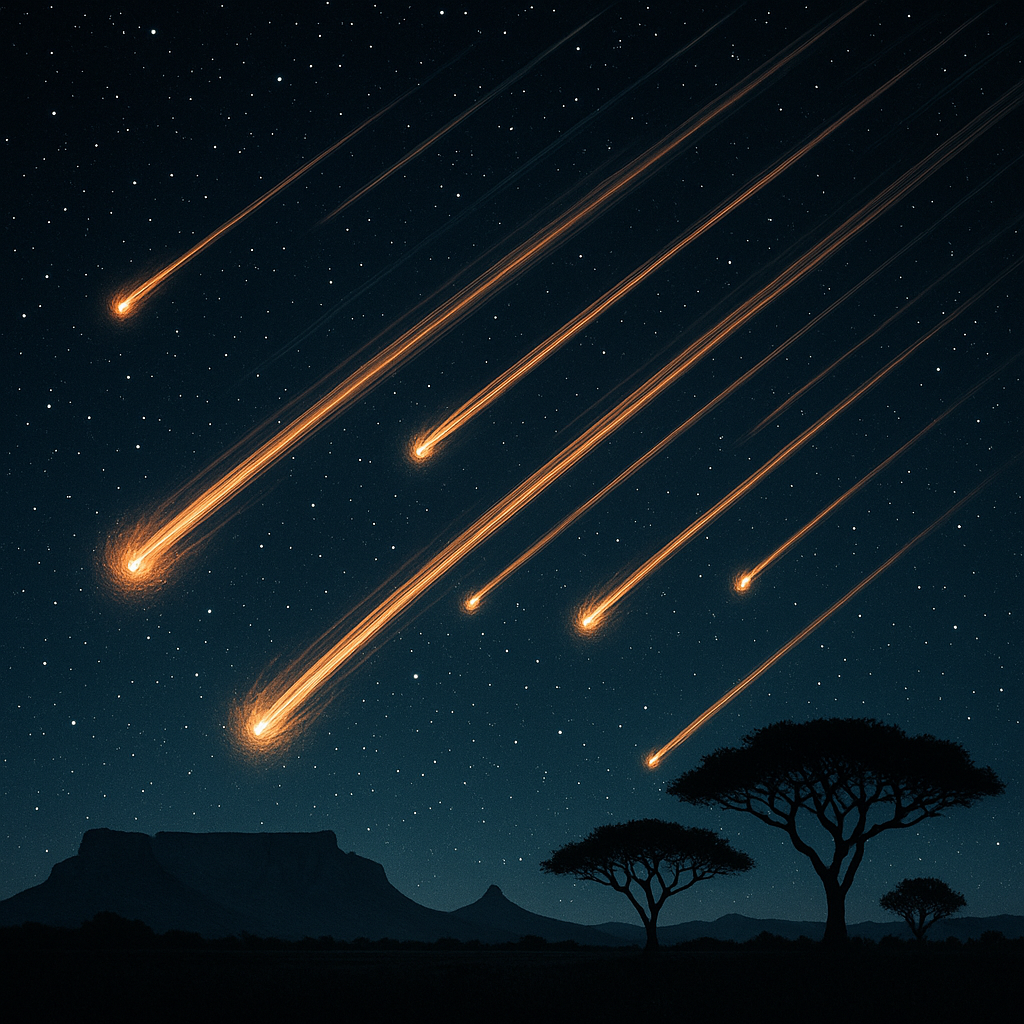
Explore South Africa's July meteor showers! Witness Delta-Aquariids, Alpha-Capricornids & more under perfect winter stargazing conditions.
South Africa's winter skies in July are a stargazer's dream, with clear, dry air perfect for seeing far-off stars. This month, four meteor showers will put on a dazzling display, turning the night into a canvas of shooting stars. The Southern Delta-Aquariids will be the busiest, but look out for the Alpha-Capricornids' slow, bright fireballs. With the Milky Way shining bright, it's the best time to bundle up and enjoy the cosmic show!
What makes South African winter skies ideal for stargazing and meteor showers?
South African winter skies are ideal for stargazing due to drier, more stable air masses that increase atmospheric transparency, allowing fainter objects to be seen clearly. The extended hours of darkness and uniform temperatures also minimize atmospheric turbulence, ensuring sharper views of celestial objects and meteor trails.
Get Cape Town news in your inbox
Stay updated with the latest stories from the Mother City.
The winter skies above South Africa are preparing to deliver one of the most spectacular astronomical displays of the year, with four distinct meteor showers converging throughout July to transform the darkness into a canvas of streaking light. As temperatures drop and nights lengthen, the southern hemisphere finds itself positioned perfectly to witness this cosmic choreography, offering stargazers an unprecedented opportunity to observe multiple meteor streams simultaneously while enjoying some of the finest atmospheric conditions for deep-sky observation available anywhere on Earth.
Why Winter Delivers South Africa's Finest Skies
The South African Astronomical Observatory has identified July as a premier month for astronomical observation, and the reasons extend far beyond the simple convenience of longer nights. Winter in the southern hemisphere brings atmospheric conditions that astronomers across the globe would envy. The extended hours of darkness provide ample time for celestial observation, but it is the quality of that darkness that truly distinguishes this period.
Winter air masses over South Africa tend to be drier and more stable than their summer counterparts. Atmospheric moisture acts as a scattering agent for light, both from artificial sources and from celestial objects themselves. When humidity levels drop, as they typically do during South African winters, the atmosphere becomes more transparent, allowing fainter objects to become visible and brighter objects to appear more crisp and defined. This same principle explains why observatories are often situated in desert environments or at high altitudes where atmospheric water content remains minimal.
The thermal stability of winter nights also contributes to superior viewing conditions. Summer evenings often generate atmospheric turbulence as warm air rises and mixes with cooler layers above, creating the shimmering effect that distorts starlight and reduces resolution. Winter's more uniform temperature distribution results in steadier air, allowing observers to discern finer details in the night sky and making meteor trails appear sharper and more distinct against the background stars.
The Southern Delta-Aquariids: July's Principal Performance
Among the four meteor showers gracing South African skies this month, the Southern Delta-Aquariids stand as the most prolific and reliable. Active from July 12 through August 23, this shower reaches its maximum activity on the night of July 31, when observers under ideal conditions can expect to witness up to twenty-five meteors per hour emanating from the constellation Aquarius.
The Southern Delta-Aquariids originate from debris left by an as-yet-unidentified comet, though some researchers have suggested possible connections to comets Marsden and Kracht, which follow similar orbital paths. The meteors enter Earth's atmosphere at relatively slow velocities compared to other showers - approximately forty-two kilometers per second - resulting in longer-lasting trails that persist for several seconds and occasionally display subtle color variations ranging from white to yellow and occasionally green.
The radiant point of this shower, the apparent origin in the sky from which the meteors seem to diverge, lies within the constellation Aquarius, specifically near the star Delta Aquarii. However, experienced observers recommend avoiding the common mistake of staring fixedly at this point. Meteors can appear anywhere in the sky, and those appearing farther from the radiant often display longer, more impressive trails as they strike the atmosphere at more oblique angles. The optimal viewing window extends from 10 PM through 5 AM, with activity typically increasing through the night as the radiant rises higher in the eastern sky.
The Alpha-Capricornids: Fireballs in Slow Motion
Sharing the peak night of July 31 with the Delta-Aquariids, the Alpha-Capricornids offer a distinctly different observational experience despite their more modest numbers. Producing approximately five meteors per hour at maximum, this shower compensates for its lower frequency with exceptional individual quality. The Alpha-Capricornids are renowned among meteor enthusiasts for producing exceptionally bright, long-lasting fireballs that traverse the sky with deliberate, almost stately progress.
This characteristic sluggishness results from the shower's remarkably low entry velocity of approximately twenty-three kilometers per second - among the slowest of any major meteor shower. The extended duration of these meteors' atmospheric passage allows observers to appreciate details often missed in faster-moving streaks: the gradual brightening as the meteoroid ablates, the persistent glowing train that may linger for minutes afterward, and occasional fragmentation events that split the incoming particle into multiple luminous components.
The Alpha-Capricornids originate from comet 169P/NEAT, a periodic comet that was only definitively linked to this shower in 2021 through sophisticated orbital modeling. This relatively recent identification highlights the ongoing nature of meteor astronomy research and the discoveries still awaiting patient observers. The shower's radiant lies in Capricornus, visible from 8 PM through 4 AM, making it accessible to observers who may not wish to remain awake through the entire night.
The Piscis Austrinids and Eta-Eridanids: Supporting Cast of Distinction
While the Delta-Aquariids and Alpha-Capricornids command primary attention, two additional showers contribute to July's celestial richness. The Piscis Austrinids, peaking on July 28 with approximately five meteors per hour, represent a relatively recently recognized shower that has gained appreciation among dedicated observers. Visible from 9:30 PM through 5 AM, this shower's radiant lies in the constellation Piscis Austrinus, the Southern Fish, near the brilliant star Fomalhaut - a natural navigational beacon that happens to mark the approximate origin point of these meteors.
The Eta-Eridanids present a more extended phenomenon, becoming active from July 31 and reaching peak activity on August 7. With only three meteors per hour at maximum, this shower might seem hardly worth noting, yet its inclusion in July's roster speaks to the exceptional richness of this period. The Eta-Eridanids are particularly notable for their extremely long duration - some meteors from this shower have been observed tracing paths across more than ninety degrees of sky - and their unusual association with material that may originate from the famous Halley's Comet, though this connection remains debated among researchers.
The Milky Way: July's Constant Companion
Beyond the transient spectacle of meteors, July offers South African observers their annual best opportunity to appreciate the Milky Way in its full glory. During winter months, the night side of Earth faces toward the center of our galaxy, placing the densest star fields and most spectacular nebular regions directly overhead during prime viewing hours.
The Milky Way's appearance from southern latitudes surpasses what northern observers can experience, as the galactic center passes much higher in the sky and remains visible for extended periods. From South Africa, the galaxy arches from the northeastern horizon, passes nearly overhead through the constellations of Crux and Centaurus, and descends toward the southwestern horizon. This orientation places the brilliant central bulge at optimal elevation for observation, revealing details invisible from more northerly locations.
Dark dust lanes bifurcate the Milky Way's luminous band, most prominently the Great Rift that divides the galaxy into two parallel streams. The Coalsack Nebula, a prominent dark nebula near the Southern Cross, appears as a distinct black patch against the surrounding star clouds - an absence of light that marks the presence of dense interstellar dust blocking more distant stellar radiation. Nearby, the Running Chicken Nebula and numerous open star clusters add texture and variety to the galactic panorama.
Essential Techniques for Optimal Observation
Successful meteor observation demands preparation and patience. Light pollution represents the most significant obstacle facing urban observers; even relatively modest artificial illumination can reduce visible meteor rates by seventy-five percent or more. Ideal locations maintain sky brightness below twenty-one magnitudes per square arcsecond, a technical specification that translates practically to areas where the Milky Way remains clearly visible and casts a perceptible shadow.
Dark adaptation requires approximately twenty minutes of complete absence from white light. During this period, the eye's pupil dilates maximally and photoreceptor sensitivity increases dramatically through biochemical changes in the retina. Even brief exposure to artificial light - checking a mobile phone, glancing at a vehicle's dashboard, or encountering another observer's flashlight - can reverse this adaptation within seconds, necessitating another complete waiting period.
Positioning significantly affects comfort and endurance. Reclining chairs or ground mats allow observers to view the zenith without neck strain, while warm clothing in multiple layers prevents the cold from cutting short observing sessions. Thermos containers with warm beverages maintain core temperature and morale during extended vigils.
Meteor observation benefits from peripheral vision, as the eye's rod cells - responsible for low-light sensitivity - concentrate toward the retina's edges. Experienced observers often report seeing more meteors when casually watching the sky rather than staring fixedly at any particular point. This technique also reduces eye fatigue during multi-hour sessions.
Navigating the Winter Sky
July's night sky presents a rich assembly of celestial landmarks that enhance any observing session. The Southern Cross, Crux, stands as the most celebrated southern constellation, its distinctive shape visible even from moderately light-polluted locations. The two bright stars of Centaurus, Alpha and Beta Centauri, known as the Pointers, lead the eye toward Crux and simultaneously frame the magnificent globular cluster Omega Centauri, visible to the unaided eye as a hazy star.
Scorpius dominates the eastern sky during July evenings, its curved tail and distinctive red supergiant Antares creating an unmistakable pattern. The constellation's proximity to the galactic center ensures a profusion of deep-sky objects for binocular or telescopic observers. Canopus, the second-brightest star in the entire night sky, rides high in the south, its brilliant white light having guided navigators for millennia.
The Southern Triangle, Triangulum Australe, though less famous than Crux, contains the remarkable open cluster NGC 6025 and serves as a useful reference point for locating more obscure constellations. Sirius, the brightest star of all, rises in the east after midnight during July, heralding the eventual transition toward spring constellations.
The Broader Context of Meteor Astronomy
These July showers occur within a larger framework of annual meteor activity that varies predictably throughout the year. The simultaneous occurrence of multiple showers, while not unique to this period, creates opportunities for scientific observation that isolated showers cannot provide. Researchers can compare meteoroid compositions, trajectories, and physical characteristics across different streams, building understanding of the solar system's debris population and the evolutionary processes that distribute cometary material throughout the inner solar system.
Amateur observers contribute substantially to this research through standardized reporting protocols that track shower activity, brightness distributions, and any anomalous phenomena such as bright fireballs or potential meteorite-dropping events. Organizations such as the International Meteor Organization coordinate these efforts, transforming individual observations into statistically significant datasets that professional astronomers utilize in their investigations.
The meteors visible this month represent material ranging from sand-grain sizes to pea-sized particles, all traveling at velocities sufficient to generate the thermal radiation we perceive as streaking light. Each visible meteor represents the complete vaporization of its parent particle, a transient existence that nonetheless connects observers directly to the primordial material from which our solar system coalesced approximately 4.6 billion years ago.
What makes South African winter skies ideal for stargazing?
South African winter skies are exceptionally clear and stable, offering optimal conditions for stargazing. This is due to drier air masses and lower humidity, which reduce atmospheric scattering of light, making fainter objects more visible. Additionally, the extended hours of darkness and more uniform temperatures minimize atmospheric turbulence, leading to sharper views of celestial objects and meteor trails.
Which meteor showers can be observed in South Africa during July?
July in South Africa is a busy month for meteor showers, featuring four distinct events. The primary performance comes from the Southern Delta-Aquariids, known for their prolific activity. Observers should also look out for the Alpha-Capricornids, which are famous for their slow, bright fireballs. Additionally, the Piscis Austrinids and the extended Eta-Eridanids contribute to the celestial spectacle.
What is unique about the Alpha-Capricornids meteor shower?
The Alpha-Capricornids, peaking on July 31st, are distinctive for producing exceptionally bright, long-lasting fireballs, despite a lower meteor rate of about five per hour. Their slow speed, approximately 23 kilometers per second, allows for a more detailed observation of the meteor as it ablates, often resulting in lingering glowing trains and occasional fragmentation. This shower originates from comet 169P/NEAT.
When is the best time to view the Southern Delta-Aquariids, and what should observers expect?
The Southern Delta-Aquariids are active from July 12th to August 23rd, peaking on the night of July 31st. Under ideal conditions, observers can expect to see up to twenty-five meteors per hour. The optimal viewing window is from 10 PM to 5 AM, as the radiant in the constellation Aquarius rises higher in the eastern sky. Meteors from this shower are known for their relatively slow speed and can display subtle color variations.
Besides meteor showers, what other celestial wonders can be seen in South Africa during July?
July offers the best opportunity in South Africa to view the Milky Way in its full glory. The night side of Earth faces the galactic center, placing dense star fields and nebulae directly overhead. The Southern Cross (Crux), Alpha and Beta Centauri (the Pointers), the globular cluster Omega Centauri, and the constellation Scorpius with its red supergiant Antares are all prominent. The Coalsack Nebula and various star clusters add to the spectacular galactic panorama.
What are some essential tips for optimal meteor shower observation?
To maximize meteor shower viewing, find a location with minimal light pollution, ideally where the Milky Way is clearly visible. Allow at least 20 minutes for your eyes to adapt to the dark, avoiding any white light exposure during this time. Use a reclining chair or ground mat for comfort, dress warmly in layers, and consider bringing a thermos with a warm beverage. Utilize your peripheral vision, as the eye's rod cells are more sensitive to low light and are concentrated at the edges of the retina, often allowing you to catch more meteors.

Liam Fortuin is a Cape Town journalist whose reporting on the city’s evolving food culture—from township kitchens to wine-land farms—captures the flavours and stories of South Africa’s many kitchens. Raised in Bo-Kaap, he still starts Saturday mornings hunting koesisters at family stalls on Wale Street, a ritual that feeds both his palate and his notebook.
View all articles →