
From heart to humanity: Earthdance Cape Town sets the stage for 2026
Earthdance Cape Town transforms into a year-round movement, blending music, activism, and community for a sustainable future.
Earthdance Cape Town is changing! It's not just a September party anymore. Now, it's a year-long adventure with three smaller festivals leading up to the big one. Imagine music, art, and nature all mixed together, with a focus on helping the planet and people. They even grow their own food and teach cool stuff, making every event a special experience.
What is Earthdance Cape Town?
Earthdance Cape Town is an evolving festival that transforms into a year-round series of three mini-festivals, culminating in a main September event. It combines music, art, environmental sustainability, and community engagement, focusing on eco-conscious practices, local food, and social impact.
Get Cape Town news in your inbox
Stay updated with the latest stories from the Mother City.
A Garden Turned Amphitheatre
Under the flanks of Table Mountain, where Atlantic gusts carry whiffs of fynbos deep into the valley, a once-a-year jamboree is breaking its own boundaries. Earthdance Cape Town - until now remembered only for a dazzling September weekend - will stretch into a year-round pulse of three mini-festivals. The first heartbeat lands on 20 June 2026, when Love in a Bowl’s tiered food gardens in Hout Bay open their gates for “Heart,” the opening chapter that will later merge into “Beat” and conclude with “Humanity.” Each meeting is both dress-rehearsal and full-blown ceremony, a lab for the main September convergence and a self-contained ritual of community.
The choice of Love in a Bowl is deliberate. Twelve autumns ago, former chef Lindy Taverner stared at a rubbish-littered slope behind a supermarket and saw dinner plates instead of debris. She and neighbours turned that single hectare into a powerhouse that now delivers 1.3 tonnes of pesticide-free vegetables every week to thirty-two early-learning centres tucked along the valley. Mothers who once queued for grants now run composting rows while toddlers poke seedlings into soil humming with cicadas. On the solstice, avocado branches will carry paper lanterns, compost heaps become drum risers, and runner-bean frames morph into biodegradable art galleries the audience can walk through.
Time bends softly here. Gates swing wide at 10 a.m., allowing parents to wander through worm-bin tutorials before the sun crests. At half-past eleven, sonic herbalist Suné Woods leads a slow-motion hike: guests bruise wild rosemary and buchu between forefinger and thumb, then slip on bone-conduction headphones to hear the plants’ ultrasonic gossip. Lunch is yanked from the earth minutes earlier - rainbow chard salads, beetroot hummus roasted in a cob oven built by last winter’s volunteers - sold on a pay-what-you-can honour system. By two o’clock, Amaza, Cape Town’s revered all-woman drum corps, migrates from pumpkin patch to a ring of salvaged red cinema couches, coaxing everyone into rhythm.
Slow-Release Music and Liquid Sanctuary
Sound is measured out like herbal tincture. Early sets roll out organic house and downtempo grooves spun by producers who also happen to be botanists, trauma counsellors, or municipal gardeners. Between tracks, astronomer-storyteller Carla Sharpe throws NASA’s latest James-Webb star-birth photos onto a bedsheet strung between two pear trees, narrating in isiXhosa and English while ants march across the projected galaxies. After dusk the tempo climbs. The Brother Moves On debuts “Synergy of Soil,” a twenty-seven-minute jazz-fusion piece that mirrors the lunar cycle many biodynamic growers swear by; bare heels press static into the terraces, returning electrons to the ground that feeds them.
Silence has its own stage. At eight the farm dam transforms into a lantern-lit sanctuary. Kayaks fitted with LED tealights drift in a slow-motion spiral as mezzo-soprano Noluvuyiso Mpofu releases a 432-Hz “Nkosi Sikelel’ iAfrika” over the water. Ten metres away, a Deaf collective funnels sub-bass through reclaimed-oak benches so the anthem thrums inside ribcages. Volunteers with handheld recorders harvest ten-second voice notes - “peace tastes like umqombothi at my granny’s stove,” “peace is a taxi driver who waits” - to splice into the global Earthdance broadcast reaching São Paulo, Mumbai and 400 other nodes next year.
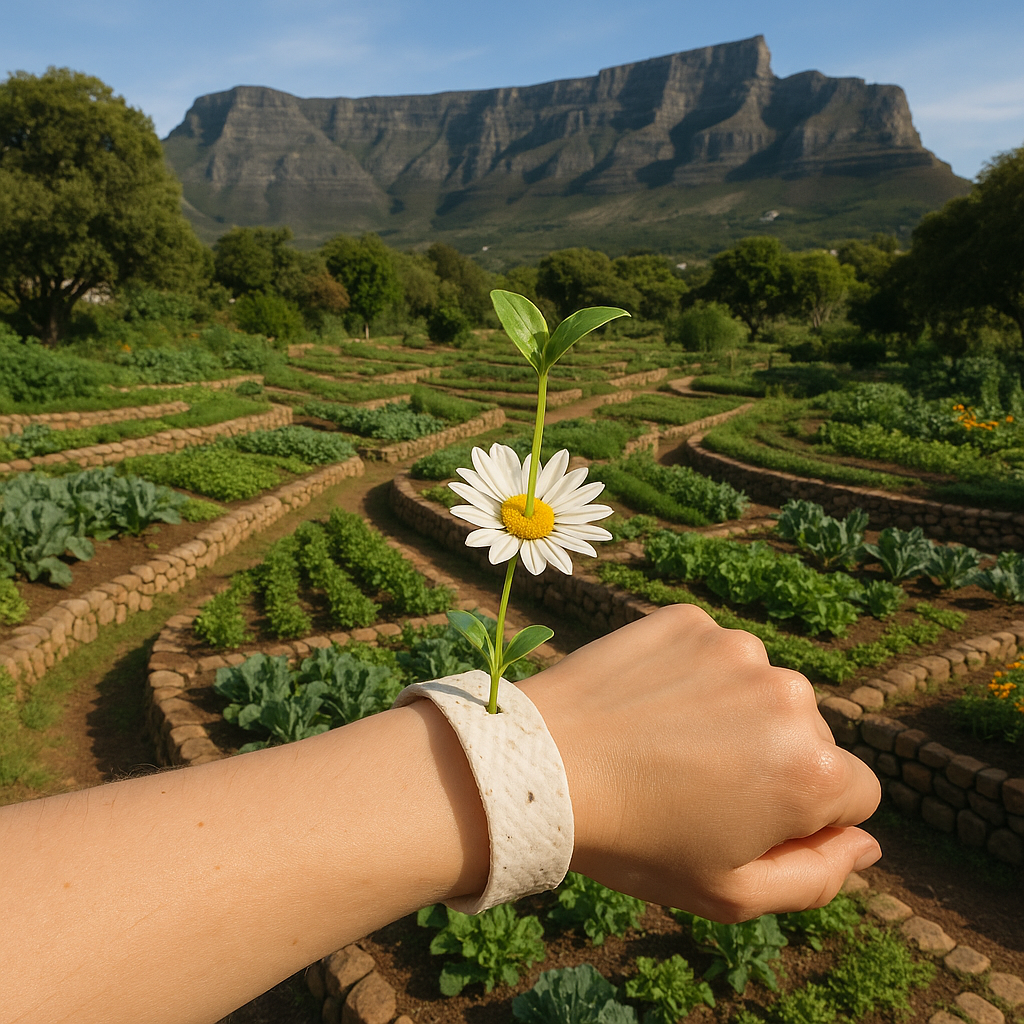
Technology keeps a deliberately low profile. No barcode scanners glare at entrances. Instead, every guest receives a bracelet pressed from wildflower-seeded paper. On the bus ride home they tear it into a sidewalk crack or backyard pot, turning memories into nectar for urban pollinators. To track impact, a QR code stitched onto up-cycled denim patches links to an open-source dashboard; ticket-holders log sprouting rates, building a living atlas of post-event biodiversity. Even the PA runs on audience thighs: two cargo-bike stations let dancers top up the battery bank while they shimmy.
Prototype City and Spiral Galaxy
This midsummer dress rehearsal is also a systems sandbox for the September main stage. A hand-dug grey-water trench siphons hand-wash runoff straight to young almond saplings - if the algae stay happy, engineers will scale the trench tenfold along the Riviersonderend escarpment. Another team maps decibel contours across the food gardens; the data will guide sound placement when 5,000 campers converge on Kromrivier without driving resident frogs into therapy. Every plank, cable and compost toilet wears an NFC tag; at 2 a.m. a volunteer scans the lot, telling an algorithm how many times each nail can still be pulled and resold.
None of this counts as charity. Revenue from food and bar flows straight into a seed-saving vault programmed to protect 120 heirloom species over three years, hedging against South Africa’s stubborn 40 percent chronic-hunger statistic. Friday early-birds can earn “Ubuntu credits” by grafting tomato seedlings or erecting owl boxes; credits knock rands off September passes or buy discounted workshops on myco-remediation or Afro-beat production. The day before Heart, cargo-bicycles from Langa Bicycle Hub deliver 400 veggie surprise-boxes to Tygerberg Hills kitchens, each carrying a postcard invitation to a zero-rated Zoom on seed sovereignty - no data cost thanks to a streaming sponsor earmarking a rand per song that night.
Up the road in November, “Beat” hijacks an abandoned platform at Cape Town Station. Commuters tap their metro cards to borrow wireless headsets and dance away train delays; playlists are crowdsourced from Heart attendees tagging tracks #BeatOfHumanity. DJs whose songs are chosen win transport vouchers to city studios, ferrying talent from Vredendal and Butterworth without leaving them broke. Augled Victorian arches will host AR murals: point your phone at a painted heron and it flaps off the brickwork, morphing into an aircraft streaming live ceasefire stats - night-clubbing fused with civic homework.
September Myth-Making and Endless Echoes
When autumn finally returns, Kromrivier Farm - two hours’ drive into a natural sandstone bowl - will become a spiral galaxy. Five concentric camping rings, footpaths paved with chipped shale from demolition waste, all feeding the “Zero-Point Stage” powered by micro-hydro from the perennial river plus retired taxi batteries gifted by a Stellenbosch start-up. Beneath the stage, mycelium panels digest sound-pressure ripples and leak a trickle of bonus watts; dancers’ heartbeats literally help run the lights.
Curators call the music policy an “ecology of tempo.” Dawn welcomes chamber-jazz trios, overtone singers and gong baths. BPM climbs with the sun, crests at 124 in the late afternoon, then falls again after the synchronised Prayer for Peace on Saturday night. No act stretches past seventy-five minutes; audiences are nudged to wander, stargaze or duck into “Galileo Grove,” where astronomers trace Orion with green lasers against the cliff. Rumour insists a Grammy-winning Malian kora player will surface mid-crowd - her name spelled by fireflies released at crescendo in glowing Xhosa letters.
The September ticket itself is a social experiment. Sales come in four-person “pods” to encourage lift-shares; each pod pockets a single golden seed unlocking a hidden bamboo lounge where artists chill and teach pop-up master-classes. Singles still get in, yet the algorithm knocks 15 percent off the pod price, tipping behaviour toward shared rides. Every wristband contains a steel cup marked with RFID; drink purchases are cashless and cup-linked. Rinse your cup at any station and you pocket a five-rand rebate plus a running tally of plastic you have not used, all visible in the festival app.
Long after the final bass note dissolves over the cliff tops, the wave rolls on. The “Heart & Beat of Humanity” archive - field recordings, dawn choruses, giggling toddlers - lands under Creative Commons in libraries, trauma clinics and refugee centres around the city. Khayelitsha teachers already weave last year’s night-crickets into mindfulness regimes before Grade-10 algebra, showing measurable cortisol drops. A Cape Town Philharmonic violinist is busy scoring the sounds for township youth orchestras, ensuring electronic textures seep into concert halls that once barred them. From June’s lantern-strung terraces to September’s star-lit basin, the story keeps sprouting, refusing to end - quietly insisting that the same heart can thump for both celebration and justice.
(≈1,050 words)
[{"question": "### What is Earthdance Cape Town's new format?", "answer": "Earthdance Cape Town is evolving from a single September event into a year-long journey. It now features three smaller 'mini-festivals' leading up to the main September celebration. The first of these, 'Heart,' takes place on June 20, 2026, followed by 'Beat,' and culminating with the main 'Humanity' event in September. This new structure aims to offer continuous engagement with music, art, and nature, with a strong focus on sustainability and community."}, {"question": "### Where do these mini-festivals take place?", "answer": "The inaugural 'Heart' mini-festival will be held at Love in a Bowl's tiered food gardens in Hout Bay. This location is significant because it's a successful community initiative that transforms a former rubbish-littered slope into a productive farm supplying local early-learning centers with fresh produce. Future events, like 'Beat,' will utilize unique urban spaces such as an abandoned platform at Cape Town Station, creating dynamic and unexpected festival environments."}, {"question": "### What kind of activities can attendees expect at Earthdance Cape Town events?", "answer": "Attendees can experience a wide range of activities designed to engage all senses and promote learning. These include slow-motion hikes led by sonic herbalists, plant-based meals sourced directly from the gardens and sold on a pay-what-you-can system, drum circles, organic house and downtempo music sets, astronomical storytelling, and live jazz-fusion performances. There are also opportunities for silent contemplation, such as kayaking in a lantern-lit dam, and interactive art installations. Workshops on topics like myco-remediation and Afro-beat production are also available."}, {"question": "### How does Earthdance Cape Town promote sustainability and community engagement?", "answer": "Sustainability and community are at the core of Earthdance Cape Town. The festival utilizes eco-conscious practices like growing its own food at Love in a Bowl, where mothers and children actively participate in farming. Technology is used thoughtfully, such as wildflower-seeded paper bracelets for attendees to plant, and a QR code on up-cycled denim patches to track post-event biodiversity. Revenue from food and drink supports a seed-saving vault protecting heirloom species, and 'Ubuntu credits' can be earned for volunteering, which can then be used for discounted tickets or workshops. The festival also supports local initiatives like the Langa Bicycle Hub and aims to bring music and art to underserved communities."}, {"question": "### What innovative technologies and systems are being prototyped at these events?", "answer": "Earthdance Cape Town serves as a 'systems sandbox' for larger-scale sustainable solutions. Examples include a hand-dug grey-water trench for irrigation, detailed mapping of decibel contours to minimize environmental impact, and NFC tags on festival infrastructure to track reusability. The main September event at Kromrivier Farm plans to power its 'Zero-Point Stage' using micro-hydro and retired taxi batteries, with mycelium panels converting sound pressure into watts. Even the PA system can be powered by kinetic energy from dancing attendees via cargo-bike stations."}, {"question": "### How does Earthdance Cape Town create a lasting impact beyond the festival dates?", "answer": "The festival aims for a ripple effect that extends far beyond the event itself. The 'Heart & Beat of Humanity' archive, comprising field recordings and community sounds, is made available under Creative Commons for use in libraries, trauma clinics, and educational settings. Past year's recordings have been integrated into mindfulness regimes for students, showing measurable stress reduction, and a Cape Town Philharmonic violinist is scoring the sounds for township youth orchestras, bridging different musical worlds. The wildflower-seeded wristbands also contribute to urban ecological restoration, ensuring that memories literally blossom into new life."} ]
A Russian-Spanish journalist and Cape Town native, channels his lifelong passion for South Africa into captivating stories for his local blog. With a diverse background and 50 years of rich experiences, Serjio's unique voice resonates with readers seeking to explore Cape Town's vibrant culture. His love for the city shines through in every piece, making Serjio the go-to source for the latest in South African adventures.
View all articles →