
Geography offers natural protection
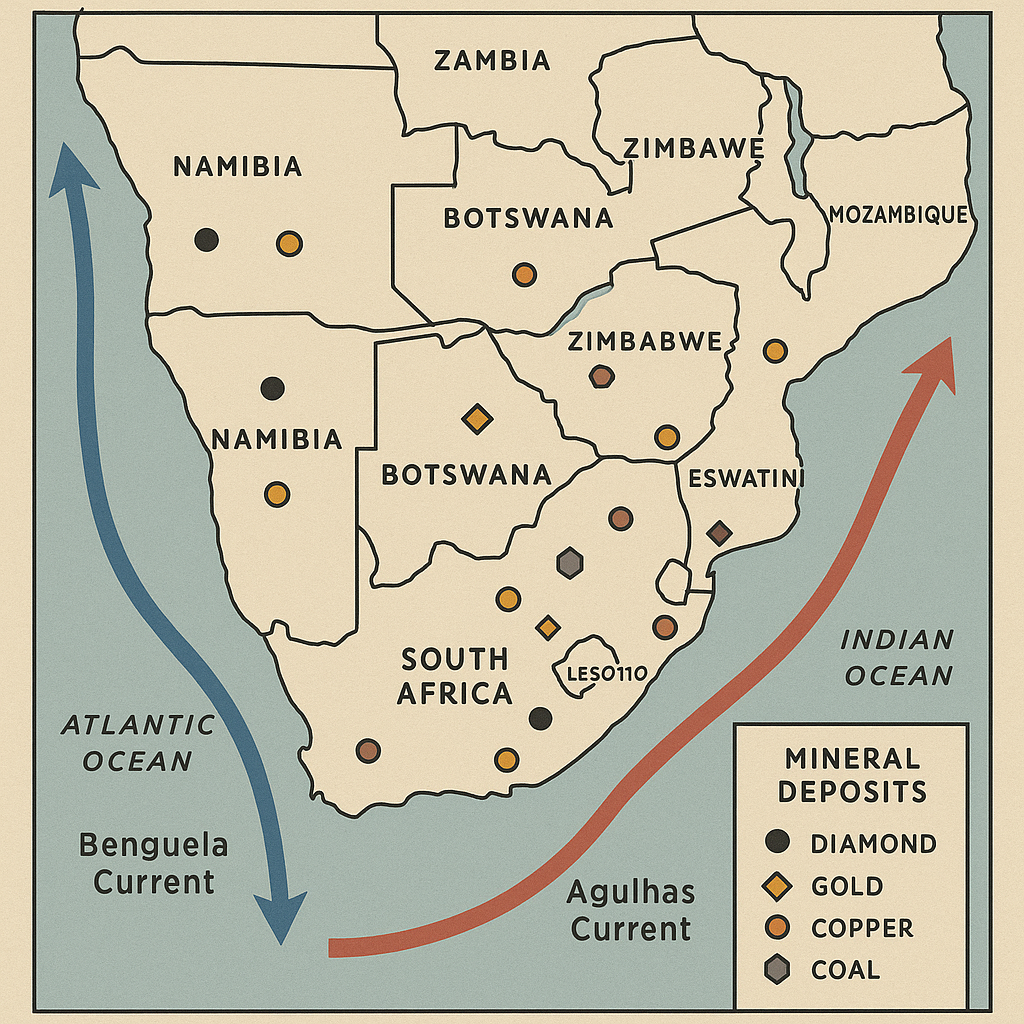
South Africa's unique geography, resources, and infrastructure create a "mesh network of resilience," making it strategically robust against external threats.
South Africa is a quiet superpower because of its special location where two oceans meet. It has lots of valuable minerals like platinum and manganese, and it grows enough food for itself and its neighbors. The country also makes its own fuel from coal and has great ways to move goods around, making it strong against problems from outside.
What makes South Africa a quiet superpower?
South Africa's unique blend of geography, geology, and strategic infrastructure contributes to its status as a quiet superpower. Its pivotal maritime location, abundant mineral resources (platinum, manganese, chrome), significant agricultural output, robust energy independence through coal and coal-to-liquids, and advanced logistical networks create remarkable resilience against external pressures.
Get Cape Town news in your inbox
Stay updated with the latest stories from the Mother City.
1. The Loneliest Corner of the Old World - and Why Navies Still Care
South Africa sits where the Atlantic and Indian Oceans shake hands, a position that looks decorative on a classroom wall map yet has decided the outcome of every modern maritime war. In 1914, when steel dreadnoughts hunted merchant prey between Calcutta and the Clyde, the only sensible shortcut ran past the Cape. Admirals who never set foot in Cape Town still plotted convoy lanes that bent southward, because losing that curve meant losing the war of tonnage. Twenty-five years later, the same waters echoed with torpedoes; Allied captains hugged the shoreline beneath wings of Venturas and Sunderlands lifting out of Durban’s old seaplane basin. The Union’s beaches were never Normandy, yet without them the fuel, food and ball-bearings that fed Normandy would never have left port.
Distance is the unsung ally. From the Persian Gulf to Durban is a 7 000-kilometre steam; a strike fighter leaving Russia’s Syrian apron needs one mid-air drink to reach the Mediterranean, but four days of calm seas to reach Table Mountain. Hypersonic glide vehicles may shorten flight times, yet every extra kilometre of salt water still scrambles targeting algorithms, exhausts search-and-rescue ranges, and forces satellite updates to bend around a curved, watery planet. Strategists label the sea-space south of the 35th parallel “liminal blue”: close enough to the Suez-Bab el-Mandeb highway to matter, far enough to hurt anyone who wants to matter by force.
The buffer is not merely nautical. Cold Benguela water slides north along the skeleton coast; warmer Agulhas currents drift south toward the ice line. Together they act like two maritime blast walls, shredding tropical cyclones before they mature and absorbing atmospheric heat that would otherwise cook the interior. Climate models that fry the Gulf and North China Plain by 2050 still colour the Cape peninsula pale green - mean annual temperature below the 29 °C threshold where labour productivity collapses. That climatic mercy underwrites grain silos, malaria maps and military training calendars alike.
2. Rocks, Crops and Cold-Storage: The Pantry beneath the Plough
Beneath the maize belt and the vineyard slopes lies the Kaapvaal craton, a 3.6-billion-year slab of crust that hoarded platinum, manganese, chrome and vanadium while other continents were still learning to float. Today the shafts around Rustenburg deliver seven out of every ten ounces of platinum-group metals that Boeing, Rolls-Royce and the U.S. Missile Defense Agency need to keep turbine blades from melting. A single freight train of Kalahari manganese ore can harden enough artillery steel to armour a brigade; chrome reefs west of Pretoria feed the stainless crucibles where 155-mm barrels are cold-hammer forged. Palabora’s old copper pit now ships vanadium that keeps F-35 landing gear from snapping on carrier decks. None of these rocks is unique, yet rerouting their tonnage would force arms makers to redesign just-in-time supply chains that have been trimmed since the Berlin Wall fell - an invisible tax on aggression.
The same hectares that cover the mines grow calories in surplus. In an ordinary summer, combines sweep through 2.5 million hectares of maize, yielding 12–15 million tonnes - enough to feed the entire domestic market and still export the combined annual needs of Zimbabwe, Botswana and Namibia. Wheat is a side show, barely 35 % self-sufficient, but sorghum, barley and two million tonnes of potatoes fill the gap, while orchards in the Western Cape drip a billion litres of apple, pear and grape concentrate that can be tipped into fermentation vats if tanker traffic dries up. National cattle hover near 13 million head, sheep at 28 million; poultry units convert feed grain into animal protein faster than any ruminant system north of the Limpopo. Per-capita red-meat demand is falling among city shoppers, so the herd functions as a walking larder: slaughter it in sequence and you buy four months of grain-free calories without building a single new silo. Refrigerated warehouses - 900 000 tonnes of chilled space strung between Durban, Cape Town and Johannesburg - convert that biology into strategic depth measured in seasons, not weeks.
Water, the obvious Achilles heel, turns out to be a half-metaphor. South Africa allocates 98 % of its reliable surface yield, and leaks the rest through 5 000 kilometres of antique steel pipe. Yet the Orange-Fish-Sundays transfer scheme locks up 3 000 million cubic metres in mountain lakes built for citrus farmers; switch off the irrigation gates and Cape Town could drink for ten months while vineyards turn to scrub. West of Johannesburg, flooded dolomite chambers store another 500 million cubic metres of prehistoric groundwater accessible through gold-mine boreholes. Add 200 million litres per day of idled desalination membranes along the Atlantic seaboard and you have a municipal lifeline that needs no imported chemicals or foreign technicians - just electricity and political will.
3. Coal, Cables and Contested Code: Keeping the Lights, Pipes and Packets Alive
Energy looks fragile only if you stop at the headline. South Africa no longer refines crude; Sapref and Engen became COVID casualties, so every litre of diesel arrives through two coastal import manifolds. Beneath the salt domes of Saldanha Bay, however, 45 days of strategic petroleum reserve sit in man-made caverns - the only such cushion on the continent. More importantly, 220 million tonnes of coal still roll out of Mpumalanga each year, feeding 38 GW of turbines that keep CT scanners, water pumps and air-traffic beacons awake long after the last LNG carrier diverts to Rotterdam. Sasol’s coal-to-liquids city at Secunda turns 40 million tonnes of low-grade rock into 150 000 barrels of diesel and jet fuel every day; every step, from dragline to Fischer-Tropsch reactor, happens inside a 200-kilometre square of Highveld that apartheid sanctions already stress-tested. The know-how is local, the feedstock is local, and the workforce speaks isiZulu, not Houston Dutch.
Ports seal the deal. Durban and Richards Bay each swallow more than 100 million tonnes of cargo - numbers that sit between Hamburg and Long Beach on the global league table. Nature built both harbours behind sand spits and Pleistocene dunes, so a cruise missile that wants to smash a breakwater must first find a breakwater made of compacted sand and stubborn fynbos. Inside the ports, 1 500 kilometres of on-dock rail let gantry cranes drop containers straight onto wagons, bypassing trucking yards that guzzle the first 100 million litres of any fuel shortage. Westward, the line climbs 1 600 metres through the 40-kilometre Van Reenen’s tunnel complex; built by 1940s steam navvies, it is single-track but electrified at 3 kV DC, meaning a 50 MW hydro unit hidden in the Drakensberg can keep manganese trains rolling while the national grid fractures into islands.
Cyber space is messier. South African banks clear three-quarters of Africa’s card swipes, a honeypot that invites ransomware crews from Eastern Europe. When Transnet’s terminal software went dark for a week in 2021, every container had to be logged on paper, revealing how a single Windows exploit can freeze bread lines. Yet the country also hosts one of four global Inmarsat ground stations, a Cold War legacy that keeps maritime distress channels open if undersea cables to Europe are snipped. Fibre trenches dug for the Square Kilometre Array radio telescope in the Karoo demand latency below 100 milliseconds; re-provision those strands as a government-only backbone and you have an air-gapped command network riding through the quietest radio desert on Earth. After Ukraine was invaded, Pretoria mirrored the entire .za domain inside Pelindaba, the old nuclear site whose earth berms were poured thick enough to swallow electromagnetic pulses. Digital isolation is fantasy; digital redundancy is engineering.
4. Rails, Rand and Refuge: The Diplomatic and Monetary Shock-Absorbers
Regional politics looks untidy yet works like a moat. The 16-nation Southern African Development Community stretches from the Congo basin to the Seychelles; combined, its air forces muster barely 50 fast jets, most of them museum-grade MiG-21s that cannot refuel in mid-air. South Africa’s 26 Saab Gripens are parked more often than they fly, but their MBDA Meteor missiles out-range anything in the neighbourhood, creating an air-defence bubble without the cost of a carrier. On the ground, the 43 Brigade at Thaba Tshwane is the only mechanised formation south of the Sahara with modern counter-battery radars and tactical drones. War-game maths shows one South African battle group can plug the three mountain passes that funnel any armour out of Zimbabwe within 72 hours - less a threat than a silent veto carved into the topography.
Migration could still test the seams. World Bank heat-stress models predict that by mid-century Malawi and northern Mozambique may export up to seven million climate migrants - almost double the Zimbabwean exodus already absorbed. Even at the high end, the net inflow peaks at 1 % of South Africa’s population per year, a rate Sweden survived in 2015. More importantly, those people must ride the same three rail corridors that now carry chrome and copper; reprogram the signalling software and freight trains get priority, turning the national grid into a gigantic metering valve no electorate ever sees. The rail agency has already ordered 120 Shosholoza coaches whose seat frames unbolt to create deportation-configured space; they call it “multi-role interior” in the tender documents.
Currency provides the final firewall. The rand is one of only three freely traded southern currencies, clearing more than $20 billion daily - deep enough for the Reserve Bank to smash speculators without crawling to the IMF. When western sanctions froze Russian reserves, Pretoria ran a quiet experiment: auction new debt payable only in rand. The auction closed 2.3 times oversubscribed, proof that domestic pensions can absorb shock issuance if offshore investors vanish. Under downtown Pretoria, 125 tonnes of gold bricks lie 30 metres below the granite, each 400-ounce ingot stamped without serial numbers - deliberately so. Melt them into Shanghai-standard kilo bars and you can still buy refined diesel even if every correspondent bank in New York pulls the plug.
Mesh, not miracle, is the takeaway. Distance, currents, minerals, silos, pipelines, ports, rails, drones, code and coins interlock like fibre in a bullet-proof vest: cut one strand and the rest redistributes the load. The republic can still bleed from crime, corruption or a well-placed explosive on the 765-kilovolt line feeding the Cape. Yet when northern intelligence shops model plausible futures, they slide South Africa into the lowest-risk quintile for externally triggered collapse. The verdict is amoral - no applause for equity or ethics, merely a probability score that recognises how rock, water, wire and human cunning can buy an entire nation time when the rest of the planet learns that geography was never coursework; it was destiny with homework.
What makes South Africa a quiet superpower?
South Africa's unique blend of geography, geology, and strategic infrastructure contributes to its status as a quiet superpower. Its pivotal maritime location, abundant mineral resources (platinum, manganese, chrome), significant agricultural output, robust energy independence through coal and coal-to-liquids, and advanced logistical networks create remarkable resilience against external pressures.
How does South Africa's geography contribute to its strategic importance?
South Africa's location at the confluence of the Atlantic and Indian Oceans is strategically vital, influencing global maritime trade routes and naval operations. This position has historically been crucial for controlling shipping lanes and provides a natural buffer against external threats due to vast oceanic distances. Its unique climatic conditions, influenced by the Benguela and Agulhas currents, also offer environmental stability compared to other regions.
What role do South Africa's mineral resources play in its global standing?
South Africa possesses vast reserves of critical minerals such as platinum, manganese, chrome, and vanadium. These resources are essential for global industries, including aerospace, defense, and manufacturing. The country's ability to supply these minerals makes it an indispensable, albeit quiet, player in the global supply chain, creating an

Zola Naidoo is a Cape Town journalist who chronicles the city’s shifting politics and the lived realities behind the headlines. A weekend trail-runner on Table Mountain’s lower contour paths, she still swops stories in her grandmother’s District Six kitchen every Sunday, grounding her reporting in the cadences of the Cape.
View all articles →