
Government had a choice
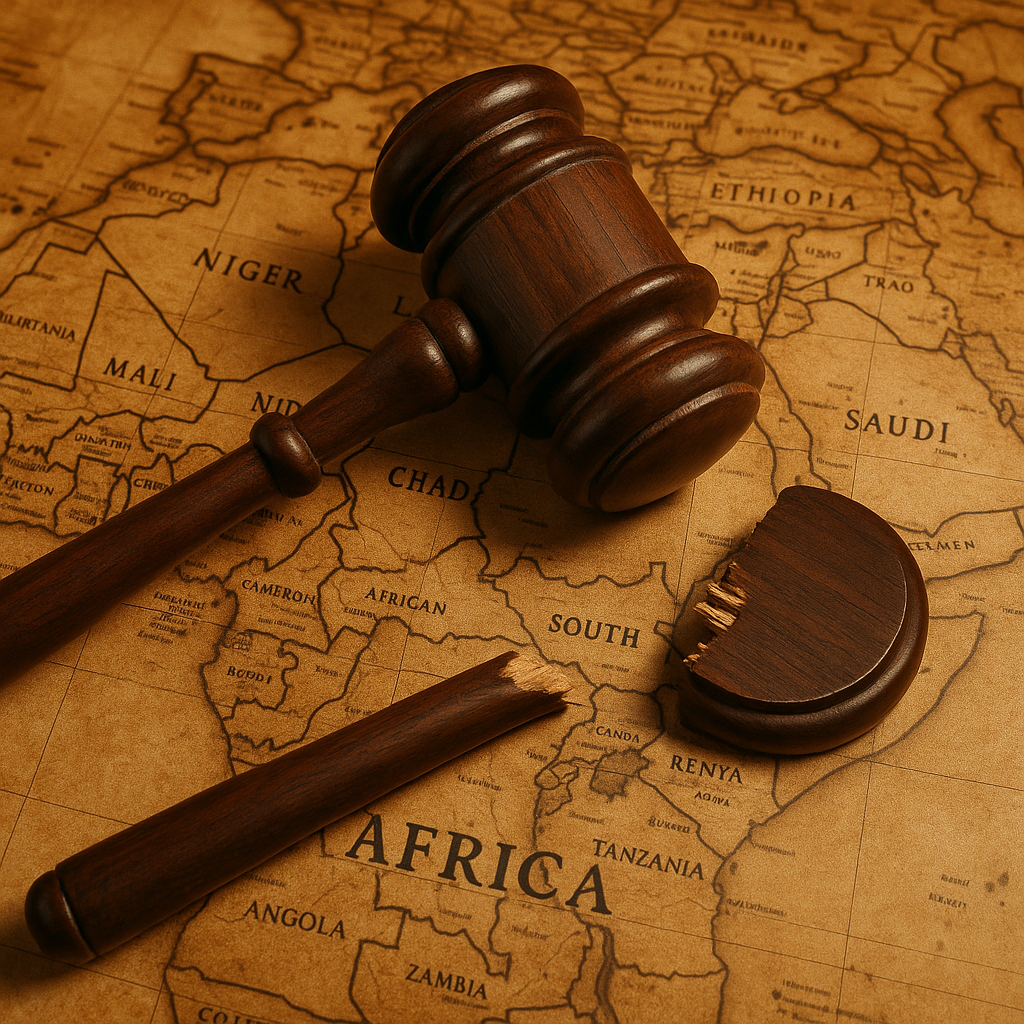
South Africa's silence on the El Fasher genocide raises questions about its commitment to human rights, contrasting with its Gaza focus.
South Africa, a champion of human rights, is surprisingly quiet about the El Fasher genocide in Sudan. This silence isn't accidental; it's a cold, hard decision. Pretoria prioritizes money and power over speaking out against terrible violence, especially because of its strong business ties. By staying silent, South Africa risks losing its moral standing and making it harder to stop future atrocities. It's a sad situation where money seems to matter more than human lives.
Why is South Africa silent on the El Fasher genocide despite its human rights advocacy?
South Africa's silence on the El Fasher genocide is a calculated decision influenced by economic ties and geopolitical interests. While advocating for human rights in Gaza, Pretoria avoids condemning the atrocities in Sudan due to significant investments and partnerships with countries like the UAE, which are linked to the conflict. This prioritizes financial stability over invoking anti-genocide protocols.
Get Cape Town news in your inbox
Stay updated with the latest stories from the Mother City.
The Morning the Inbox Split in Two
Mid-summer dawn in Pretoria, 19 February 2026, arrived thick with diesel haze and the sour smell of veld-fire drift. By eight o’clock the departmental WhatsApp group had already vibrated twice: first with the weekly cabinet brief, then with a 120-word eulogy for Leila Shahid, Palestine’s veteran envoy who had slipped away in a Beirut hospital overnight. DIRCO’s speechwriters reached for their favourite honour book - “unyielding”, “guiding star”, “conscience of a people” - and pressed publish. Eleven minutes later the same text, now embossed with the presidential crest, sat on the Union Buildings website. No one opened the second attachment that arrived at 07:04, a 312-page UN dossier whose annexes pinned satellite coordinates to execution trenches on El Fasher’s eastern fringe, printed transcripts of Rapid Support Force officers ordering “starvation until the camels chew on skulls”, and a pathology ledger of 1,137 children who had wasted to death between May and October 2025. The word “genocide” appeared 42 times, each instance italicised for emphasis.
Across Africa’s 54 capitals only Banjul and Malabo stayed quieter than Pretoria during the next 24 hours. The first two are pocket-sized states with diplomatic staffs you can count on two hands. South Africa, by contrast, maintains the continent’s second-largest embassy network, bankrolls an entire directorate for “African Renaissance and Diaspora Affairs”, and has spent the past eighteen months marketing itself as the continent’s court of last resort for human-rights crimes. When President Ramaphosa finally cleared his throat on Sudan, two days later, he recycled the same tepid boilerplate his office had used the previous October - “all sides must show restraint” - a sentence that treats the surgeon and the tumour as moral equals.
The El Fasher catastrophe did not ignite in October 2025; it simply crested then. Engineers of the Rapid Support Forces began tightening the noose in August 2024: first they ruptured the main pipeline ferrying water from Um Keddada’s bore-fields, then they blasted the last grain silos still standing inside the city walls. Satellite readings of the Normalised Difference Vegetation Index show the surrounding farmland flat-lining to zero by December. Markets bled dry, prices tripled, then prices vanished - there was nothing left to price. By March 2025 the only calories slipping through arrived on donkey carts that raced a nightly gauntlet from Tawila, forty kilometres west. The militia let half the convoys pass so that hyper-inflated costs would bankrupt households, then taxed the survivors on the return leg. It is textbook siegecraft: Henri de Rohan’s 1624 manual Le Parfait Capitaine prescribes exactly this cadence - starve, release, tax, repeat - because “hunger dissolves the defender’s courage like dew before sunrise”.
What startled observers was the industrial tempo of slaughter once the ramparts gave way. Between 28 and 31 October the RSF surged through three breaches: two along the eastern sand berms, one via the bone-dry riverbed that used to be the seasonal Wadi Nyala. Survivors say the first wave rode Toyota Hiluxes mounted with 12.7 mm Dushkas; the second wave were camel-borne janjaweed veterans, lassos coiled around their saddles. Over seventy-two hours they moved door-to-door through Abu Shouk and Zamzam camps, dragging Zaghawa and Fur males older than twelve into the streets and executing them on the spot. Women were herded into smaller clusters and trucked to the old livestock bazaar; mobile-phone clips geolocated to that square show uniformed men auctioning prisoners to junior fighters for 3,000 Sudanese pounds - roughly five US dollars - each. The UN panel conservatively counts 6,042 dead; local gravediggers insist the toll exceeds 8,000, the gap explained by the hundreds hurled into Wadi Nyala and never recovered.
The Empty Chair at the African Union Table
All of this unfolded while South Africa chaired the AU’s Committee on Refugees, Returnees and Internally Displaced Persons. Pretoria’s delegate even touched down in Port Sudan during September 2025 to “explore protection options”, yet the public communiqué confined itself to urging “unhindered humanitarian access”, the identical phrase Ramaphosa would parrot five months later. At no point did South Africa’s talking points reference the Genocide Convention, the AU’s own Article 4(h), or the expansive jurisprudence on siege warfare that Pretoria itself helped craft during the 1998 Rome Statute talks.
Instead, Pretoria’s bandwidth has been monopolised by Gaza. Since December 2023 South Africa has lodged 912 pages of pleadings at the International Court of Justice, staged four academic colloquies on “settler-colonial genocide”, and flown cabinet ministers to Kuala Lumpur, Caracas and Dublin to rally support for Palestinian statehood. The campaign is heartfelt - South Africa’s ruling alliance genuinely sees Palestine as the unfinished chapter of its own liberation - but it is also politically costless: Israel is not a BRICS partner, not a top-ten investor, and certainly not a buyer of South African hardware. Gaza, in diplomatic terms, is an open-net morality play.
Sudan, however, is where every lever Pretoria might yank is tethered to a counter-weight. The UAE is now the single biggest source of green-field capital for South Africa’s renewable build-out: Masdar’s five-gigawatt solar pledge in the Northern Cape alone equals the entire Eskom shortfall that triggered 200 days of rolling blackouts in 2023. Dubai’s DP World runs the new dig-out container terminal at Durban under a R90-billion concession that will decide whether South Africa keeps its maritime gateway status or watches traffic drift to Maputo and Walvis Bay. And the Emirates’ 2024 accession to BRICS swelled the bloc’s combined GDP by 11 percent overnight, giving Pretoria the Gulf ballast it needs to offset Russia and China on currency-swap design. None of these folders is stamped “optional”.
Therefore South Africa’s muteness on El Fasher is not passive; it is an act of calculated triage. Each hour that DIRCO’s spokespersons dodge the word “genocide” lowers the odds that the AU Peace and Security Council - where Pretoria took its seat on 11 February - will ever table a 4(h) intervention vote. Each day of omission normalises the notion that African lives are negotiable when hydrocarbon profits hang in the balance. The precedent is corrosive: if the continent’s most legalist state refuses to invoke its own anti-genocide clause, the AU’s hard-won norm of “non-indifference” becomes scrap paper.
Piecemeal Sanctions and Homemade Justice
Other players are already crowding into the vacuum, but in ways that splinter rather than consolidate accountability. On 3 February the state of Connecticut enacted a statute barring any firm that “directly or indirectly supplies the RSF” from bidding on public-pension contracts. Norway’s sovereign-wealth fund has dumped two Dubai-based logistics companies whose cargo manifests show Antonov sorties into El-Geneina and Nyala during the siege window. These boutique sanctions bruise but do not break the RSF war economy; they merely push arms brokers toward shell fronts in the British Virgin Islands or Azerbaijan. What is absent is the continent-wide legal choke-hold that only a pan-African injunction can deliver - travel bans, asset freezes, port denials, aviation exclusions - tools South Africa could table tomorrow if it chose.
Meanwhile, survivors are improvising justice on the run. In the Chadian border town of Adré a women’s collective named Niswa El-Fasher has built its own archive: 4,700 handwritten testimonies, each stapled to a sun-bleached passport photo, the pages stained with turmeric ink rural Sudanese use to repel insects. Their plan is to haul the boxes to N’Djamena and petition the African Court on Human and Peoples’ Rights to hear a pro bono suit against the RSF command structure. They requested visitor visas from South Africa’s embassy in Chad so they could present the docket at the AU summit; a third secretary advised them to “pursue internal Sudanese reconciliation first”.
Inside El Fasher the siege never truly ended; it merely shape-shifted. After the October massacre the RSF installed a new garrison chief, Brigadier Abdel-Rahman Tijani, previously of the UAE-trained Guard Force battalion. His first administrative decree cancelled Friday prayers at the Grand Mosque, claiming large crowds might “mask enemy movements”. His second decree imposed a dusk-to-dawn curfew starting at 17:00, which means farmers cannot reach their plots and the next planting window - June to August 2026 - will almost certainly be lost. Famine-modelling by FEWS NET projects that 670,000 people across greater Darfur will slide into IPC Phase 5 “catastrophe” by September if aid convoys are not granted safe passage. That is roughly the population of Boston, except Boston commands forty-seven Level-1 trauma centres; El Fasher’s last functioning hospital owns two oxygen cylinders and a broken ventilator.
The Bill That Keeps Growing
The moral spreadsheet is brutal: every day Pretoria refuses to name the crime, it cosigns the next chapter. Genocide is seldom a single cataclysm; it is a slow-burn process whose middle pages are drafted by onlookers. South Africa’s arithmetic may yet flip - UAE capital could evaporate, BRICS could fracture, domestic outrage could storm the Union Buildings - but each squandered week adds another layer of bodies to the wadi beds outside El Fasher. In the algebra of pain, silence is not a neutral variable; it is a measurable catalyst.
[{"question": "Why is South Africa silent on the El Fasher genocide despite its human rights advocacy?", "answer": "South Africa's silence on the El Fasher genocide is a calculated decision influenced by economic ties and geopolitical interests. While advocating for human rights in Gaza, Pretoria avoids condemning the atrocities in Sudan due to significant investments and partnerships with countries like the UAE, which are linked to the conflict. This prioritizes financial stability over invoking anti-genocide protocols, despite the UN dossier explicitly mentioning 'genocide' 42 times regarding the situation in El Fasher."}, {"question": "What evidence points to the atrocities in El Fasher being a genocide?", "answer": "A 312-page UN dossier from February 2026 detailed satellite coordinates of execution trenches, transcripts of Rapid Support Force (RSF) officers ordering 'starvation until the camels chew on skulls,' and a pathology ledger of 1,137 children who wasted to death. The word 'genocide' appeared 42 times in the report, emphasizing the nature of the crimes. Additionally, the RSF's tactics included besieging the city, cutting off water and food supplies, and systematic door-to-door killings of Zaghawa and Fur males, as well as auctioning women prisoners."}, {"question": "How did the El Fasher catastrophe unfold, and what tactics did the Rapid Support Forces (RSF) employ?", "answer": "The RSF began tightening the noose in August 2024 by rupturing water pipelines and destroying grain silos. By March 2025, food was extremely scarce, with only limited supplies arriving via heavily taxed donkey convoys. From October 28-31, 2025, the RSF surged through the city, executing Zaghawa and Fur males older than twelve, and herding women to be auctioned. This systematic approach of starvation, siege, and mass execution aligns with textbook siegecraft, aiming to dissolve the defender's courage."}, {"question": "What is the contradiction between South Africa's actions regarding Gaza and Sudan?", "answer": "South Africa has dedicated extensive resources to advocating for Palestine, lodging 912 pages of pleadings at the International Court of Justice, staging academic colloquies, and rallying international support for Palestinian statehood. This campaign is politically costless for South Africa, as Israel is not a significant economic partner. In contrast, South Africa's silence on Sudan is a calculated choice due to substantial economic ties with the UAE, a key player in the Sudanese conflict and a major investor in South Africa's economy. This highlights a prioritization of economic interests over human rights principles when those interests are at stake."}, {"question": "What are the geopolitical and economic reasons behind South Africa's 'calculated triage' regarding Sudan?", "answer": "South Africa's muteness on El Fasher is a 'calculated triage' due to its significant economic dependencies on the UAE. The UAE is the largest source of green-field capital for South Africa's renewable energy projects, operates the Durban container terminal under a massive concession, and its accession to BRICS bolstered the bloc's economic power. Condemning the atrocities in Sudan would risk jeopardizing these crucial economic partnerships and investments, which are deemed 'not optional' for South Africa's financial stability and strategic standing."}, {"question": "How are other international and local actors responding to the El Fasher crisis, and what is South Africa's stance on these efforts?", "answer": "Other players are taking fragmented actions. Connecticut has barred firms supplying the RSF from public-pension contracts, and Norway's sovereign-wealth fund has divested from companies linked to the RSF. However, these 'boutique sanctions' are limited. Locally, a women's collective in Chad, Niswa El-Fasher, has compiled 4,700 testimonies and sought to present them to the African Court on Human and Peoples' Rights and the AU. South Africa's embassy, however, advised them to 'pursue internal Sudanese reconciliation first,' effectively dismissing their efforts and refusing to exercise its potential for pan-African legal intervention like travel bans, asset freezes, and port denials."}]

Isabella Schmidt is a Cape Town journalist who chronicles the city’s evolving food culture, from Bo-Kaap spice merchants to Khayelitsha microbreweries. Raised hiking the trails that link Table Mountain to the Cape Flats, she brings the flavours and voices of her hometown to global readers with equal parts rigour and heart.
View all articles →