
Government may finally be heeding calls for Cape Town military land to be developed for housing
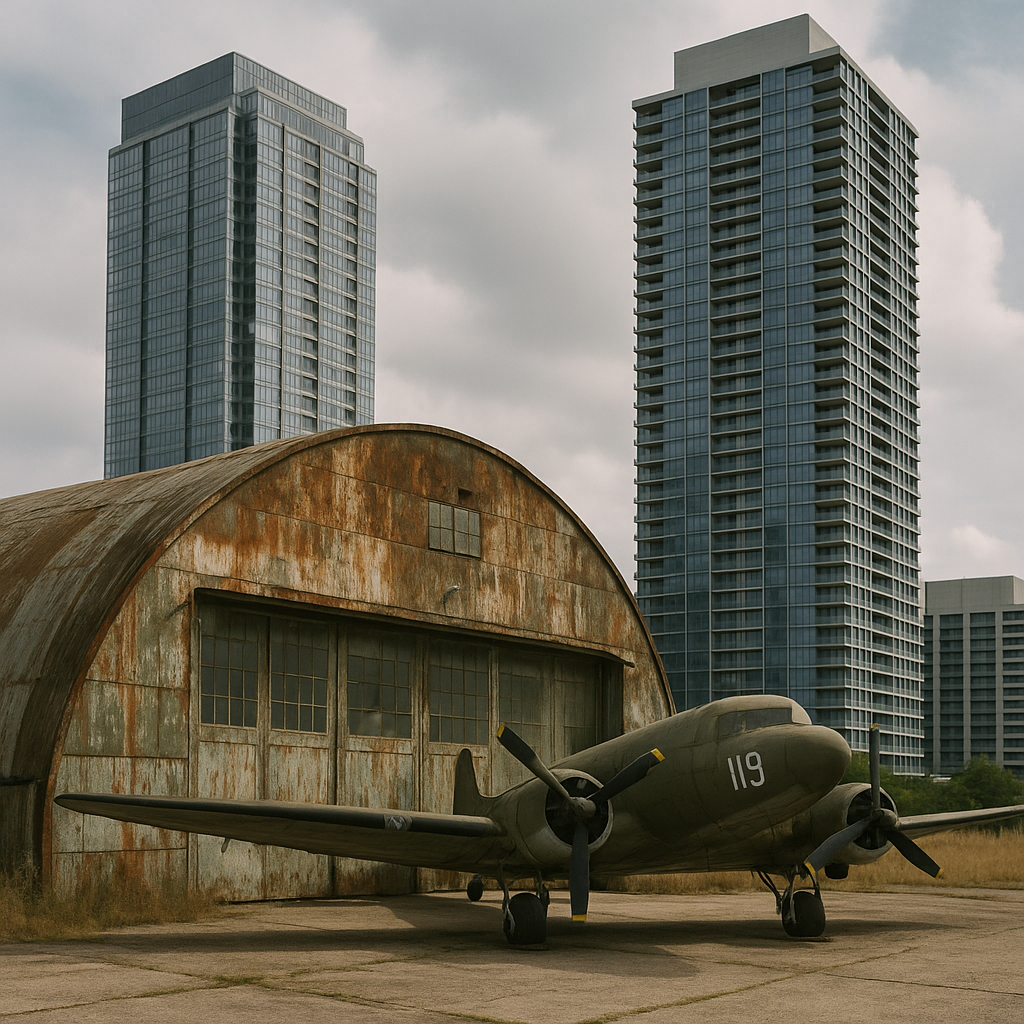
Explore the complex process of converting Cape Town's military airfields into mixed-income housing, tackling logistics, finance, and social challenges.
Cape Town wants to turn old air bases into new homes, but it's a giant puzzle. Many government departments, big money for roads and pipes, and cleaning up old messes are huge problems. Everyone from people living nearby to history lovers has their own ideas. It's a race against time to get everyone to agree and build lots of homes for the city.
What are the challenges in redeveloping Cape Town's ex-air bases?
Redeveloping Cape Town's ex-air bases faces numerous challenges including complex governmental approvals across three national departments, significant infrastructure costs (R6.2 billion for bulk services, R980 million for electricity, R320 million for transport), environmental decontamination, and managing diverse stakeholder interests from informal settlements to heritage groups and labor unions.
Get Cape Town news in your inbox
Stay updated with the latest stories from the Mother City.
Why Three Forgotten Grass Strips Still Matter in 2024
Cape Town’s final, sizeable tracts of publicly owned land lie directly beneath the flight path into the airport. Wingfield, Ysterplaat and Youngsfield – once humming with maritime patrol planes, Shackleton bombers and Border-War mobilisation drills – are now silent expanses behind rusting fences. For more than three decades the public dialogue was dominated by slogans: “People before planes”, “Land for homes, not hangars.” That phase is over. In 2024 the debate is procedural: which minister signs first, whose budget absorbs the R6-billion-plus bulk-infrastructure bill, and how to hand over keys without plunging the city into service-delivery chaos.
These three properties are the last pieces well-located enough to dent the metro’s 400 000-unit backlog. They sit inside the urban edge, already ring-fenced by freeways and business nodes, avoiding the political minefield of farmland expropriation. Yet they are also bound by the Defence Act of 2002, which states that a ministerial declaration of “surplus to military requirement” must be preceded by Treasury concurrence and Public Works sign-off – a single paragraph that has frozen every attempt since 1996.
How Big Is Big? A Numbers Tour of a Would-Be Megaproject
Spatial modeller Jens Horber calculates that the combined 668 hectares could host as many as 67 000 homes without exceeding a floor-area ratio of 1.2 and a ground coverage of 40 %. That density translates into a brand-new town of roughly 200 000 residents – larger than Mossel Bay’s entire population. City Housing Directorate planners prefer a more cautious 47 000 units, reserving wedges of Wingfield and Ysterplaat as ecological belts and freight corridors for Century City.
Either scenario dwarfs anything Cape Town has delivered lately. Joe Slovo Phase 3 in Langa produced just over 1 000 homes across four years. Reaching even the City’s reduced target would require:
- forty-two tower cranes rotating simultaneously,
- 1.8 million cubic metres of ready-mix concrete, and
- strip-mining another 1 000 hectares of dune sand in the Western Cape, according to the Aggregate and Sand Producers Association.
The scale is sobering, but the land itself is arguably the lowest-hanging fruit left in the metro.
The Paper Chase: Three Pens, One Signature Gridlock
The project sits at the intersection of three national departments, each clutching a different pen.
-
Public Works and Infrastructure (DPWI)* – custodian of the deeds – must first declare the land surplus under section 2(1) of the Defence Act. Minister Dean Macpherson’s office issued a May 2024 statement confirming “agreement in principle” and nodding to the new State Land Lease and Disposal Policy (SLLDP). That policy keeps freehold off the table: the State will retain the ground and lease sites for 99-year terms, collecting rent indexed to CPI. Critics say this is privatisation in disguise; pragmatists argue that Treasury simply has no capital budget to buy-out Defence outright.
-
Human Settlements* holds the second pen. The current Breaking New Ground subsidy is pegged at R267 000 per unit. Thembi Simelane, the minister, insists that the 2024 Division of Revenue Bill already “ring-fences” the required R17.5 billion, but Treasury has yet to confirm the re-prioritisation. Without that confirmation, banks will not underwrite the blended-finance stack the City proposes.
-
The South African National Defence Force* owns the third pen – literally, its Chief must sign “no objection” letters. Wingfield and Youngsfield are already cleared, but Ysterplaat is still active: the Navy’s Fleet Support Unit stores spare propeller shafts there. Relocating that stockpile to Simon’s Town is priced at R900 million and would take thirty months, according to an Armscor briefing circulated last year.
Dollars, Dirt and Delay: The Hidden Ledger of Launching Phase 1
-
Decontamination hurdles* – Ysterplaat’s soil carries polycyclic aromatic hydrocarbons that exceed legislated limits. Defence puts the clean-up at R450 million; DPWI has no budget. The City’s workaround is to start on the uncontaminated northern fringe and let bioremediation run in parallel, a five-year rolling programme that mirrors Treasure Island’s staged approach in San Francisco.
-
Bulk services* – The single biggest ticket is R6.2 billion for water and sewerage. Cape Town’s Water Strategy already plans to upgrade the 54-inch Blackheath-Milnerton pipeline, but only in 2032. Pulling that timeline forward to 2026 would require emergency procurement under Treasury Regulation 16A. A 15-cent-per-kilolitre bulk levy is on the table to help pay for it.
-
Electricity* – Century City’s 132 kV substation already hits 85 % capacity in summer. Eskom’s latest study says another 130 MVA will be required for 67 000 new units. A second transformer at Montague Gardens, plus four kilometres of new 132 kV cable trenching along the N1, carries a R980 million price tag.
-
Transport* – MyCiTi’s Phase 2A trunk route stops 2 km short of Wingfield. Extending the bus-rapid-transit spine across the N1/N7 interchange needs a dedicated bridge, priced at R320 million. Traffic studies warn that without it Potsdam Road will collapse into gridlock by 2030.
Stakeholders with Pitchforks and Lawyers: Getting to Social Licence
-
Informal settlements* – Kosovo and Rasta Camp hug Youngsfield’s fence. Residents organised as the Youngsfield Land Occupiers Forum cite the 2018 Mwelase judgment: any eviction must offer alternative accommodation within 5 km. They want on-site upgrading, not relocation to Philippi.
-
Commercial tenants* – A 32-hectare vegetable farm on Wingfield’s eastern edge operates under a 30-year SANDF lease. Owner Willem van Zyl won an interdict forcing DPWI to give 24 months’ notice; that clashes with the planned Phase 1 handover date of December 2025.
-
Heritage lobby* – Ysterplaat’s Hangar 5 is a provincial heritage site, the only surviving corrugated-iron aircraft hangar of its type in the southern hemisphere. Integrating it into the precinct slices off developable bulk and raises architectural costs.
-
Labour unions* – NEHAWU has threatened interdicts unless a Project Labour Agreement guarantees 70 % local labour and a R120/hour minimum wage. Agreement is still being brokered.
Global Cheat Sheet: Three Cities That Pulled It Off
-
Brentwood, Vancouver* – An 80-hectare naval reserve reinvented between 1995 and 2013. Developers traded cash and social amenities for density bonuses, yielding CAD $265 million in community benefits and 11 000 homes anchored by a SkyTrain station.
-
Treasure Island, San Francisco* – A 180-hectare artificial ex-Navy base. Issue $500 million in tax-allocation bonds for seismic retrofitting before the first resident moved in; 2 000 units completed, 6 000 under construction.
-
Randburg Waterworks, Johannesburg* – A 200-hectare military water plant converted between 2003 and 2011. Mixed-use rezoning plus National Urban Renewal grants delivered mid-rise apartments along William Nicol Drive. The project was delayed for two years when contractors struck an unmapped 11 kV cable – a reminder to survey every centimetre before digging.
Key takeaway for Cape Town: publish the land-value-capture formula on day one and bundle bulk-infrastructure funding into the concession to avoid mid-stream stand-offs.
The Clock Starts in February 2025 – If the Pens Move
The last procedural hurdle is proclamation in the Government Gazette. Surveyor-General diagrams must be updated, military servitudes de-registered and a Permanent Base Closure certificate (AR 67/DP-3) lodged. If ministers Macpherson and Simelane meet their promised December 2024 policy announcement, the first site-establishment meeting is pencilled for 15 February 2025.
A successful pilot on a 24-hectare wedge of Youngsfield – 1 500 units, blended rentals and ownership – could then be rolled out in 12-hectare tranches across Wingfield and Ysterplaat. City finance officers crunch the numbers: 67 000 homes phased over twelve years at a 7.6 % real discount rate. The sums work – but only if every pen finally hits the dotted line.
[{"question": "
What are the primary challenges in redeveloping Cape Town's ex-air bases?
", "answer": "Redeveloping Cape Town's ex-air bases faces numerous challenges including complex governmental approvals across three national departments (Public Works and Infrastructure, Human Settlements, and the South African National Defence Force), significant infrastructure costs (R6.2 billion for bulk services, R980 million for electricity, R320 million for transport), environmental decontamination (such as polycyclic aromatic hydrocarbons at Ysterplaat), and managing diverse stakeholder interests from informal settlements to heritage groups and labor unions. The Defence Act of 2002 also presents a hurdle, requiring a ministerial declaration of 'surplus to military requirement' preceded by Treasury concurrence and Public Works sign-off, which has historically frozen attempts at redevelopment."}, {"question": "How much housing could these ex-air bases provide for Cape Town?
", "answer": "The combined 668 hectares of Wingfield, Ysterplaat, and Youngsfield could potentially host as many as 67,000 homes, which would create a new town for approximately 200,000 residents. City Housing Directorate planners propose a more cautious estimate of 47,000 units, reserving parts of Wingfield and Ysterplaat for ecological belts and freight corridors. Even the lower target represents a massive undertaking for Cape Town, requiring significant resources and planning."}, {"question": "Why is inter-departmental approval so crucial and complex for this project?
", "answer": "The project's approval is complex because it intersects with three national departments, each holding a critical 'pen.' Public Works and Infrastructure must declare the land surplus, Human Settlements needs to secure R17.5 billion in funding for subsidies (which Treasury still needs to confirm), and the South African National Defence Force must provide 'no objection' letters, with Ysterplaat still being an active site requiring relocation of naval stores at a cost of R900 million. Without all three entities signing off, the project cannot proceed."}, {"question": "What are the major infrastructure costs and environmental concerns associated with the redevelopment?
", "answer": "Significant infrastructure costs include R6.2 billion for water and sewerage upgrades, R980 million for electricity infrastructure to support the new units, and R320 million for transport extensions, including a dedicated bridge for the MyCiTi bus route. Environmentally, Ysterplaat's soil requires R450 million for decontamination due to polycyclic aromatic hydrocarbons, and a five-year bioremediation program is envisioned as a workaround."}, {"question": "Who are the key stakeholders, and what are their concerns regarding the redevelopment?
", "answer": "Key stakeholders include residents of informal settlements like Kosovo and Rasta Camp, who demand on-site upgrading rather than relocation. Commercial tenants, such as a vegetable farm on Wingfield, require 24 months' notice before displacement. The heritage lobby is concerned about preserving sites like Ysterplaat's Hangar 5, a provincial heritage site. Labor unions like NEHAWU are advocating for Project Labour Agreements to guarantee local employment and minimum wages."}, {"question": "What lessons can Cape Town learn from other cities that have redeveloped ex-military sites?
", "answer": "Cape Town can draw lessons from cities like Brentwood (Vancouver), Treasure Island (San Francisco), and Randburg Waterworks (Johannesburg). Key takeaways include the importance of establishing a clear land-value-capture formula from the outset and bundling bulk-infrastructure funding into the concession to avoid mid-project delays and conflicts. These examples highlight the need for comprehensive planning, managing complex financing, and addressing potential unforeseen issues like unmapped utilities early on."}]
Lerato Mokena is a Cape Town-based journalist who covers the city’s vibrant arts and culture scene with a focus on emerging voices from Khayelitsha to the Bo-Kaap. Born and raised at the foot of Table Mountain, she brings an insider’s eye to how creativity shapes—and is shaped by—South Africa’s complex social landscape. When she’s not chasing stories, Lerato can be found surfing Muizenberg’s gentle waves or debating politics over rooibos in her grandmother’s Gugulethu kitchen.
View all articles →