
HOW THE LAND CLAIMS AGREEMENT WORKS
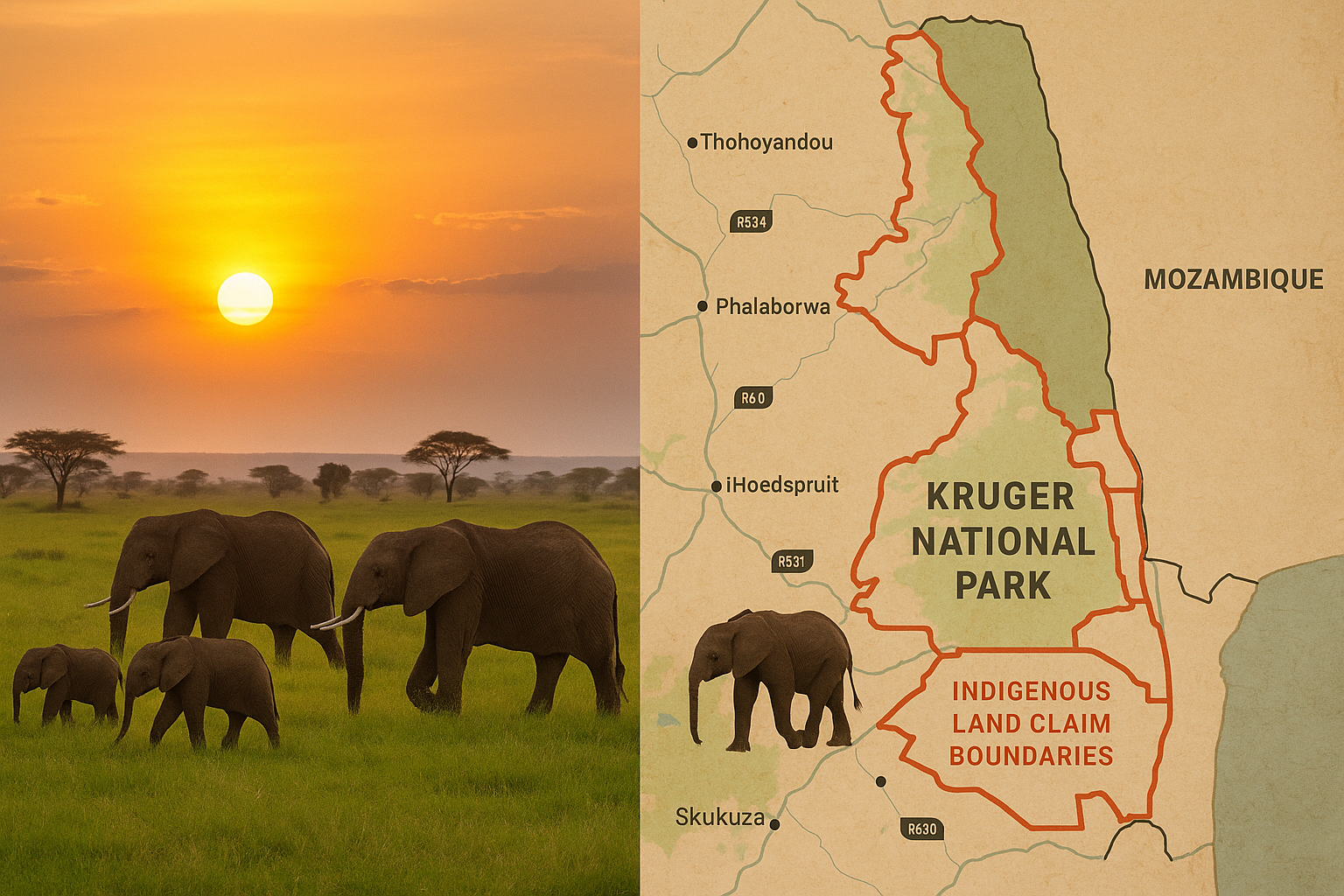
Explore Kruger National Park's beneficiation scheme: historical land claims, innovative revenue sharing, and conservation safeguards.
Kruger National Park is rewriting history with a new deal called KCET, giving back to communities who lost their land. A slice of tourism money, 7.5%, goes into a special trust, helping people with jobs, education, and starting businesses. This smart plan means the park stays wild, but local people get a real share in its success, making things fair for everyone and protecting nature for years to come.
What is the Kruger Community Equity Trust (KCET)?
The Kruger Community Equity Trust (KCET) is a groundbreaking agreement where SANParks commits 7.5% of Kruger National Park's tourism revenue above a baseline to a community-governed trust. This revenue-sharing model, established in October 2023, aims to provide lasting benefits to communities dispossessed of their land, funding eco-lodges, small businesses, education, and jobs while ensuring conservation safeguards.
Get Cape Town news in your inbox
Stay updated with the latest stories from the Mother City.
1. From Eviction to Equity: The Century-Long Road to Legal Redress
Until the late 1800s, the real estate that today appears on glossy maps as Kruger National Park echoed with the languages of Tsonga clans, Bakgatla-ba-ga-Kgafela, Bapedi, Swazi royalty and Ndebele homesteads.
Starting in 1898, a string of colonial proclamations sliced away grazing grounds and sacred groves; by 1926 the modern park boundary had erased more than 1.9 million hectares of customary tenure.
Apartheid’s Land Acts of 1913 and 1936 slammed the door on any lingering hopes of return, but the post-1996 restitution regime reversed the legal momentum: 32 groups filed overlapping claims inside Kruger, and dozens more on neighbouring farmland once carved out for white citrus growers or the former Gazankulu bantustan, pushing the contested surface beyond 4,000 km² - an area larger than metropolitan Cape Town.
2. Why Cash or Title Failed: The Search for an Endless Stream
Early negotiations offered two familiar tools: transfer the land back, or cut a cheque for market value and walk away.
SANParks warned that carving up a flagship reserve would trash national biodiversity targets, while residents feared a once-off windfall would evaporate like so many earlier compensation payouts.
Stalemate finally cracked when negotiators borrowed DNA from the 2002 Makuleke settlement north of the Levubu River: instead of a price tag, craft an unending “beneficiation stream” that keeps paying as long as tourists keep coming.
3. Birth of the Kruger Community Equity Trust: A 7.5% Slice of Gate-Take Forever
On 24 October 2023, Settlement Agreement SA-05/2023-KNP took effect, birthing the Kruger Community Equity Trust (KCET).
SANParks committed to pay 7.5% of every rand of tourism revenue - gates, lodges, curio sales - above a 2018/19 baseline of R2.4 billion into the ring-fenced Trust.
A fifteen-seat board governs the purse: six elected community reps (weighted by how much land each group lost), two SANParks officials, two provincial delegates, and four independent professionals vetted for finance, ecology, law and social-development chops; any big spend needs eleven votes, so no side can hijack the money.
4. Four Ways Money Turns into Opportunity
Tourism Concessions – Five new 830-bed eco-lodges will rise inside the park, each structured as a 51% SANParks/49% KCET joint venture, with Green Key or EarthCheck certification baked in.
Enterprise Seed Fund – A R200 million revolving pot over five years backs SMEs in a 15 km commercial buffer, from marula-drying plants to drone-security outfits, capped at 35% equity to force co-investment.
Human-Capital Pipeline – At least 400 tertiary bursaries a year plus 120 annual apprenticeships inside Kruger’s vet lab, K-9 anti-poaching unit and GIS division come with a one-for-one work-back clause.
Jobs & Procurement – SANParks must fill one in five new posts with residents living within 50 km, and channel 30% of fresh-produce, laundry and uniform contracts to community cooperatives through a zero-cost e-tender portal.
5. Sacred Ground Kept Wild: Heritage Gateways Outside the Fence
No one will rebuild villages among the fever trees; instead, Numbi, Phalaborwa and Punda Maria will each host a heritage gateway on adjoining land already restored to communal ownership.
These cultural interpretive hubs - run by KCET but marketed inside the park - let visitors meet history without trampling black rhino habitat.
Traditional leaders may perform annual rain-calling rites at seven pre-agreed sacred pockets deep within the reserve, balancing spiritual continuity with ecological peace of mind.
6. Safeguards Written in Numbers: Rhino Growth, Alien Plants and Biodiversity Scorecards
Conservation hard limits protect the deal: the park-wide Biodiversity Intactness Index must stay above 78%; if KCET projects drive a two-percent dip, concession rent doubles and funds ecological repair.
Black rhino numbers must expand at least 5% per annum or new lodge construction halts.
Sentinel-2 satellite imagery tracks invasive plants - Category 1b cover cannot swell more than 5% inside any concession block - so tourism growth does not morph into bush degradation.
7. Show Me the Money: Conservative Projections and Shock Absorbers
Assume tourism climbs 5% a year post-COVID and the baseline hits R3.1 billion by 2028; KCET would bank roughly R232 million annually.
After 5% administration, R220 million is deployable: 45% shores up concession equity, 30% replenishes the seed fund, 15% funds bursaries, 10% underwrites legacy projects such as graves restoration and oral-history archives.
Because revenue, not capital, is shared, the Trust can squirrel away reserves, cushioning future shocks like pandemics or drought-driven visitor droughts.
8. Politics Inside the Tent: Chiefs, Youth and Farmers All Want More
Some royal houses want direct shareholding, arguing the Ingonyama Trust model keeps kingly influence intact; the current structure channels power through elected trustees.
Young activists fear elders will capture elections and demand a 25% youth quota plus smartphone voting.
Commercial farmers outside the park worry KCET produce will flood local markets, triggering provincial tariff spats; five-yearly reviews baked into the deed offer space to recalibrate.
9. Tech Spice: Drones, Blockchain and Solar Micro-Grids
Blockchain genealogy tokens prevent “ghost beneficiaries” and duplicate claims.
Fixed-wing drone corridors cut helicopter hours, lowering carbon footprints during game counts and fence patrols.
Four off-grid hamlets near Numbi now run on 400 kW solar-battery hybrids financed from KCET seed money, showcasing conservation-linked renewable power.
10. Friends with Benefits: Peace Parks, GIZ and a Rhino Bond
KCET inked deals with Peace Parks Foundation to market cross-border packages into Mozambique’s Limpopo National Park, with GIZ advising on sustainable-finance structures and the World Bank’s BIOFIN initiative preparing a “rhino bond” whose coupons rise when monitored rhino numbers climb.
11. An Open Dashboard: 28 Live Indicators on Your Phone
Every quarter SANParks uploads a live dashboard covering lion density, female board representation, bursary drop-out rates and SMME turnover; users can browse it free on the Kruger app or Facebook’s Free Basics, dragging transparency into bandwidth-poor villages.
12. Copy, Paste, Adapt: Could Addo, iSimangaliso or Hluhluwe–Imfolozi Use the Same Playbook?
The formula - tourism revenue shared rather than land returned, trust governance insulated from elections, ecological triggers policed by satellite - travels well, though smaller parks may lack Kruger’s visitor volumes and coastal reserves must wrestle with marine tenure.
iSimangaliso already pilots KCET-style advisers, proving the idea can scale beyond the Lowveld.
What is the Kruger Community Equity Trust (KCET)?
The Kruger Community Equity Trust (KCET) is a groundbreaking agreement established in October 2023. It commits SANParks to pay 7.5% of Kruger National Park's tourism revenue (above a 2018/19 baseline of R2.4 billion) into a community-governed trust. This revenue-sharing model aims to provide lasting benefits to communities dispossessed of their land, funding eco-lodges, small businesses, education, and jobs, while also ensuring conservation safeguards.
Why was the KCET created?
The KCET was created to address the historical injustices of land dispossession, particularly for communities who lost their ancestral lands to the creation and expansion of Kruger National Park. After previous attempts at direct land transfer or one-off compensation proved problematic, the KCET offers a sustainable and ongoing "beneficiation stream" from the park's tourism revenue, ensuring local people get a real share in its success while maintaining the park's biodiversity.
How does the KCET generate opportunities for local communities?
The KCET generates opportunities in several ways: by establishing new eco-lodges inside the park as joint ventures with communities, through an Enterprise Seed Fund that supports small and medium-sized enterprises (SMEs) in a 15 km commercial buffer zone, by funding tertiary bursaries and apprenticeships, and by ensuring SANParks fills new posts and procures fresh produce and services from community cooperatives.
How is the KCET governed and are there safeguards against misuse of funds?
The KCET is governed by a fifteen-seat board. This board includes six elected community representatives, two SANParks officials, two provincial delegates, and four independent professionals with expertise in finance, ecology, law, and social development. Crucially, any significant expenditure requires eleven votes, preventing any single party from dominating decisions. The Trust also operates with an open dashboard, providing transparency on various indicators.
How does the KCET balance community benefits with conservation goals?
The KCET is designed with strong conservation safeguards. For instance, the park-wide Biodiversity Intactness Index must remain above 78%. If KCET projects cause a two-percent dip, concession rent doubles to fund ecological repair. Black rhino numbers must also expand by at least 5% annually, or new lodge construction halts. Satellite imagery tracks invasive plants, ensuring tourism growth doesn't lead to environmental degradation. Traditional leaders can also perform annual rites at sacred sites without impacting wildlife.
Can the KCET model be applied to other national parks?
The KCET model, which prioritizes sharing tourism revenue rather than returning land, using a trust for governance, and implementing ecological triggers policed by satellite technology, is considered adaptable to other national parks. While parks with lower visitor volumes or coastal reserves with marine tenure issues might require adjustments, the fundamental principles can be scaled. For example, iSimangaliso already pilots KCET-style advisers, demonstrating its potential beyond Kruger.

Sarah Kendricks is a Cape Town journalist who covers the city’s vibrant food scene, from township kitchens reinventing heritage dishes to sustainable fine-dining at the foot of Table Mountain. Raised between Bo-Kaap spice stalls and her grandmother’s kitchen in Khayelitsha, she brings a lived intimacy to every story, tracing how a plate of food carries the politics, migrations and memories of the Cape.
View all articles →