
Hundreds march on Parliament demanding an increase in alcohol tax
Cape Town activists march for higher alcohol taxes to fund future generations & combat alcohol's societal costs. Discover their demands.
People marched in Cape Town to ask the government to make alcohol more expensive and control it better. They want a special tax on strong drinks and a minimum price for all alcohol. The money from these changes would help make communities safer and healthier. The marchers showed how much harm alcohol causes, using sad stories and powerful symbols to get their message across to lawmakers.
What is the main purpose of the Cape Town march?
The Cape Town march, organized by the Southern African Alcohol Policy Alliance (SAAPA), aims to advocate for increased alcohol taxation and stricter regulations. They propose a 20% surcharge on strong drinks, a floor price for pure alcohol, and an end to quantity discounts, with funds channeled into community safety and health.
Get Cape Town news in your inbox
Stay updated with the latest stories from the Mother City.
Roeland Street Becomes a River of Colour and Grief
At 09:00 sharp on 18 February, khaki bucket hats swarmed out of buses outside Parliament, every hat stitched with the slogan “See the real price of drink.” Cardboard placards - sun-yellow, reef-blue, fire-red - undulated above the tar like kites in a summer gale. Organisers from the Southern African Alcohol Policy Alliance (SAAPA) had rehearsed this moment for weeks: WhatsApp choirs in Manenberg, patrol groups in Khayelitsha, drama clubs in Mitchell’s Plain each received the same digital kit - poster stencil, two-minute jingle, street-corner script timed to red robots. By 10:00 the human chain had swallowed Roeland Street, forcing official cars to slink through Tuynhuys’s back gate.
Odwa Nakani, SAAPA’s national coordinator, balanced on a tower of Coke crates and refused to preach morality. Instead, he fired statistics like confetti: every Friday-to-Sunday, alcohol hijacks 44 % of Groote Schuur’s trauma beds; liquor lurks in 56 % of murder dockets; 30 000 road corpses each year. A 2023 University of Cape Town model insists a R12 beer triggers R47 in state clean-up costs. Behind him, volunteers hoisted a bedsheet cartoon: a shebeen roof transformed into a greedy mouth devouring children, cars, a clinic logo.
Gumboot dancers in neon bibs - primary-school girls no taller than the placards - beat a rhythm against the tar, chanting “Phantsi ndixolele, phantsi!” The call-and-response kept pensioners with wheezy lungs in the game: “How many shebeens?” “Too many!” “How many graves?” “Too many!” Between beats, the crowd advanced, a fusion of anti-apartheid funeral march and TikTok flash-mob precision.
Pamela Booysen, 57, chair of the Gugulethu Development Forum, spent two hours in a make-up chair creating a syrup-blood scalp wound and a crimson sling. She and theatre-maker Inga Mkalali performed a silent loop: flirtation, intoxication, assault. Mkalali slammed Booysen against a traffic-light pole; a halved coconut cracked on the tar like a 9 mm. When the mime froze, Booysen spoke still pinned to the metal: “This isn’t theatre; it’s Tuesday night in NY 1.” Real bruises peeked beneath theatrical ones.
Nomisile Maputuka, 43, patrol commander, marched in bullet-proof vest and walkie-talkie. Since 2018 she has logged 1 847 after-dark domestic-violence calls; 1 203 involved alcohol. She flips the dog-eared book at any sceptic. “Last week a 19-year-old stabbed his mom over a hidden R20. Blade: R5. ICU bill: thousands. Tax the bottle, spare the mother.”
A Three-Metre Memo Lands at Parliament’s Door
At 11:15 the procession reached the National Assembly gates. Gilbert Jood, parliamentary chamber assistant, waited in navy suit and nervous smile. Protest protocol allows only ten delegates across the yellow security line; SAAPA brought 200 identical copies, each folded into hot-pink cardboard echoing the Department of Health’s bottle-of-death campaign. Fully unfurled, the memorandum stretched three metres, a deliberate nod to 1950s anti-pass scrolls.
The pink sheet listed four fiscal nips:
1. Slap a 20 % ad-valorem surcharge on drinks stronger than five percent, phased over twenty-four months.
2. Channel seventy cents of every extra rand into a ring-fenced “Community Safety & Health Fund” co-managed by Treasury and provincial clinics.
3. Kill quantity discounts - no more “buy five crates, get one free” that small shebeens survive on.
4. Set a floor price of R1.20 for every 10 ml of pure alcohol, the same lever Scotland used to gut ultra-cheap cider.
Jood accepted the scroll with both hands, cameras clicking, but had no answer on when the finance committee will schedule hearings. Parliament may take eight weeks; activists vowed to return every Wednesday until a date appears on the board.
Why Treasury Already Has R52 Billion Yet Still Feels Broke
South Africa’s excise rates look fierce on paper - R2.44 on a 750 ml beer, R74.44 per litre of neat spirits - but inflation has chewed away twelve percent of their real value since 2015. Over the same stretch, retail alcohol volumes climbed nine percent. Licensing chaos fuels the drift: a Western-Cape tavern permit costs R2 950 and half a year of patience; in Limpopo the fee is R500 and approval arrives in thirty days. The mismatch invites “licence tourism”: trucks load in the cheap province and sell where rules bite harder. SAAPA wants Treasury to centralise excise stamps and close the gap.
Officials counter with nightmare visions of illicit hauls. The WHO guesses contraband liquor already slakes 23 % of national thirst. Yet Pretoria researchers calculate that a 20 % price bump would trim legal consumption by 11 % and grow the illicit slice a manageable 2.3 points, still netting Treasury extra billions and fewer broken bodies.
Alcohol taxation already fills state coffers faster than tobacco, sugar, or green levies combined - R52 billion in 2023/24. Still, activists argue the treasury harvests cash while outsourcing the social bill to emergency wards, courts, and graveyards.
Generations, Grief, and a Wheelie-Bin Full of Broken Glass
Not every township resident cheers higher levies. A rival petition, pushed by the South African Liquor Traders’ Association and ricocheting through WhatsApp, claims 30 000 signatures. It insists taxation “criminalises black entrepreneurship” and scapegoats beer for joblessness and gender-based violence. SAAPA’s rebuttal recruits clergy and recovering drinkers whose moral capital outweighs profit spreadsheets in precincts where pastors still double as micro-lenders and funeral insurers.
Young marchers injected climate arithmetic: one litre of beer guzzles 300 litres of virtual water in a drought-prone land. Flattened beer-can placards warned “Your dop is our Day Zero.” A University of the Western Cape student circulated QR codes that translate a six-pack into bath-water equivalents.
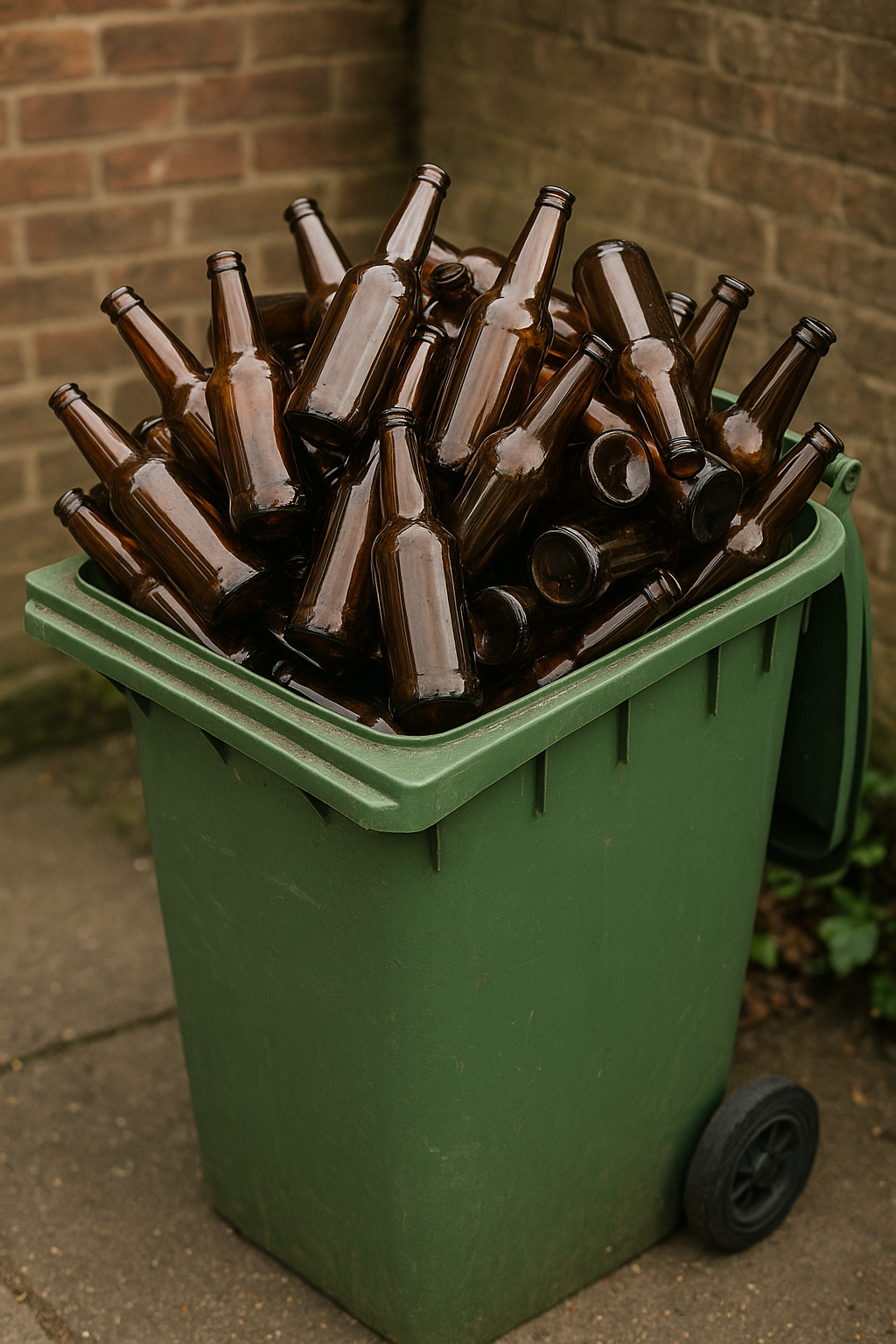
The most deafening prop was a mundane wheelie-bin pushed by Khayelitsha nurses. Inside: 270 brown glass bottles, the weekend trauma census at District Hospital. Every 50 metres they added another container, the clink-clank percussion dramatising real-time harm. By the time the bin reached the gates it overflowed, forcing a ministerial convoy to swerve around the glittering shards.
Calendars, Calculators, and the Next Performance
Treasury’s medium-term budget drops in October; committee pre-hearings start in June. SAAPA has already block-booked 25 buses for a return march branded “No Budget without Booze Reform.” Together with the Treatment Action Campaign they will train 300 community health workers to swamp the 30-day public-comment portal, a bureaucratic valve grassroots groups usually ignore. Medical Research Council boffins are crunching foetal-alcohol numbers timed to hit media two weeks before the finance minister’s speech.
Back in Gugulethu, Pamela Booysen rinses syrup off her sling and stores the costume in a Tupperware labelled “For the next time.” She laughs when asked for the performance tally. “Every show is the first for someone,” she says. “Change doesn’t begin with the whole bottle - only with one hand deciding not to lift it.”
[{"question": "
What is the main purpose of the Cape Town march?
", "answer": "The Cape Town march, organized by the Southern African Alcohol Policy Alliance (SAAPA), aims to advocate for increased alcohol taxation and stricter regulations. They propose a 20% surcharge on strong drinks, a floor price for pure alcohol, and an end to quantity discounts, with funds channeled into community safety and health initiatives. This is to mitigate the significant social and economic harms caused by alcohol abuse in South Africa."}, {"question": "Who participated in the march and how did they convey their message?
", "answer": "The march saw a diverse range of participants including organizers from SAAPA, community members from various townships like Manenberg, Khayelitsha, and Mitchell's Plain, as well as pensioners, primary-school girls (gumboot dancers), and community health workers. They conveyed their message through powerful symbols such as cardboard placards with slogans, a bedsheet cartoon depicting the harm of alcohol, performances illustrating alcohol-related violence, and a wheelie-bin filled with 270 empty brown glass bottles symbolizing a weekend's trauma cases."}, {"question": "What specific policy changes are the marchers advocating for?
", "answer": "The marchers are advocating for four key fiscal changes: a 20% ad-valorem surcharge on drinks stronger than five percent, phased over twenty-four months; channeling seventy cents of every extra rand into a ring-fenced \"Community Safety & Health Fund\"; eliminating quantity discounts (e.g., \"buy five crates, get one free\"); and setting a floor price of R1.20 for every 10 ml of pure alcohol. These measures aim to make alcohol more expensive and less accessible, particularly cheap, high-alcohol content beverages."}, {"question": "What are the current statistics and costs associated with alcohol abuse in South Africa?
", "answer": "Alcohol abuse in South Africa is linked to significant harm: it accounts for 44% of Groote Schuur Hospital's trauma beds from Friday to Sunday, is present in 56% of murder dockets, and contributes to 30,000 road fatalities annually. A 2023 University of Cape Town model estimates that a R12 beer triggers R47 in state clean-up costs. Furthermore, Nomisile Maputuka, a patrol commander, reported that 1,203 out of 1,847 after-dark domestic-violence calls since 2018 involved alcohol."}, {"question": "How do current alcohol taxation and licensing policies contribute to the problem?
", "answer": "While South Africa's excise rates appear high on paper, inflation has eroded their real value by 12% since 2015, while retail alcohol volumes increased by 9%. Licensing inconsistencies also fuel the problem; a Western Cape tavern permit costs R2,950 and takes half a year, whereas in Limpopo it's R500 and approved in 30 days. This discrepancy leads to \"licence tourism,\" where alcohol is sourced in provinces with laxer regulations and sold elsewhere. SAAPA proposes centralizing excise stamps to address this issue."}, {"question": "What are the next steps for SAAPA and its allies in their advocacy efforts?
", "answer": "SAAPA plans to continue its advocacy, including a return march branded \"No Budget without Booze Reform\" before Treasury's medium-term budget in October. They will also train 300 community health workers with the Treatment Action Campaign to participate in the 30-day public-comment portal for legislative changes. Additionally, Medical Research Council researchers will release data on foetal alcohol syndrome two weeks before the finance minister's speech, aiming to influence policy decisions."}]
Lerato Mokena is a Cape Town-based journalist who covers the city’s vibrant arts and culture scene with a focus on emerging voices from Khayelitsha to the Bo-Kaap. Born and raised at the foot of Table Mountain, she brings an insider’s eye to how creativity shapes—and is shaped by—South Africa’s complex social landscape. When she’s not chasing stories, Lerato can be found surfing Muizenberg’s gentle waves or debating politics over rooibos in her grandmother’s Gugulethu kitchen.
View all articles →