
Joint police-military exercise launches ahead of full deployment
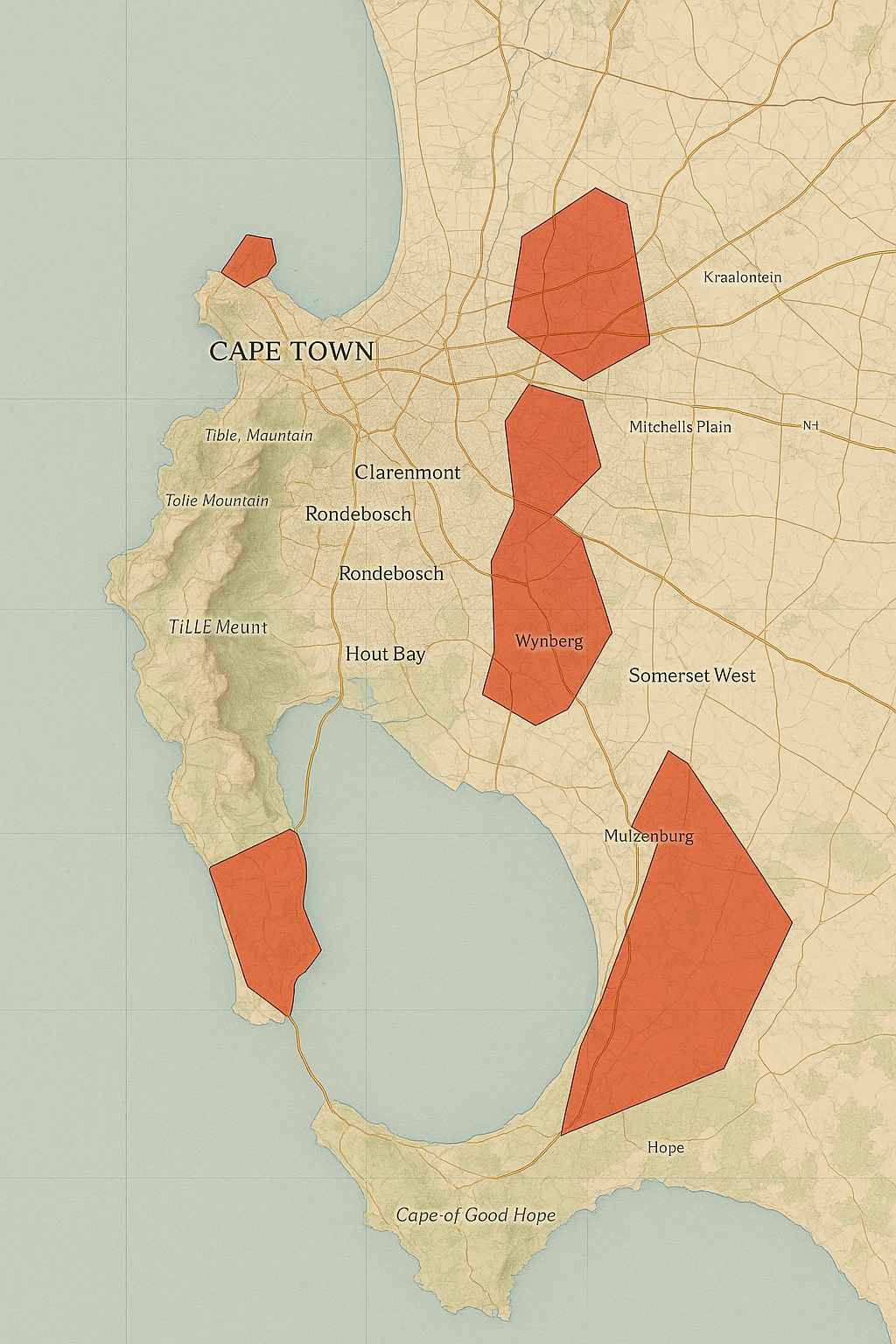
Cape Town rehearses for a massive civil-military crime suppression operation, using drones, civilian data, and new tactics against gangs.
Cape Town is getting ready for a huge crime fighting practice called "Operation Prosperity Scan." They're using helicopters, special tech, and even a student's app to find crime spots. The army wants more money, but there are talks about how much it will cost and how to keep people safe. This big plan hopes to stop crime without hurting the community.
What is Operation Prosperity Scan?
Operation Prosperity Scan is a civil-military crime sweep rehearsal in Cape Town, codenamed after Israel's "Kochav HaShahar" model. It involves 48-hour media blackouts, embedded reporters, and using community crime data to pinpoint micro-hotspots. The drill aims to deploy soldiers and technology to combat crime effectively.
Get Cape Town news in your inbox
Stay updated with the latest stories from the Mother City.
Section 1 – Sunrise over the Flats: a silent dress rehearsal
At 05:30 on 18 March the familiar Cape Town dawn chorus of taxis and seagulls was drowned out by the steady whomp-whomp of three Oryx helicopters.
The gun-metal grey birds lifted from Air Force Base Ysterplaat, split into a loose triangle and drifted above Manenberg, Hanover Park and Khayelitsha. Children climbed corrugated roofs for a better view; grandmothers clutched radios tuned to Voice of the Cape, waiting for the promised disclaimer that this was “only practice.”
Officialdom had learned its lesson from the July 2021 looting panic: if residents think the real thing has started, shops empty, taxi fares triple and stray gunshots multiply. Brigadier Novela Potelwa therefore fired off a midnight tweet: “Not the deployment - merely the dress run.” The same reassurance landed in nine official languages on ward-councillor WhatsApp groups.
The drill carried the codename “Operation Prosperity Scan.” Planners copied Israel’s “Kochav HaShahar” model: 48-hour media blackout on troop numbers, embedded reporters who hand in cellphones with taped lenses, and - an SA twist - one observer seat for every neighbourhood forum that could produce a certified crime logbook stretching back to 2020. Forty-seven forums qualified; thirteen of their delegates arrived in second-hand bullet-proof vests bought with stokvel savings.
Section 2 – Pin-pointing the enemy: from container to cloud map
Across the yard of Philippi police station a repurposed shipping container glowed with monitors. SAPS analysts superimposed 38 000 shot-spotter audio clips on a Google Earth layer last refreshed during the 2018 drought. Red measles-like polygons popped up: Lavender Hill, Beacon Valley, RR-Section, stretches of the N2 where gangs still spray trucks to force high-jack stops - an echo of Maputo’s ring-road corridor in the 1990s.
Army engineers asked for rooftop landing zones; metro cops wanted CCTV blind-spots; defence intelligence demanded the GPS co-ordinates of every informal petrol seller - those one-litre Coke bottles that double as Molotov nurseries. By lunch the master layer carried 812 “micro-hotspots,” each smaller than a soccer pitch. Granularity matters: in 2019 soldiers waited at the right street but the wrong end, letting dealers sprint three blocks and melt away.
Then a 19-year-old UCT coder, Aaliyah Williams, walked in with a laptop and a neon-pink 4G dongle. Her student-built app “GangTracker” polls 1 400 cheap Android phones handed to high-schoolers, asking nightly: “Did you hear gunshots?” A “yes” triangulates within 25 m. She offered to merge the civilian heat-map with the SAPS version under a Creative Commons licence. After a tense haggle, commanders agreed to use the data for “pattern validation” only. Within sixty minutes 112 new midnight-tavern flashes appeared - places the official layer had missed.
Section 3 – Parallel fronts, hidden costs and April’s ticking clock
While cameras chased helicopters, an air-force drone skimmed the derelict St Helena gold mine outside Welkom. The thermal eye counted 87 warm bodies 3 km underground at 04:00 and a stolen Eskom transformer glowing like a sunrise on the operator’s tablet. The same engineers who mapped gang alleys now calculate how many paratroopers can be shuttled south without gutting the Cape mission. Answer: 180 soldiers, two C-130s, one A400M, R2.4 million in jet fuel - enough to pay sixty social workers for a year.
National Treasury’s baseline allots R7.8 billion for “public order and safety.” Defence wants an extra R1.4 billion for a 12-month anti-crime surge, roughly R3.8 million a day. That covers 3 300 soldiers, 900 reservists, four helicopters, three fixed-wing aircraft and 45 vehicles. It ignores the R480 million needed to rebuild barracks wrecked in the 2021 riots. To soften the blow the ministry revived the 1998 “Section 100 Committees,” letting premiers veto troop movements if provincial social costs breach a secret ceiling. Premier Alan Winde insists every soldier be paired with a social worker; the army counters with one social worker per platoon - 78 instead of 3 300 - still under negotiation.
The High Court must still rule whether corner-shot rubber-bullet ricochets inside tin shacks amount to “excessive force.” Treasury must sign the re-allocation by 1 April. Gang graffiti in Lavender Hill already warns: “April Fool’s brings real guns - who’s the joke on?”
Section 4 – People, pesos and pixels: making force work without breaking society
Journalists on the Ysterplaat tarmac inspected new toys: six Milkor 380 drones with 35-hour endurance, thirty Mahindra Marksman armoured bakkies whose polymer-filled tyres seal when shot, and fifty corner-shot rifles able to fire around 90-degree angles - hardware already battle-tested in Medellín and on Israeli borders. Rules of engagement, however, still come from a 2013 directive mandating verbal warning, water cannon and 30-second pauses - protocols fantasy in a midnight shack shoot-out.
Civilian pockets will feel the presence too. A UWC working paper calculates every soldier pumps R1 900 a month into township haircuts, airtime and vetkoek - potentially R18.8 million over the cycle. Yet “moral-hazard rent” looms: spaza prices triple, job searches stall. The authors suggest soldier-only debit cards redeemable at formal retailers, mirroring Jordan’s refugee-coupon system.
Finally, the communication war. SANDF contracted a private firm to run “Operation Calm Voice,” a 60-second WhatsApp radio drama in isiXhosa, Afrikaans and Kaaps. Listeners follow “Gatvol Gert,” a reformed gangster who warns youths not to loot when patrols appear. A toll-free tip-line harvested 1 100 leads in 48 hours; one voicenote uncovered 35 explosive cartridges inside a Factreton Wendy house.
Ecuador’s recent surge shows what can go right - and wrong - when soldiers hit city streets: homicides down 35 %, extortion up 60 %. Cape Town’s planners vow to track those metrics daily, hoping that boots on the ground, eyes in the sky and data in the cloud can bend the crime curve without snapping the social fabric.
What is Operation Prosperity Scan?
Operation Prosperity Scan is a large-scale civil-military crime sweep rehearsal taking place in Cape Town. It's codenamed after Israel's "Kochav HaShahar" model and involves the deployment of soldiers, specialized technology, and data analysis to combat crime hotspots. The operation includes media blackouts and the use of community crime data to pinpoint specific problem areas.
What technologies and methods are being used in Operation Prosperity Scan?
The operation is utilizing a range of technologies and methods, including Oryx helicopters, Milkor 380 drones, Mahindra Marksman armoured vehicles, and corner-shot rifles. Data analysis plays a crucial role, with SAPS analysts superimposing shot-spotter audio clips on Google Earth. A unique addition is a student-built app called "GangTracker" which polls high-schoolers about gunshots, providing real-time civilian heat-maps to identify crime locations. The operation also uses embedded reporters and community crime logbooks.
Who is involved in planning and executing this operation?
Various entities are involved, including the South African Police Service (SAPS), the South African National Defence Force (SANDF), and potentially metro police. Planning incorporates lessons from past events, such as the July 2021 looting panic, to ensure community safety and communication. Community members are also involved, with neighbourhood forums providing crime data and delegates observing the drills.
What are the financial implications and challenges of Operation Prosperity Scan?
The operation carries significant financial costs. The SANDF is requesting an additional R1.4 billion for a 12-month anti-crime surge, which would cover thousands of soldiers, reservists, aircraft, and vehicles. This is in addition to the R7.8 billion already allotted for public order and safety. There are also debates about balancing military spending with social worker funding and the cost of rebuilding damaged barracks.
How is community safety and public perception being managed?
Officials are actively managing public perception and safety. Brigadier Novela Potelwa issued a midnight tweet and messages in nine languages to ward-councillor WhatsApp groups, assuring residents that the helicopter drills were "only practice" to prevent panic. Embedded reporters are part of the plan, and there's an initiative called "Operation Calm Voice" – a WhatsApp radio drama aimed at discouraging looting. There are also discussions about rules of engagement to avoid excessive force and concerns about the socio-economic impact on communities.
What are the potential impacts and goals of this operation?
The primary goal is to significantly reduce crime by targeting micro-hotspots with a combination of military presence and advanced technology. The operation aims to "bend the crime curve without snapping the social fabric." However, there are concerns about potential negative impacts, such as an increase in extortion (as seen in Ecuador's similar operations), the financial burden on taxpayers, and the delicate balance between military intervention and community well-being. The success of the operation will be measured by daily tracking of metrics like homicide rates.

Isabella Schmidt is a Cape Town journalist who chronicles the city’s evolving food culture, from Bo-Kaap spice merchants to Khayelitsha microbreweries. Raised hiking the trails that link Table Mountain to the Cape Flats, she brings the flavours and voices of her hometown to global readers with equal parts rigour and heart.
View all articles →