
Khayelitsha clinic struggles to meet the needs of growing population
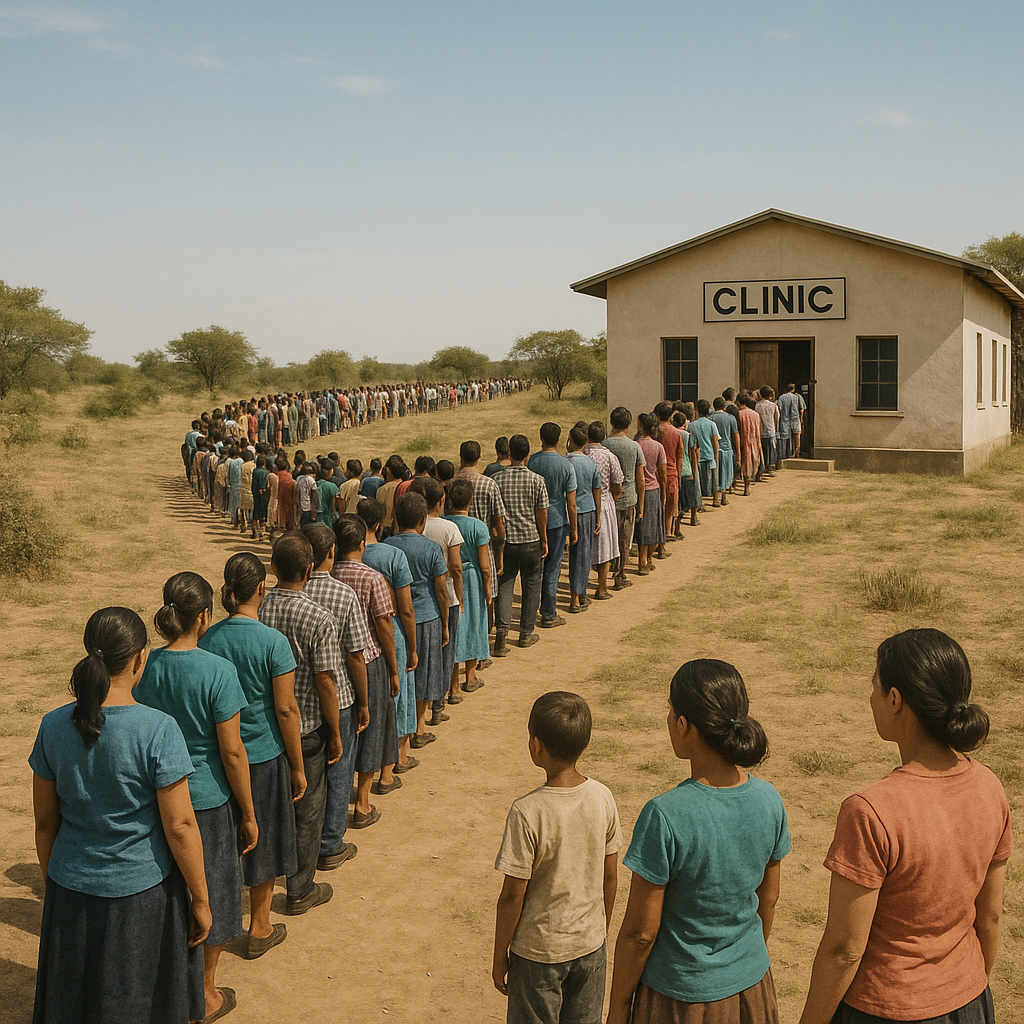
Nolungile Clinic faces extreme overcrowding, staff shortages, and systemic issues, forcing patients to endure long waits for vital care.
Nolungile Clinic is a place where hope and long waits collide. Patients wake before the sun, joining endless queues for basic healthcare, often facing medicine shortages and not enough staff. It's a tough daily fight for health in a clinic bursting at the seams, leaving people feeling lost and unheard under the big sky.
What challenges do patients face at Nolungile Clinic?
Patients at Nolungile Clinic endure excessively long queues, often waiting many hours from early morning. They also face frequent medication stock-outs, insufficient staff, and outdated facilities that struggle to serve a rapidly growing population. This leads to fragmented care and significant delays in essential health services.
Get Cape Town news in your inbox
Stay updated with the latest stories from the Mother City.
At the Gate Before Sunrise
A pale winter sun has barely lifted above the tin roofs of Site C when Nolungile Clinic’s entrance already looks like a busy taxi rank. Two uneven human columns snake from the front door, bend around brightly painted shipping containers that sell vetkoek and “loose” cigarettes, and finally dissolve among the hooting minibus taxis at the traffic circle. Folding stools, threadbare blankets and supermarket bags become unplanned seating for people who know dusk may find them still waiting.
Sibongiseni Nkenkane, a 39-year-old panel-beater from Lwandle, clutches ticket 202, stamped at 06:48. Each month he collects antiretrovirals for his seven-year-old. “The pill scares my son unless he sees me fetch it,” he says, sliding the child’s card from a frayed envelope. “If I leave to pick him up from school later, my place disappears. So the boy sits here too.” Last month he spent nine hours on the pavement only to be told at 16:55 that the dispensary had “run out of labels.”
Three steps away sits Amanda Ndovele on a cooler box, cradling a toddler whose forehead burns at 38.9 °C. Yesterday she secured a promised consultation with the lone doctor, yet at 16:15 she was waved off because “two doctors cannot possibly see 400 walk-ins.” Armed with the same yellow ticket and a neighbour’s promise to fetch her older children at sunset, she is back for round two. Her slip now reads 287.
Micro-City of Makeshift Solutions
The clinic forecourt resembles a mini township. Traders weave between legs offering loose sticks of cigarettes, vetkoek with polony and prepaid electricity vouchers. A man in a neon construction vest advertises “queue babysitting” for twenty rand an hour: he’ll keep your spot while you dash to the BP garage toilets. A laminated flyer advertises a WhatsApp group: Nolungile Patient Solidarity – queue updates in real time. It has already hit WhatsApp’s 1 024-member ceiling twice.
Inside the fence, yellow triage benches are packed shoulder to shoulder. A single nurse in maroon scrubs squeezes blood-pressure cuffs while a security guard yells “Next folder!” every half-minute. An NGO-donated queue screen freezes stubbornly on ticket 48; the pharmacy printer is out of ink. Behind the reception hatch a hand-written note pleads: “Speak slowly. We are short-staffed and under pressure.”
Every surface tells a story of improvisation: corrugated iron extensions, repurposed shipping containers, a fan held together with cable ties. The air smells of antiseptic mixed with the sweet dough scent from neighbouring spaza shops. Here, survival and bureaucracy intersect daily.
Numbers that Don’t Add Up
Site C’s official headcount jumped from 48 000 in 2011 to 81 000 in 2022, an almost seventy per cent leap driven by backyard shacks and rural in-migration. Yet Nolungile still fits inside its original footprint: eight consultation rooms, four counselling cubicles, one pharmacy window and a youth corner carved from a retrofitted container. The maths is brutal.
Western Cape Health’s own roster lists only 2 full-time doctors, 1 sessional physician who shows up twice a week, 2 newly qualified clinical associates, 15 professional nurses, 10 enrolled nursing assistants, 5 pharmacy staff and 9 allied professionals - dieticians, social workers and counsellors. Set against the national norm of 3.5 clinicians per 1 000 users, the clinic should employ 283 people; only 44 turn up daily. Each worker therefore serves roughly 409 residents every month.
Budget lines split awkwardly between provincial government (which pays staff and chronic-drugs) and the City (which handles refuse, environmental health and the youth-friendly corner). Last year provincial authorities bought a new ultrasound machine, yet City electricians took six months to sign off additional power supply, so the device sat boxed while pregnant women travelled seven kilometres to Khayelitsha District Hospital.
Lines, Shortages and Work-Arounds
Inside the tiny pharmacy storeroom, boxes of first-line HIV tablets and six-month insulin supplies reach the ceiling. Yet a bright yellow tag warns that depot-medroxyprogesterone - the two-month contraceptive injection - is out of stock until August. Pharmacists hand out combined oral pills as a bridge; uptake is low and some women fall pregnant while waiting.
Patients have invented elaborate coping mechanisms. Between 03:00 and 06:00 a “shadow queue” forms; names are scribbled on a communal sheet guarded by a community elder. When pharmacy stock-outs loom, colour-coded tickets printed by the Khayelitsha Health Forum help staff triage faster - until security confiscates the slips for “undermining official systems.” When a nurse calls in sick, a WhatsApp phone tree warns thousands within minutes: “Come only for emergencies.”
Abulele Dyasi, Eastern sub-district spokesperson, maintains the facility “meets its approved establishment.” Two extra doctors should arrive by October 2024 through a rural-allowance scheme. A R2.8 million extension will add two rooms and a shaded canopy, but first Eskom must certify an additional 50 kVA transformer - currently buried in red tape.
Parallels, Pilots and Possibilities
Globally, Nolungile’s queues echo “the inverse care law reloaded”: informal settlements swell while clinics are asked to deliver first-world chronic care on shoestring budgets. Nairobi’s Langata Health Centre saw daily visits leap from 400 to 1 200 after devolution; Kenya’s workaround was to franchise micro-clinics inside shipping containers. Brazil’s Family Health Strategy assigns interdisciplinary teams to 3 500 inhabitants apiece - still more generous than Nolungile’s ratio.
Local NGOs are testing miniature revolutions. Médecins Sans Frontières rented a neighbouring spaza and created the “Side-room Club,” where retired GPs see stable hypertensive patients on Saturday mornings, trimming 90 routine visits from weekday queues. Treasury lawyers are now assessing whether free care in a private room counts as unlawful outsourcing.
HealthKey, a local start-up, installed three refrigerated lockers on the grounds. Stable chronic patients receive an SMS once meds are ready and can collect 24/7. Early stats show average collection of 40 seconds, versus 67 minutes inside the building. The pilot hopes to divert 5 000 monthly pickups, but lockers still need formal stock approvals and user education.
Voices, Gaps and Data Shadows
Zuqaqambe Potwana, 64, squints through scratched lenses that should have been replaced last July. “They said, ‘Come back in August.’ August is cold again. How will I see puddles when it rains?” Bongani Mabanga, 55, survived a stroke in 2019 and now receives a two-week supply of amlodipine. “Stretch the stock, they say, but also don’t miss a dose. My heart is caught between two truths.”
No live dashboard tracks daily attendance or pharmacy stock. The District Health Information System uploads totals three weeks after month-end. A lone activist with a Google Form has crowdsourced 3 700 timestamps since May; peaks appear on Mondays and child-grant payment days. Forty-two per cent of users wait more than four hours; pharmacy queues peak between 11:30 and 15:00, the exact window when staff rotate lunch breaks.
Clinic posters remain mostly in English and Afrikaans, though isiXhosa dominates among 88 % of users. Consent forms for contraceptive implants are unavailable in braille or isiXhosa, so many women sign with a thumb-print yet cannot later recall side-effects they were warned about. A grassroots Women’s Health Club now shares isiXhosa voice notes via the “Intyatyambo” WhatsApp group, already reaching 2 300 women.
When the gates close at 17:00, Site C’s night-time economy keeps the adjacent taxi rank alive until 22:00. Sex-workers finishing their shift sometimes queue for post-exposure prophylaxis at 04:00, ahead of factory workers who need hypertension tablets. Security guards unofficially reserve chairs from the guard room for a five-rand coin or a shared pie.
Dreams, Quarries and Tomorrow’s Fault Lines
City planners earmarked a 5 000 square-metre plot two blocks north for a future “Wellness Hub” that would combine a clinic, gym and soup kitchen. Funding depends on a multilateral loan stuck in treasury since 2020. If built, projections show it will relieve Nolungile by just 18 % once fully operational in 2027 - a reprieve, not a rescue.
Demographers forecast Site C will exceed 100 000 residents by 2031, propelled by backyard shacks, new Breaking New Ground houses and an upcoming BRT feeder route. Already, some chronic patients “pharmacy-shop,” splitting prescriptions among three facilities to dodge stock-outs. Fragmented care undermines HIV viral suppression and diabetes HbA1c targets. Ambulances now take 42 minutes to transfer obstetric emergencies to hospital, up from 18 minutes in 2021.
Two corporate pharmacies, Clicks and Dis-Chem, opened within three kilometres, offering chronic dispensing to those on medical aid or who can pay cash. A 30-day supply of first-line HIV medication costs R215 - more than half the child-support grant. NGO surveys show fewer than 12 % of Nolungile users can afford this escape hatch.
In late 2023 the Springboks donated R1 million of their victory-parade funds to upgrade “sporting facilities.” Half was ring-fenced for an astro-turf pitch beside the clinic. While kickabouts have no direct impact on health, the NGO in charge quietly lets the clinic use the change-room containers as weekend overflow rooms. Over six Saturday mornings, volunteer UCT intern doctors diagnosed 110 flu cases and 38 new diabetics in those repurposed change rooms.
For now, each dawn begins the same: the rattle of gates, the shuffle of feet on cold concrete, the scent of rooibos in shared Thermos flasks. Nolungile remains both lifeline and labyrinth, a place where hope and bureaucracy grind together beneath an unforgiving Cape Flats sky.
[{"question": "
What is Nolungile Clinic and what are its primary challenges?
\nNolungile Clinic is a vital healthcare facility in Site C, serving a large and rapidly growing population. Its primary challenges include excessively long patient queues, frequent medicine shortages (stock-outs), insufficient medical and administrative staff, and outdated facilities that are struggling to cope with the high demand. This results in significant delays for essential health services and a general feeling among patients of being unheard.
\n","answer": ""},{"question": "How long do patients typically wait for services at Nolungile Clinic?
\nPatients at Nolungile Clinic often face extremely long waiting times, with many arriving before sunrise and waiting for several hours. Examples include a patient waiting nine hours to collect medication and another being turned away after waiting most of the day for a consultation, returning the next day for another long wait. This is exacerbated by the clinic's limited capacity and high patient volume.
\n","answer": ""},{"question": "What kind of informal support systems and coping mechanisms have emerged around the clinic?
\nDue to the severe overstretched resources, a \"micro-city of makeshift solutions\" has developed around Nolungile Clinic. This includes vendors selling food and essentials, individuals offering \"queue babysitting\" services, and informal WhatsApp groups for real-time queue updates. Patients also form \"shadow queues\" from 3 AM, managed by community elders, and use color-coded tickets from the Khayelitsha Health Forum to try and streamline triage, though these are sometimes confiscated.
\n","answer": ""},{"question": "What is the staffing situation at Nolungile Clinic compared to national norms?
\nNolungile Clinic is severely understaffed. While Site C's population has grown significantly, the clinic's staffing levels remain critically low. The clinic should ideally employ 283 people based on the national norm of 3.5 clinicians per 1,000 users for a population of 81,000. However, only 44 staff members turn up daily, meaning each worker serves approximately 409 residents every month, leading to immense pressure and compromised care.
\n","answer": ""},{"question": "Are there any initiatives or pilot programs being implemented to alleviate the pressure on Nolungile Clinic?
\nYes, several initiatives are being explored or implemented. Médecins Sans Frontières (MSF) runs a \"Side-room Club\" in a rented spaza shop, where retired GPs see stable hypertensive patients on Saturday mornings. HealthKey, a local start-up, has installed refrigerated lockers for 24/7 chronic medication collection, aiming to divert 5,000 monthly pickups. Additionally, the clinic sometimes uses repurposed change-room containers from an astro-turf pitch (donated by the Springboks) as weekend overflow rooms, staffed by volunteer intern doctors.
\n","answer": ""},{"question": "What long-term plans or future challenges are anticipated for Nolungile Clinic and the surrounding community?
\nCity planners have earmarked a plot for a future \"Wellness Hub\" intended to relieve Nolungile Clinic, though funding is pending, and it's projected to only relieve 18% of the burden by 2027. Demographers forecast Site C's population to exceed 100,000 by 2031, which will further strain resources. The lack of real-time data, language barriers in patient information, and the increasing cost of private healthcare alternatives for the majority of the population are also significant ongoing challenges. Fragmented care due to patients \"pharmacy-shopping\" and increasing ambulance transfer times for emergencies underscore the growing crisis.
\n","answer": ""}]
Hannah Kriel is a Cape Town-born journalist who chronicles the city’s evolving food scene—from Bo-Kaap spice routes to Constantia vineyards—for local and international outlets. When she’s not interviewing chefs or tracking the harvest on her grandparents’ Stellenbosch farm, you’ll find her surfing the Atlantic breaks she first rode as a schoolgirl.
View all articles →