
Paddler rescued after missing off Bloubergstrand
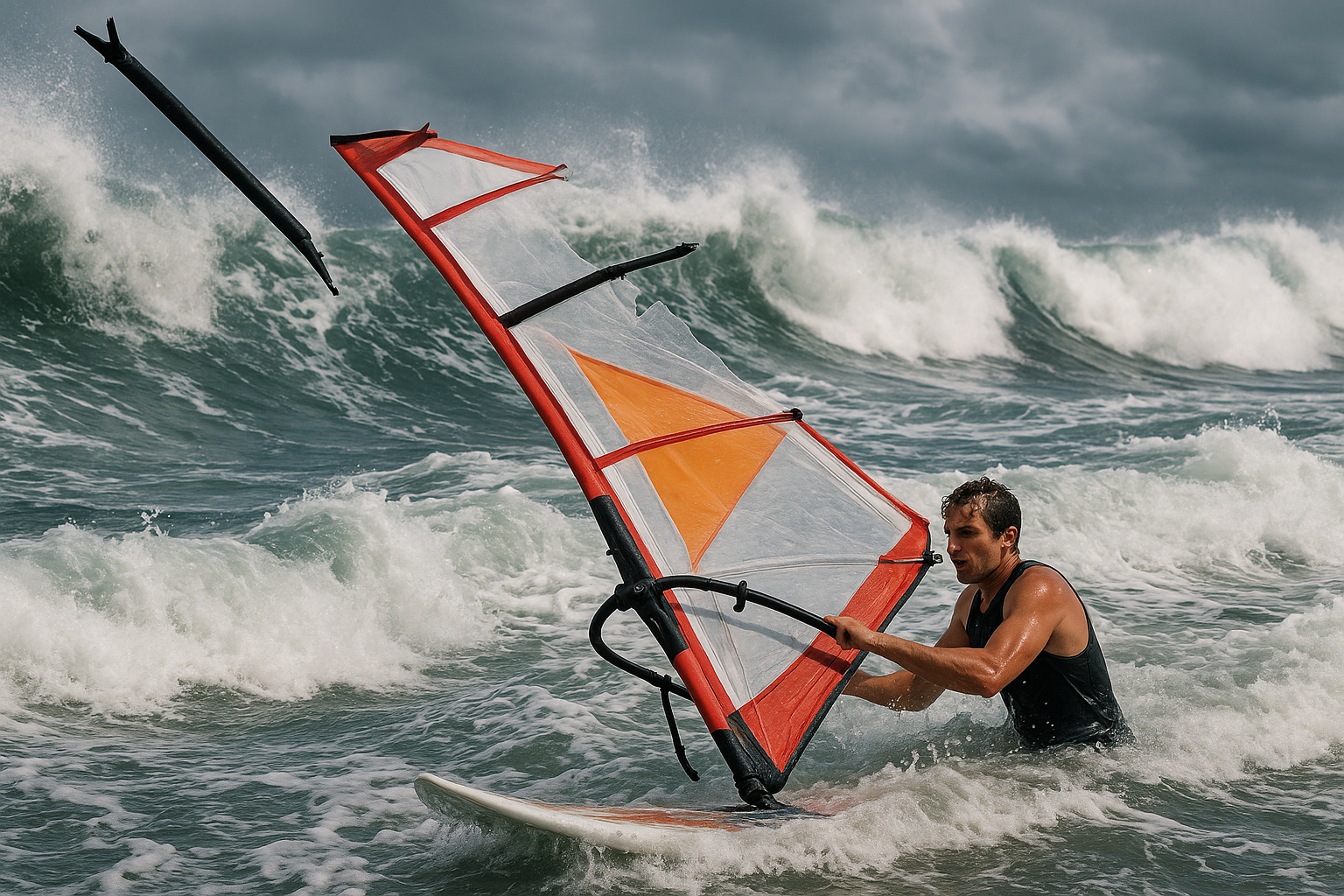
A windsurfer faces a life-threatening hypothermia incident off Bloubergstrand, triggering a multi-agency rescue operation.
A windsurfer named "Flame" got into big trouble when strong winds snapped his mast, leaving him freezing in the ocean. Luckily, many rescue teams, like the NSRI, police, and paramedics, worked super fast together. They used helicopters, drones, and boats to find him near some rocks. They pulled him out just in time, cold but safe, showing how amazing teamwork can save lives.
What happened during the Bloubergstrand rescue?
During a Bloubergstrand rescue, a windsurfer named "Flame" was caught in dangerous berg-winds, leading to his mast breaking and him becoming hypothermic. A coordinated effort by NSRI, Metro EMS, SAPS, and local volunteers located and rescued him using helicopters, drones, and rescue boats, highlighting the efficiency of multi-agency response to water emergencies.
Get Cape Town news in your inbox
Stay updated with the latest stories from the Mother City.
Midday Calm Shattered
Tuesday’s lunch hour ended with a dry northerly sliding down the Blaauwberg gap. The gusts herded kite-surfers south toward Dolphin Beach, so the broad water in front of Ons Huisie sat oddly quiet. At 14:17 a single windsurfer - blood-red sail sheeted tight for speed - pushed off the bar at Small Bay. On the sand he looked like just another athlete out for “a relaxed dash to the shipping lane,” as one beach stroller later recalled.
Behind that simple image lay layers of risk no one yet sensed. The sailor, a 43-year-old marketing consultant from Polokwane who had rented a cottage on Stadler Road for the past four months, was a weekend regular distinguished by a scarlet 4.4 m² Neil Pryde sail. Locals openly called him “Flame.” On weekdays, however, few recognised him; Tuesday’s ocean had fewer friendly eyes than usual.
Wind dynamics were already swinging violently. A shallow temperature inversion funnelled the breeze, making it shift twenty-five degrees in only sixty minutes. The South African Weather Service had fired off a small-craft warning at 13:30, but no loudspeaker reached the launch zone. A digital signboard beside the car park had crashed at 09:42 the previous day and still merrily promised “Moderate north-easterly - enjoy.” False comfort framed the setting.
Sudden Escalation and Panic Calls
By 14:52 the ocean had transformed. Swell periods collapsed to seven seconds, and Melkbosstrand’s automatic station reported sustained thirty-knot winds punching up to thirty-eight. Recreational kit simply cannot weather that load for long. Spectators watched Flame attempt a desperate tack toward land, the red sail stalling, then the mast snapping at the boom collar. Board and sailor parted company, the hull drifting east on the ebbing tide while Flame clambered aboard like a castaway, kneeling and punting with the broken mast instead of a paddle.
Fifteen minutes later his silhouette vanished behind rows of white-water crests. A runner on the dune path didn’t wait. At 15:11 she dialled South Africa’s universal emergency line, 112. Inside eighty-nine seconds the call bounced into the City of Cape Town Joint Operations Centre in Goodwood, where software immediately tagged it “water emergency,” ranked the threat level, and pushed location pins to every relevant agency.
While the caller was still breathing hard into her phone, the choreography kicked in. Pagers shrilled, VHF radios crackled, WhatsApp alerts pinged. No single person ran the table yet; instead, an algorithmic playbook choreographed the first wave of human responders.
Coordinated Chaos on Water, Sand and Sky
First Wave of Assets
NSRI Melkbosstrand answered at 15:13. The West Coast Rescue trailer already sat coupled and fuelled. One minute later Big Bay Surf Lifesavers received orders to spin up the twin-hulled Gemini. Metro EMS launched the EMS/AMS Skymed helicopter (BK-117 G-JOCA) at 15:15, lifting from Ysterplaat only eleven minutes later. At 15:16 SAPS Water Wing was told to warm the eThekwini-class RHIB Inkunzi at Table Bay Yacht Club, and at 15:17 the West Coast Coastwatchers WhatsApp group - seventy-eight members strong - sent a bilingual blast: “Red-sail windsurfer overdue, last seen 1 km NW Ons Huisie - eyes on!”
Shaping the Search
Rowan Marais, commander of NSRI Station 18, assumed on-scene leadership seven minutes after the first rescue craft arrived. Two clear legs formed:
- The Maritime Arc: West Coast Relief ran a 1.2 nautical-mile expanding square centred on 33°48′40″S, 18°28′12″E - the last known position.
- The Littoral Sweep: BBSL Gemini hugged the counter-current just outside the breakers, hunting debris and flashes of colour.
Birds and Drones Above
Skymed arrived overhead at 15:39, FLIR turret whirring. Air temperature was a mild sixteen degrees Celsius, but the sea still lingered at thirteen, creating a three-degree contrast that turned any human into a bright pixel. Simultaneously, four DJI Matrice 300 drones launched from Dolphin Beach parking lot. Flying a thirty-metre “lawn-mower” grid, they streamed live footage to the JOC. Shore teams added four jetskis between Big Bay and Melkbosstrand lighthouse; SAPS divers stood by for negative-buoyancy free-drops if deeper sweeps became necessary.
Pin-Point Recovery and Aftermath
Sighting and Penetration
At 15:46 the FLIR operator marked a heat signature wedged between two sandstone tongues dubbed Kids Rock - shallow, barnacled shelves only exposed at low tide. A shred of red fabric fluttered nearby. Coordinates shot across VHF channel 21: “Target stationary, 0.35 nm NNE of Ons Huisie lighthouse, twenty-eight metres from the break line.”
Because the reef was too shallow for the rescue craft’s keel, NSRI swimmer Liam de Kock - twenty-four-year-old paramedic - rappelled from West Coast Relief at 15:49. He reached Flame at 15:53, clipped in a short-tow, and confirmed consciousness but pronounced confusion. Core temperature read 29.4 °C via tympanic probe - deep into hypothermia.
Rapid Hoist and Beach Landing
Surf-zone recovery risked capsizing both swimmer and casualty, so De Kock secured Flame into a vertical strop and winched straight onto Skymed, burning only two minutes of the aircraft’s remaining fuel. Once stabilised, Flame transferred to the rescue boat, which beached at Small Bay at 16:11.
Triage and Transport
Medics stripped wet gear, wrapped Flame in a pre-warmed hypothermia kit, and tucked heat packs into armpits, groin and lateral chest. Although he shivered - stage II hypothermia - active core rewarming was postponed. Two litres of 0.9 % saline warmed to thirty-eight degrees Celsius ran through an inline heater. ECG leads revealed textbook Osborne (J) waves. Spine precautions stayed in place because altered mentation masked possible trauma. At 16:27 Metro EMS raced toward New Somerset Hospital on a fourteen-minute green-code run.
Lessons Carved in Foam and Sand
Technology Notes
Skymed’s FLIR pod - ZAR 8 million, 640×480-pixel long-wave infrared, thirty-power zoom - arrived via provincial disaster grants. NSRI’s four-week-old Sea-Truck rigid hulls (38 knots on twin 60 hp motors) earned their second live shout. Coastwatchers, founded in 1964 for shark spotting, now fields forty-eight percent female membership and real-time translation for Afrikaans, English and isiXhosa.
Policy and Gear Gaps
A 2022 CSIR study found that surface currents along the fifteen-metre contour can accelerate past 0.8 m/s under sustained thirty-knot berg-winds - double typical south-easter drift. The report urged an SMS alert system triggered automatically when AWS gusts exceed twenty-seven knots; red tape still stalls deployment.
On-scene debriefs surfaced human details. Flame’s phone, fully charged but zipped in a non-waterproof wetsuit sleeve, drowned within minutes, erasing any GPS trace. A surf-caster 300 m away owned a handheld VHF and could have provided an earlier bearing had he known which channel to monitor. NSRI’s newly donated dry-robes remained in central stores; medics improvised with silver blankets and café blankets.
Community Echo
By sunset, Stadler Road neighbours hung a bedsheet banner scrawled “Dankie!” outside the Big Bay clubhouse. Inside the foyer, a whiteboard lists every responder - dispatcher, barista, helicopter pilot - like a living poem. Flame’s identity remains private at his family’s request, yet a neighbour says his first full-sentence question on regaining lucidity was “Did they save my sail?” Somewhere between gear and gratitude, the Atlantic keeps tally of stories never quite finished.
[{"question": "What are \"Berg-Winds\" and why are they dangerous for watersports?", "answer": "Berg-Winds are strong, dry, offshore winds that occur in South Africa, often associated with a shallow temperature inversion that can cause rapid shifts in wind direction and intensity. They are dangerous for watersports like windsurfing and kitesurfing because they can quickly escalate, leading to unpredictable gusts and conditions that exceed the capacity of recreational equipment, making it difficult or impossible to return to shore safely. In \"Flame's\" case, these winds caused his mast to snap."}, {"question": "Who is \"Flame\" and what happened to him?", "answer": "\"Flame\" is a 43-year-old marketing consultant and a regular windsurfer in Bloubergstrand, known for his scarlet 4.4 m² Neil Pryde sail. During a windsurfing session, strong berg-winds caused his mast to snap, leaving him stranded in the ocean. He became hypothermic before being rescued by multiple emergency services."}, {"question": "What emergency services were involved in the rescue of \"Flame\"?", "answer": "The rescue of \"Flame\" involved a highly coordinated effort from multiple emergency services and volunteers. These included the National Sea Rescue Institute (NSRI) from Melkbosstrand, Metro EMS (Emergency Medical Services) with their Skymed helicopter, the South African Police Service (SAPS) Water Wing, Big Bay Surf Lifesavers, and local West Coast Coastwatchers who assisted with spotting and communication."}, {"question": "What technology and methods were used to locate and rescue \"Flame\"?", "answer": "To locate \"Flame,\" the rescue teams utilized advanced technology. The Skymed helicopter was equipped with a FLIR (Forward-Looking Infrared) turret, which detected his body heat against the colder sea temperature. Additionally, four DJI Matrice 300 drones flew \"lawn-mower\" grids, streaming live footage to the Joint Operations Centre (JOC). Once located between two sandstone tongues, an NSRI paramedic rappelled from a rescue craft, secured \"Flame,\" and he was then hoisted directly onto the Skymed helicopter due to the shallow reef conditions."}, {"question": "What were the immediate medical actions taken after \"Flame\" was rescued?", "answer": "Upon rescue, \"Flame\" was found to be deeply hypothermic with a core temperature of 29.4 °C. Medics immediately stripped his wet gear, wrapped him in a pre-warmed hypothermia kit, and applied heat packs. Although shivering, active core rewarming was postponed. He received two litres of 0.9% saline warmed to 38°C through an inline heater, and ECG leads revealed Osborne (J) waves, typical of hypothermia. Spine precautions were maintained due to his altered mental state, and he was transported to New Somerset Hospital for further treatment."}, {"question": "What lessons were learned from this rescue operation?", "answer": "Several lessons were learned. Technologically, the FLIR pod on Skymed and NSRI's new Sea-Truck rigid hulls proved invaluable. However, there were policy and gear gaps: a 2022 CSIR study recommending an SMS alert system for strong berg-winds was still awaiting deployment due to \"red tape.\" Flame's non-waterproof phone failed, highlighting the need for robust communication devices. Also, a nearby surf-caster with a handheld VHF could have provided earlier assistance if he knew the correct channel. The incident also underscored the importance of community involvement and the dedication of volunteers like the Coastwatchers."}]

Liam Fortuin is a Cape Town journalist whose reporting on the city’s evolving food culture—from township kitchens to wine-land farms—captures the flavours and stories of South Africa’s many kitchens. Raised in Bo-Kaap, he still starts Saturday mornings hunting koesisters at family stalls on Wale Street, a ritual that feeds both his palate and his notebook.
View all articles →