
SA faces a growing crisis as hundreds of prisoners remain on the run
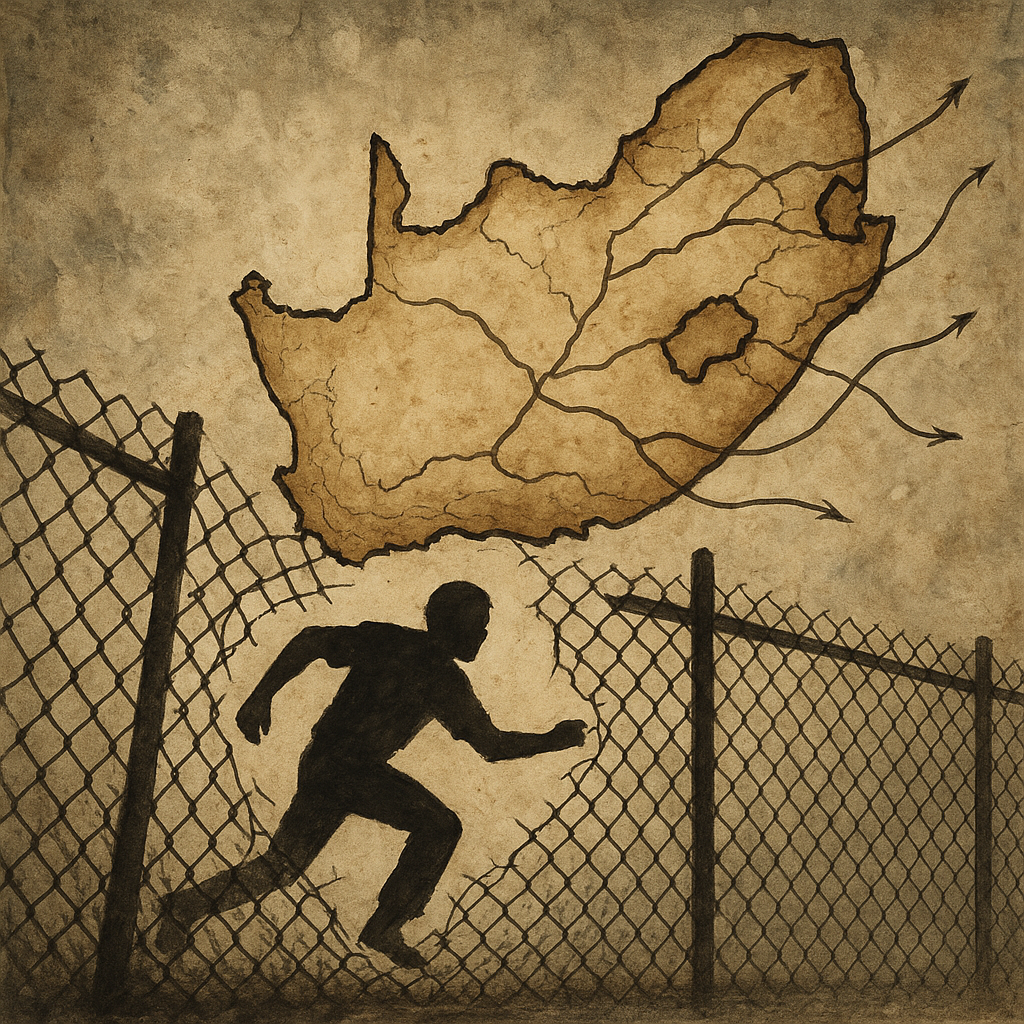
South Africa faces a rising prison-break crisis, with 284 escapes this year. Corruption, infrastructure failures, and border post vulnerabilities fuel a "vanishing fence" economy. Discover the anatomy of these escapes and the proposed solutions.
In South Africa, prisoners escape through 'walk-aways' (easy, low-cost escapes during transfers), 'Hollywood blasts' (violent, organized crime-funded breakouts), 'inside jobs' (corruption helped by staff), and 'rust & neglect' (using old, broken prison walls and fences). These ways of escaping are common because of corruption, old buildings, and money problems. The problem is getting worse, with more prisoners escaping each year.
How do prisoners escape in South Africa?
Prisoners in South Africa escape through four main methods: walk-aways (low-security transfers), Hollywood blasts (violent, organized crime-funded breakouts), inside jobs (corruption involving staff), and rust & neglect (exploiting crumbling infrastructure). These methods vary in cost, risk, and frequency, with walk-aways and inside jobs being common due to corruption and infrastructural decay.
Get Cape Town news in your inbox
Stay updated with the latest stories from the Mother City.
Inside South Africa’s Escalating Prison-Break Economy and the Border Posts That May Become Gates
1. Red Dots on a Map: When Stats Refuse to Behave
At 08:03 on 15 October 2024 the control room wall in Pretoria lit up like a Christmas tree on fire: 284 scarlet pin-pricks, every dot a living, breathing inmate who had wriggled out of state custody during the previous 365 days. The tally climbed 7.74 % above the year before even though the headline number of “break-out events” had actually dropped. Translation: fewer riots, bigger holes. Members of the Select Committee on Security and Justice stared at the paradox the way tourists watch a traffic light that stays red for too long - everyone knows it must change, nobody knows when.
Parliamentary clerks passed around a one-page brief that tried to soften the blow. It used phrases such as “concentrated failure nodes” and “negative safety dividend.” What it really meant was that South Africa is getting better at counting escapes and worse at preventing them. The chandelier above the committee table swayed slightly; the building itself seemed embarrassed.
A junior MP asked whether the 284 include the three prisoners who walked out of a rural police station the previous Sunday while the sole duty officer was buying chicken feet from a roadside vendor. The answer was yes - those three are already amber on the map, heading for grey.
2. Four Lanes Out of the Cage
SAPS analysts split every getaway into four business plans, each with its own price tag and risk profile.
-
Walk-Aways* – the discount aisle. Court cells, hospital wards, the back ramp of a state mortuary van: 41 % of all fugitives choose this low-cost option. A R1 500 handshake to an orderly, maybe R3 000 if the magistrate is running late and lunch smells good.
-
Hollywood Blasts* – the premium product. Only 11 % of incidents, but they come with explosives, AK rounds and a soundtrack of screaming tyres. Organised-crime brokers charge roughly R250 000 a head; cash-in-transit suspects pay a 50 % surcharge because their faces are already on highway billboards.
-
Inside Jobs* – the civil-service lane. Ghost dockets, filed-down locks, a forged SAPS 13 release form with the right embossed stamp: 27 % of escapes buy this package. Payment can be a bag of cell-phones, a fistful of Tik crystals, or a signed contract to eliminate a witness.
-
Rust & Neglect* – the freemium model. No bribe, just a century-old prison wall that finally crumbles, a CCTV camera that has not blinked since 2017, a perimeter fence used by local goats as scratching post. These exits account for 21 % of the total, yet they produce the highest recidivism: within ninety days almost two-thirds are back on the job, usually hijacking or house-breaking.
3. Highways That Move Tomatoes - and Fugitives
Criminals ride the same arteries that carry oranges, chrome ore and weekend tourists. A Civilian Secretariat heat-map overlays escape density on top of the N1 freight corridor: the reddest stripe starts at Musina, dips through Polokwane, slides down to Pretoria, then surfs the N3 to Durban before hopping onto the N2 “Wild Coast” towards the Eastern Cape. Those tarmac ribbons handle 78 % of cross-border freight, 81 % of seized counterfeit cigarettes, and - per the Financial Intelligence Centre - 92 % of dirty cash that re-enters the formal economy after rhino horn and abalone have been laundered into handbags and wristwatches.
One-hundred-and-twelve of the 284 absconders are labelled “border-prone.” They hold valid passports, have cousins in neighbouring countries or have already been deported once. If they reach the Limpopo River within two days their odds of permanent disappearance almost quadruple. The river is wide, the crocodiles are real, but the taxis on the other side run on time.
Committee members asked for a comparison graph: rhino-poaching arrests versus prison escapes. The curves overlap like lovers; nobody found the coincidence romantic.
4. One-Stop Ports: Fast Lane for Whom?
Dr Leon Schreiber’s One-Stop Border Post Bill landed twenty-four hours before the hearing. It promises 90-second clearance for travellers who smile at the camera and whose fingerprints match the cloud. Critics warn the algorithm will wave low-risk holidaymakers through while high-risk shipping containers bake in the sun - and that baked cargo sometimes includes people.
The committee wanted to know whether the new biometric turnstiles will talk to the prisoner-tracking dashboard in Pretoria. The honest reply: not in this financial year. SAPS AFIS still runs on software compiled when the first iPhone was a rumour; it chokes on real-time visa-overstay alerts. Until the two systems shake hands, a man who crawled out of Baviaanspoort on Monday can present a forged SADC laissez-passer at Beitbridge on Wednesday, and the red dot on the wall will simply fade to amber, then disappear.
Meanwhile, Treasury has ring-fenced R3.8 billion for border-modernisation, but the line-item for “inter-operability with corrections” is tucked into phase three, sometime after the digital-TV switch-off and the next general election. The gate may lift faster than the law can run.
5. The Price List Nobody Wants to See
Corruption Watch slipped a fourteen-page tariff sheet onto the committee table. It reads like a sushi menu from hell:
- “Lunch-break release” – R5 000
- “ID-tag switch with awaiting-trial detainee” – R12 000
- “Hospital escort, laundry-door exit” – R25 000
- “SAPS 13 warrant with embossed stamp” – R40 000
Rates are USD-pegged and jump 15 % every December when rural stations shrink to skeleton staff. Investigators traced the franchise as far west as Upington and as far east as Nongoma, indicating a supply chain more sophisticated than most fast-food brands.
The committee chair asked whether anyone had ever been convicted on the strength of the rate card. The silence that followed was thick enough to butter bread.
6. Gadgets versus Guts: An Arms Race in Slow Motion
SAPS dreams of 1 200 body-cams that can live-stream a court escort, 17 fixed-wing drones with ninety-minute stamina, four mobile cell-site simulators and a R1.8-billion RFID wristband tender. None has cleared Treasury vetting; all are parked in the same queue as new police boots and paper for photocopiers.
Escape networks, meanwhile, shop on Takealot and Wish. GPS jammers cost R1 300 and fit into a Coke can. Aluminium-foil courier pouches mute RFID pings for cents. A 3-D printer that retails for R5 000 can spit out a handcuff key in eighteen minutes; the plastic survives two twists, enough to pop the lock if the van overturns. The key dissolves in coffee if the plan fails - evidence gone before the investigator finishes the accident report.
The committee recommended a pilot where correctional workshops are scanned for printer serial numbers. Nobody explained how to police a device that can be dismantled faster than a Lego toy.
7. Women in Uniform: Trusted, Attacked, Scarce
Female officers comprise 31 % of SAPS but only 11 % of court-escort teams. Inmate surveys label them “too honest to bribe” yet “easy to overpower.” Numbers bear out the paradox: escapes involving all-female escorts show 40 % fewer corruption attempts and 60 % more physical assaults.
A draft policy wants mixed-gender teams for every Category-A detainee, but the union argues rostering by sex breaches labour law. The matter is now parked in the Commission for Conciliation, Mediation and Arbitration, where it will age like unpasteurised milk.
One MP asked whether arming female officers with tasers would close the strength gap. The reply came in acronyms: POP, BRT, BRT-II, none of which fit into a holster small enough for a woman who already carries body armour, radio, pepper-spray and the fear of being judged too weak.
8. Paper Chase: Discipline That Never Ends
Less than 28 % of SAPS disciplinary cases finish within the ninety days the law allows. The backlog stands at 4 878 files, 1 142 of them for “custodial negligence.” A single escape triggers four parallel probes - departmental, IPID, JICS, sometimes the SIU - each with its own docket, witness list and lawyer. Median legal cost per unfinished file: R87 000, billed to the taxpayer, not the officer, because the case is “still pending.”
The committee chair proposed outsourcing internal hearings to an independent tribunal modelled on military courts. That would need an amendment to the SAPS Act, a process that itself can take two parliamentary cycles and a white paper that no one has budgeted to write.
In the meantime, court calendars clog, witnesses withdraw, and escapees put kilometres between themselves and the paperwork that was meant to chain them.
9. Private Trucks, Public Danger
Since 2019 the Department of Correctional Services has outsourced 38 % of long-distance transfers to private security firms - G4S, Fidelity and assorted smaller brands. Contracts charge per kilometre and impose a R2-million escape penalty, yet the same fine print allows the contractor to bill SAPS for “force-majeure security upgrades” if the truck carries more than 75 % of design capacity.
The outcome is predictable: pack the vehicle until the springs groan, claim the upgrade, blame a burst tyre when someone slips out at a traffic light. In the past twenty-four months three such invoices - totaling R14.7 million - were paid in full, with zero prisoners recaptured. The committee requested the contracts; the department pleaded “commercial confidentiality.” The papers arrived heavily redacted, the blacked-out lines forming bars more secure than any the escapees ever saw.
10. The Limpopo 112: Gone but Not Forgotten - Just Forgotten by Law
Interpol keeps a quiet list titled “SA-ESC/LIM”: 112 South African escapees believed to have crossed a border river, a fence or a bribe-laden handshake. Forty-three are wanted for murder, twenty-seven for cash-in-transit robberies, eleven for rape. Their mug shots circulate on a WhatsApp group of seventy-two border officials spread across Zimbabwe, Botswana and Mozambique.
Yet South Africa last updated its extradition dossiers in 2022; Home Affairs blames a shortage of certified fingerprints. Result: a fugitive can be rearrested in Bulawayo, skip on US$200 bail, and resurface in Mozambique renting safe houses to new arrivals at US$50 a night, breakfast included. Themba “Double-T” Tsotetsi did exactly that; he now advertises rooms on a Facebook page that boasts 4.7 stars for “security and discretion.” The committee requested a bilateral extradition blitz; diplomats replied that the Mozambican attorney-general is on leave until after the local elections.
11. Counting the Cost of One Red Pixel
National Treasury budgets R1.02 million per medium-security inmate per year. When that person vanishes, the immediate manhunt bill - overtime, helicopter fuel, IPID investigation, court postponements - averages R370 000 inside the first thirty days. If the prisoner stays free beyond ninety days, witness protection and re-trial expenses push the contingent liability to R1.1 million. Multiply by the current 284 outstanding cases and the hidden invoice hits R390 million, enough to replace ageing CCTV at forty-two prisons or to fund the entire RFID wristband programme for a full fiscal cycle.
None of these figures show up in the main budget because they are classified “contingent” rather than “accrued,” the accounting equivalent of sweeping broken glass under the rug and hoping nobody walks barefoot.
12. Tomorrow’s Toys, Yesterday’s Bottlenecks
Behind closed doors the committee toyed with three pilots:
- A blockchain register that time-stamps every cell-door opening and links it to biometric scans of both prisoner and escort.
- An AI video layer that flags loitering near perimeter fences and auto-launches a drone to loiter at sixty metres.
- A community app that rewards citizens with data bundles for uploading geo-tagged photos of suspected escapees, the images fed into a Council for Scientific and Industrial Research facial-recognition engine.
All three demand the same missing ingredient: 5G spectrum inside correctional precincts, currently frozen until the national digital-television migration switches off old frequencies. Until that hurdle is cleared, the wall map will keep glowing red - 284 fugitives, 284 stories, 284 reasons why the fence is not a barrier but a revolving suggestion.
How do prisoners escape in South Africa?
Prisoners in South Africa employ four primary methods to escape: 'walk-aways,' which are low-cost escapes often during transfers; 'Hollywood blasts,' violent and organized breakouts frequently funded by criminal syndicates; 'inside jobs,' facilitated by corrupt prison staff; and 'rust & neglect,' where inmates exploit old, damaged, or poorly maintained prison infrastructure. These methods are prevalent due to underlying issues such as corruption, aging facilities, and financial constraints within the correctional system, contributing to an increasing number of escapes each year.
What are the different types of prison escapes in South Africa and their costs?
There are four main types of escapes, each with varying costs and risks. 'Walk-aways' are the cheapest, accounting for 41% of escapes, often costing R1,500-R3,000 for a bribe. 'Hollywood blasts' are high-risk, high-cost (around R250,000 per head, with a 50% surcharge for cash-in-transit suspects), involving explosives and firearms, making up 11% of incidents. 'Inside jobs' involve corruption, like forged documents or filed locks, representing 27% of escapes and paid for with items like cell phones or drugs. Finally, 'rust & neglect' are 'freemium' escapes (21%), exploiting dilapidated infrastructure without direct bribes, though these escapees have the highest recidivism rate.
How many prisoners escaped in the last year, and what does this indicate?
In the 365 days leading up to October 15, 2024, a total of 284 inmates escaped from state custody in South Africa. This figure represents a 7.74% increase from the previous year, despite a decrease in the number of 'break-out events.' This paradox suggests that while large-scale riots might be less frequent, the system is becoming less effective at preventing individual escapes, indicating a growing problem with

A Russian-Spanish journalist and Cape Town native, channels his lifelong passion for South Africa into captivating stories for his local blog. With a diverse background and 50 years of rich experiences, Serjio's unique voice resonates with readers seeking to explore Cape Town's vibrant culture. His love for the city shines through in every piece, making Serjio the go-to source for the latest in South African adventures.
View all articles →