
SARB unveils special R2 and R5 coins marking historic milestones
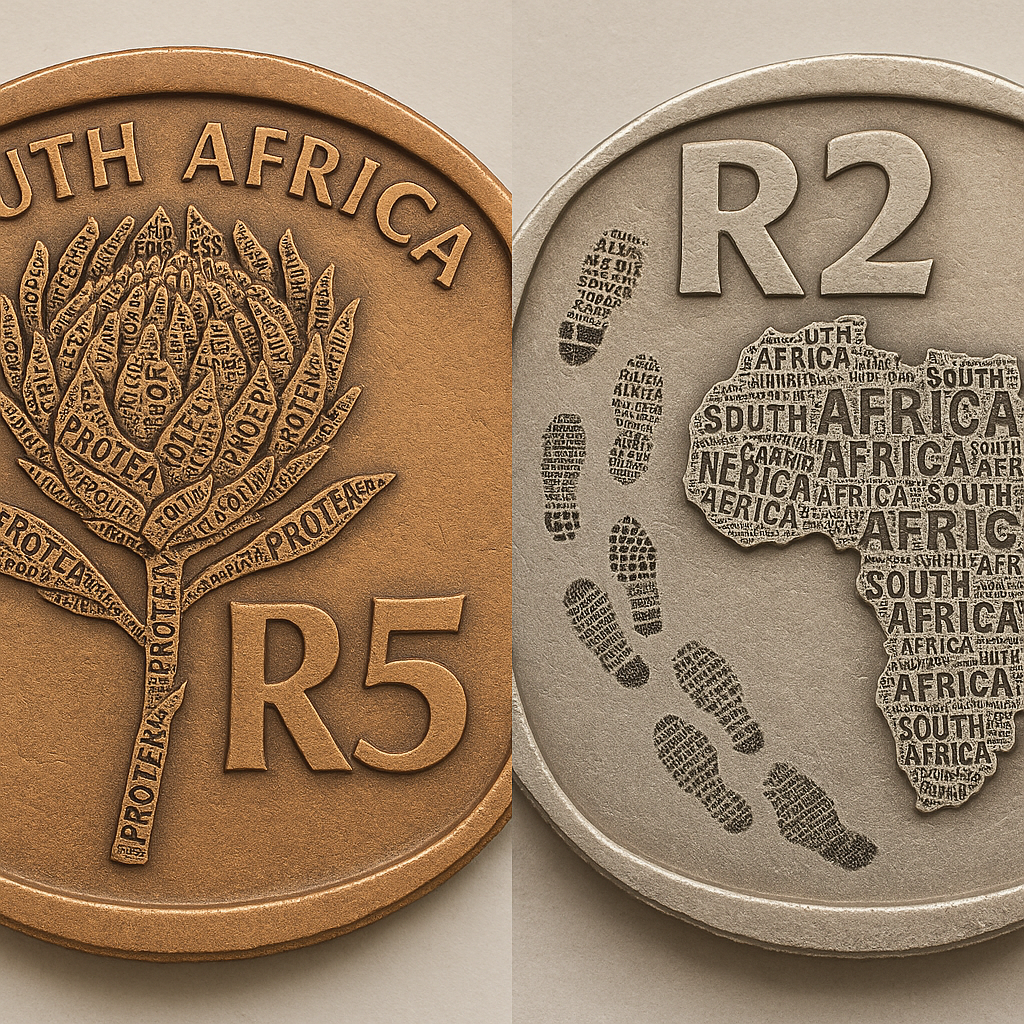
Explore South Africa's 2026 commemorative R2 and R5 coins, celebrating education and democracy with unique designs and historical significance.
South Africa is getting amazing new coins in 2026, marking 50 years since the Soweto Uprising. These special R2 and R5 coins will tell stories of brave students and the country's journey to democracy. They're like tiny history books you can hold, teaching everyone about South Africa's past and hopeful future, making every purchase a lesson.
What is the significance of the new South African coins being released on June 16, 2026?
The new South African R2 and R5 coins, released on June 16, 2026, commemorate the 50th anniversary of the Soweto Uprising. They tell stories of education, resistance, and the constitutional project, turning everyday transactions into lessons about South Africa's democratic history and future, ensuring these narratives circulate widely.
Get Cape Town news in your inbox
Stay updated with the latest stories from the Mother City.
How a handful of everyday coins will rewrite the national narrative on 16 June 2026
The Day the Past Becomes Pocket-Sized
Sixteen June has always carried the ache of history: the morning in 1976 when thousands of Soweto schoolchildren rejected Afrikaans as the language of their classrooms and, in one defiant stride, altered the moral course of the country. Exactly half-a-century later, the South African Reserve Bank will place new coins into circulation on that same date. Every R2 and R5 that passes through a vendor’s palm, a taxi owner’s pouch or a church offering bowl will carry layered storytelling about education, resistance and the constitutional project.
The deliberate timing is more than symbolism. By synchronising release with Youth Day, the Bank turns every marketplace into a pop-up classroom. No extra museum ticket is required; the lessons will jingle in shoppers’ pockets and clatter in school tuck-shop tins. Each coin is struck to circulate for at least five five years, ensuring that the anniversary will echo far beyond the speeches and marches of a single morning.
Bank executives insist this is not nostalgia packaged as numismatics. Instead, it is an active invitation to remember that democracy was not granted - it was demanded, debated, bled for and, above all, learned into existence. The coins therefore speak to the present as much as to the past: their arrival is timed to coincide with the public-exam period in 2026, a coincidence educators expect to exploit when students reach for change to buy post-paper vetkoek.
Three Stories for Two Rand, One Story for Five
Sub-Series One: The R2 Trio
Design team leaders decided early that no single image could contain the breadth of South Africa’s struggle for learning, so they created three separate but interlocking narratives.
First coin - “Footsteps of ’76” - captured from a bird’s-eye view, children walking single-file. The elongated shadows fuse into the outline of the national map. Along the rim, almost invisible without magnification, run the first names of the ten learners shot at Orlando West. The effect is subtle and chilling: names that could have belonged to any classroom roll-call now become the border of the country they died to redefine.
Second coin - “The Torchbearer” - gives centre stage to Charlotte Maxeke, South Africa’s first black female graduate. She raises a graduation cap in her right hand, but her left hand cradles an open book whose fluttering pages turn into ascending doves. Beneath her elbow sits the seal of Wilberforce University, the U.S. institution that conferred her degree in 1901. Designers refused to airbrush her into hagiography: her determined squint and high cheekbones remain intact, a choice they defended as “historical honesty over cosmetic diplomacy”.
Third coin - “The Living Document” - offers the Constitution as machinery rather than monument. Thirty interlocking gears form the numeral “30”, reminding citizens that clauses only function when people keep them moving. A latent-image security feature reveals the words “We the People” when the coin is tilted toward light, a wink to anyone patient enough to look twice.
The R5: A Constitution You Can Spin Between Your Fingers
Where the R2 coins dissect the past, the R5 integrates it. A single King Protea dominates the reverse, but closer inspection reveals that each petal is composed entirely of micro-printed text: the Constitution’s Preamble reproduced in all eleven official languages, spiralling outward from the stigma like a linguistic fingerprint. Circling the rim, three miniature icons reprise the trio of the R2 coins: a marching footprint, a mortarboard, and a gear wheel. The breast of the Protea is textured to feel like the surface of an open book, another tactile nod to inclusivity.
From Idea to Edge: Forty-Four Months of Collaboration
A public call in mid-2023 flooded the Currency Issue Technical Committee with more than 1 200 proposals - some scrawled on napkins, others accompanied by three-ring binders thick with footnotes. A small advisory group - historians from Fort Hare, constitutional-law scholars from Wits, industrial-design students from Tshwane University of Technology - shrank the stack to six milestones. Cabinet then endorsed three separate R2 themes and asked the R5 to serve as a unifying canvas.
The South African Mint in Centurion began striking 35 million blanks - nickel-plated steel for the R2, bi-metal for the R5 - built to endure two decades of daily abrasion and still emerge legible. The alloy for the R2 contains ninety-four percent recycled scrap metal salvaged from dismantled mine headgear in Gauteng, trimming the carbon footprint of the entire run.
Throughout 2024, open-studio sessions in Soweto, Makhanda and Cape Town invited residents to scratch motifs into clay blanks. Patterns of marching feet and open palms recurred so insistently that designers froze them as core elements. Schoolchildren, pensioners and taxi washers left literal fingerprints in the design process; those fingerprints have been translated into subtly textured fields on the final coins.
Security, Sustainability and Sightless Access
The Mint added three fresh anti-fraud layers. First, a micro-engraved QR-type lattice you need a 200× loupe to even locate. Second, a colour-shifting ring on the R5 that flips from forest green to gold when you rotate the coin. Third, laser-etched outlines of the national coat of arms at the three and nine o’clock positions of every R2. No single device is the gatekeeper; together they deter but do not intimidate.
Blind users can still tell their change apart. R2 coins feature reeded edges in two distinct counts: seven ridges for the 1976 theme, twelve for the 1901/2021 motifs. The R5 keeps the familiar interrupted reeding, so fingertips alone can separate the denominations.
Environmental credentials did not arrive as an afterthought. The Mint switched to closed-loop water polishing, saving 1.2 million litres compared with earlier commemorative runs. Album covers are printed on sugar-cane paper embedded with marigold seeds; once the folders outlive their usefulness, owners can plant them in damp soil.
Curriculum, Commerce and the Wider Ripple Effect
Education Beyond the Mint
Come June 2026, the Department of Basic Education will tuck a fold-out pamphlet into every matric exam pack. One side maps how each coin links to the syllabus - Grade 9 covers the Soweto uprising, Grade 11 studies Maxeke’s activism, Grade 12 interrogates constitutional supremacy. A QR code on the pamphlet launches an augmented-reality module in which the coins explode into holograms narrated by teenagers speaking Setswana, isiXhosa and Sepedi.
Retailers as Reluctant Historians
Shoprite and Pick n Pay have upgraded coin counters to recognise the new edge profiles. When the software detects a Youth Day coin, the cashier’s screen flashes a single trivia nugget - dates, names, GPS coordinates of Morris Isaacson High School - before the till drawer snaps open. A pilot programme at Soweto’s Bara Mall logged an average of twelve customer questions per cashier per shift in late 2025, turning minimum-wage workers into accidental tour guides.
Parallel Anniversaries and Pan-African Echoes
The coin release is only the opening chord. Nine August 2026 will mark seventy years since the 1956 Women’s March; a sterling-silver proof set of the same designs - limited to 30 000 pieces - will retail at a premium whose profits fund bursaries for women in technical trades. Post offices will issue stamps bearing micro-printed excerpts from Maxeke’s 1918 address to the Transvaal Native Congress. The African Union has already named its new virtual university portal after Maxeke, and South Africa’s everyday currency now amplifies that continental conversation.
After 2026: From Circulation to Continuation
A 1 000-Kilometre Life Cycle in One Day
Picture a Tuesday in July 2026. A Grade-10 learner in Mdantsane buys an orange for R2.50 and pockets a “Footsteps of ’76” R2 in her change. The stall owner tips a taxi driver with that same coin plus a “Torchbearer” R2 by late afternoon. By dusk the Maxeke coin rattles in a shebeen’s pool-table float, and by midnight the original Soweto coin lands in a church collection plate, twenty kilometres and six pairs of hands removed from its first transaction. Every handoff is a miniature lesson.
Phased Retirement and Second Lives
The Reserve Bank commits to letting the coins live their full five-year circulation cycle. Worn pieces that no longer trigger vending-machine sensors will be withdrawn gradually and melted down. The recovered metal will be recast as medals for the national Teaching Excellence Awards, ensuring that metal once used to honour learning continues to celebrate it.
Global Comparison and Future Templates
Only a handful of countries have dared to embed constitutional anniversaries into everyday currency. Canada’s 1982 nickel dollar saluted its patriated charter; Mexico’s 2017 10-peso honoured a centenary constitution. Both issues relied on base metals rather than silver or gold, a precedent South Africa follows, ensuring that history remains in daily circulation rather than locked away in velvet boxes.
The Easter Egg for UV Torch Owners
Hold any “Footsteps of ’76” coin under ultraviolet light and the national outline glows faintly. The fluorescing ink is not random graffiti; it reveals the precise GPS coordinates of the Morris Isaacson High School assembly point - 26° 14′ 21″ S, 27° 54′ 26″ E. Numismatists already call it the best pub-quiz cheat since the 2002 Krugerrand privy mark.
Three years out, the coins are still in crates stacked high at the Centurion vault. Yet their story is already racing ahead - loaded into school printers, coded into point-of-sale software, planted in albums that will one day burst into marigolds. On 16 June 2026 they will finally reach the smallest purse, the smallest palm, and begin that quiet, ceaseless work of teaching without a classroom.
[{"question": "What is the significance of the new South African coins being released on June 16, 2026?", "answer": "The new South African R2 and R5 coins, released on June 16, 2026, commemorate the 50th anniversary of the Soweto Uprising. They tell stories of education, resistance, and the constitutional project, turning everyday transactions into lessons about South Africa's democratic history and future, ensuring these narratives circulate widely."}, {"question": "What are the designs featured on the new R2 coins?", "answer": "The new R2 coins feature three distinct designs. The 'Footsteps of \'76' coin shows children walking in single-file, with their elongated shadows forming the outline of South Africa, and the first names of ten learners shot at Orlando West along the rim. The 'Torchbearer' coin depicts Charlotte Maxeke, South Africa's first black female graduate, holding a graduation cap and an open book with pages transforming into doves. The 'Living Document' coin illustrates the Constitution as machinery, with thirty interlocking gears forming the numeral '30', and a latent security feature revealing 'We the People' when tilted."}, {"question": "What is unique about the design of the new R5 coin?", "answer": "The new R5 coin features a prominent King Protea, where each petal is micro-printed with the Preamble of the Constitution in all eleven official languages, spiraling outwards. The rim includes miniature icons from the R2 coins: a marching footprint, a mortarboard, and a gear wheel. The breast of the Protea is textured to feel like an open book, providing a tactile element."}, {"question": "How are the new coins designed to be accessible and environmentally friendly?", "answer": "The coins are designed with accessibility in mind for visually impaired users; R2 coins have distinct reeded edges (seven ridges for the 1976 theme, twelve for the 1901/2021 motifs), and the R5 retains its familiar interrupted reeding. Environmentally, the R2 alloy includes 94% recycled scrap metal from dismantled mine headgear, and the South African Mint uses closed-loop water polishing. Additionally, album covers for the coins are printed on sugar-cane paper embedded with marigold seeds, allowing them to be planted after use."}, {"question": "What security features do the new coins incorporate?", "answer": "The new coins incorporate three fresh anti-fraud layers. A micro-engraved QR-type lattice requires a 200x loupe to locate. The R5 coin features a color-shifting ring that flips from forest green to gold when rotated. All R2 coins have laser-etched outlines of the national coat of arms at the three and nine o'clock positions. For a fun 'Easter egg,' holding any 'Footsteps of \'76' coin under UV light reveals the precise GPS coordinates of Morris Isaacson High School."}, {"question": "How will these coins be integrated into education and retail?", "answer": "The Department of Basic Education will provide pamphlets with matric exam packs, linking each coin to the curriculum and offering a QR code for an augmented-reality module narrated by teenagers in various languages. Retailers like Shoprite and Pick n Pay are upgrading coin counters to recognize the new edge profiles, triggering trivia nuggets about the coin's history on cashier screens. This aims to turn everyday transactions into educational moments and cashiers into 'accidental tour guides.'"}]

Lerato Mokena is a Cape Town-based journalist who covers the city’s vibrant arts and culture scene with a focus on emerging voices from Khayelitsha to the Bo-Kaap. Born and raised at the foot of Table Mountain, she brings an insider’s eye to how creativity shapes—and is shaped by—South Africa’s complex social landscape. When she’s not chasing stories, Lerato can be found surfing Muizenberg’s gentle waves or debating politics over rooibos in her grandmother’s Gugulethu kitchen.
View all articles →