
Search continues after Cape Town teen disappears at Monwabisi Beach
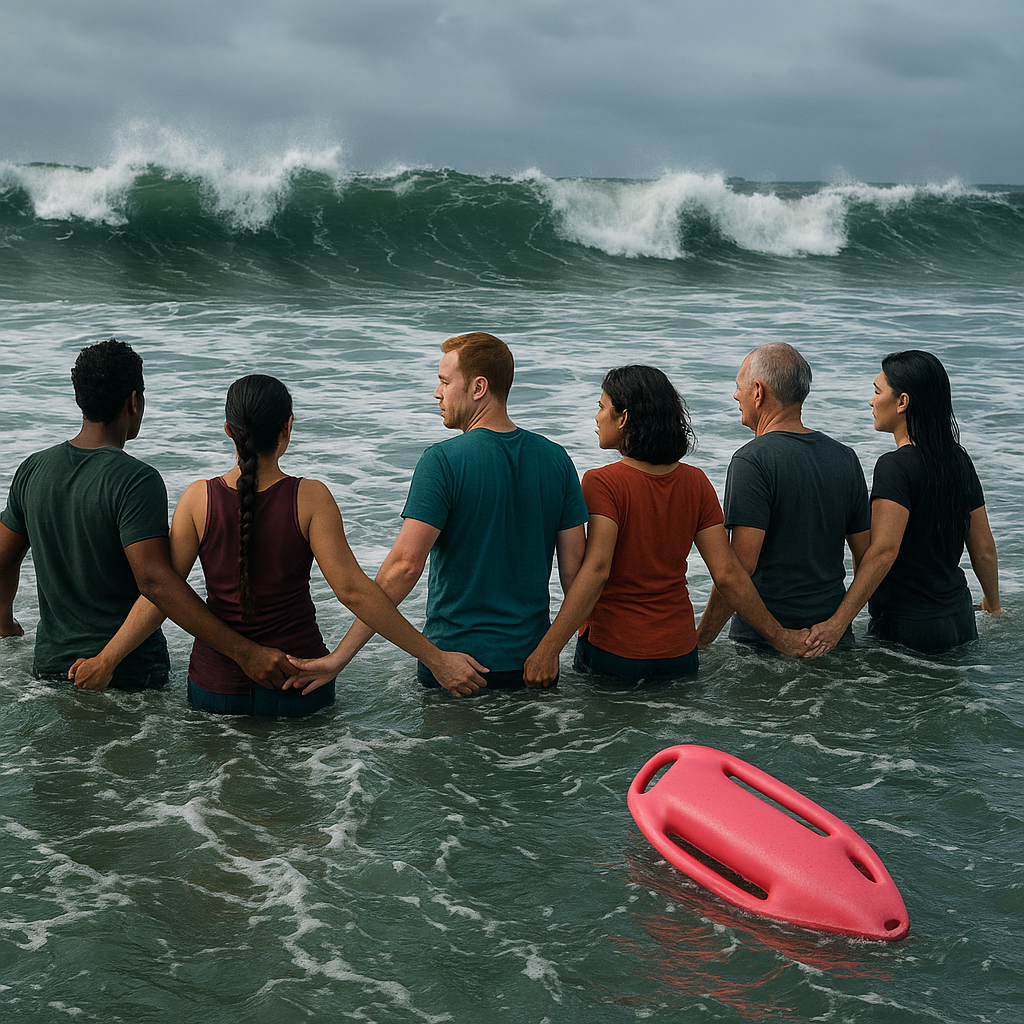
A human chain forms to rescue five teens caught in a rip current at Monwabisi Beach, highlighting the hidden dangers of the ocean.
This story plunges you into the heart of a rip current crisis at Monwabisi Beach, where five friends face the ocean's deadly power. Despite a community's brave human chain and frantic rescue efforts, one boy, Lwandile, is tragically lost to the unforgiving waves. The narrative highlights the critical lack of awareness, resources, and understanding of rip currents, leaving many vulnerable. It's a poignant reminder that while the ocean offers beauty, it also holds hidden dangers that demand respect and preparation.
What is a rip current and how does it form?
Rip currents are powerful, narrow channels of water moving swiftly away from the shore. They form as excess water piled up on the beach by waves seeks an exit, often through incisions in sandbars. These currents can reach speeds comparable to a competitive swimmer, carrying individuals far offshore.
Get Cape Town news in your inbox
Stay updated with the latest stories from the Mother City.
Dawn Over False Bay
Monwabisi Beach wakes up early. At 09:42 on this particular Saturday, a bleached winter sun skims the dunes, burnishing them the colour of millet porridge. The notorious “Cape Doctor” – the south-easterly wind – rattles pennants above the lifeguard tower as gulls shriek and wheel over empty chip packets. Grandmothers in pastel head-wraps already parade the boardwalk, though the weekend has has barely sounded. From Khayelitsha’s Bongweni lanes to Philippi’s gridlocked avenues, minibus taxis pop their doors and spill families clutching umbrellas and cooler boxes. No one notices the tide has stolen a thirty-minute march on schedule.
Beneath what looks like an ordinary shoreline, sandbars cut secret trenches. Between each third wave the sea lies eerily flat – a tell-tale runway that funnels excess water seaward at treadmill speed. Local kids recite a playground rhyme: “When the sea goes dark, keep your feet on the mark.” Today the Atlantic glints bottle-green, a shade that hides rather than reveals.
Lifeguards are off-season. Forty-two bright-pink rescue buoys stand in aluminium cages, each stamped with three-language pictograms, yet fewer than three out of ten visitors grasp the instructions. December-to-March cover, budget cuts, and sand that reshapes itself overnight leave the rest of the year to chance.
Five Boys, One Fateful Sprint
Lwandile Mqalo – seventeen, lean, and the only one of his group to finish a fifty-metre dash in a municipal pool – leads his four friends beneath the milkwood trees. They stuff two knotted plastic shopping bags into their pockets for makeshift float boards and set their finish line at a bobbing yellow buoy eighty metres out. Akhona, Sibulele, Ayabonga and Thando never made it past holiday splash lessons; to them the pool certificate in Lwandile’s wallet is proof enough.
At 10:52 they splash in shoulder-to-shoulder. Four minutes later the conveyor claims them. Sibulele kicks hard, remembers “swim sideways,” but the rip pivots and screws him like a bottle-top. Lwandile, five metres ahead, shouts “Back! Go back!” yet each stroke is a losing tug-of-war against a 2.5-metre-per-second current. Their screams switch from bravado to terror. Picnickers lower phones, uncertain whether this is play or panic.
On shore, boardshorts-clad Odette Van Reenen and hip-hop producer “Sketch” abandon their own boards and sprint. An unknown man in faded trunks rips the pink rescue buoy from its pole and races ahead, barefoot, hollering in isiXhosa: “Grab the rope part!” Behind them, wire-braai-mielie hawkers link arms; a grandmother swaddles a trembling boy in her sarong. Candle-bright Nokia screens blink SOS toward lifeguards half a kilometre away.
Dragged Ashore, One Still Missing
Eleven minutes after the first scream, Akhona rolls onto the sand with the pink buoy wedged under his arms. Three surfboards follow, ferrying Sibulele and Ayabonga. Boys cough up salt water and yellow bile while off-duty medics listen for the crackling “rice-krispies” sound that signals seawater in alveoli. Paramedics tag all four as non-fatal drownings with racing pulses and glassy eyes.
Lwandile is not among them. Thirty metres beyond the break, a final wave lifts him, silhouettes his outstretched hand, then folds him into indigo. The south-easter smothers the next shout.
Word rockets across WhatsApp groups. The NSRI Strandfontein crew launches JetRIB 1 - an inflatable twin-engine craft that can skim ankle-deep water - at 11:13. A police WaveRunner relays GPS pins from a hobby drone; helicopter Red 7 cuts metallic circles overhead. Divers rotate in pairs, twenty-minute bottom times, weighted milk-bottles marking lanes. At 14:04 a pod of dolphins arcs through the cordon; for thirty seconds every heart stops, then the animals surf on, indifferent.
Science, Statistics and the Missing Pieces
Rip currents are not mythical “undertow.” They are surface escape valves for water piled ashore by waves. On Monwabisi the recipe is textbook:
- 1.8 m easterly swells
- surplus water mass seeking an exit
- 40–60 cm incision channels carved through sandbars at mid-tide
- exit speeds rivalling Michael Phelps in full flight
- a 200–300 m drift before the swimmer senses disaster.
Lwandile becomes the twelfth False Bay fatality this year, the fourth at Monwabisi since January. City logs show 47 rip-related incidents every warm season. Winter storms shuffle 80 000 m³ of sand overnight, redrawing hazard maps faster than survey teams can print them.
Equipment exists; understanding lags. The pink buoys – installed 2017 after a horrendous spate – go missing because no sign explains they must be returned. Less than a third of regular visitors comprehend the pictograms. Lifeguards occupy the tower only four months a year; for the other eight the shoreline is politely ignored.
Budgets and bricks are scarce. Khayelitsha’s five high schools share one zinc-frame pool that appears each summer and vanishes with the first cold front. Twenty-minute NGO lessons on boogie boards are welcome yet reach only six beaches. Meanwhile, 80 % of the community lives within a seven-kilometre smell of salt but never receives a formal minute of instruction.
Vigil, Viral, and a Ripple Up-Country
By dusk a gazebo glows with candles inside hollowed-out butternuts that float like tiny lanterns on the very current that took Lwandile. Choirs from Lwandle and Makhaza rehearse hymns; police chaplains hand out thermal blankets. His mother, Ntombizodwa, paces the high-water mark barefoot, calling “Lwandos!” in rhythm with the sets. Sodium searchlights ignite the surf at 19:17; each wave crest burns orange, then snuffs out.
Online, the pink buoy’s journey inspires copy-cat kindness. Surfers cable-tie spare leashes to poles, Sharpie-ing “Return – Re-use – Save” on the plastic. Ninety new leashes sell in a Strandfontein shop within two days, most to teens who never owned one. An infographic showing dark-water danger is shared 6 300 times; a Bloemfontein boy recognises the signs at Loch Logan and refuses to swim. He is now enrolled at the university pool.
The Weather Service warns of fresh 2.2 m south-westerly swells rolling in Monday. Monwabisi flies the red flag until at least Wednesday. Forecast models run by UCT’s oceanographers churn 36 hours ahead, but the sandbars will do as they please.
Between breakers and ambulances, between rhyme and radar, a single lesson loops: the ocean offers free rides, some outbound, never round-trip.
What is a rip current and how does it form?
Rip currents are powerful, narrow channels of water that move rapidly away from the shore. They form when waves push a large amount of water onto the beach, and this excess water needs to flow back out to sea. Often, this return flow carves out channels in sandbars, creating a fast-moving current. These currents can be deceptively strong, sometimes reaching speeds that even competitive swimmers struggle against, and they can quickly carry a person far from the shore.
Why are rip currents so dangerous?
Rip currents are dangerous because of their speed and their ability to pull swimmers away from the safety of the shore. They are not an 'undertow' that pulls you down, but rather a surface current that pulls you out. Panic often leads to exhaustion as swimmers try to fight against the current by swimming directly back to shore, which is the wrong strategy. The lack of awareness and understanding of how to react to a rip current significantly increases the risk of drowning, as tragically shown by Lwandile's story.
What should you do if you get caught in a rip current?
The most important thing to remember if caught in a rip current is not to panic and not to try to swim directly against the current back to shore. Instead, you should:
1. Stay calm and conserve your energy.
2. Swim parallel to the shore until you are out of the current. You will feel the current weaken as you move sideways.
3. Once you are out of the rip current, swim at an angle back to shore, away from where you were originally caught.
4. If you are unable to swim out of the current, float on your back and wave for help to attract attention from lifeguards or others on the beach.
Are there any warning signs of a rip current?
Yes, there are several visual clues that might indicate a rip current, although they can be subtle. Look for:
* A channel of churning, choppy water.
* An area of noticeably different water color.
* A line of foam, seaweed, or debris steadily moving seaward.
* A break in the incoming wave pattern, where waves are not breaking. This 'runway' of flat water can be a tell-tale sign that water is escaping seaward.
However, even with these signs, rip currents can be hard to spot, especially for an untrained eye, and they can change rapidly with the tides and sandbar shifts.
Why was there such a lack of resources and awareness at Monwabisi Beach?
The tragic incident at Monwabisi Beach highlights a critical lack of resources and awareness. Lifeguards are only present for a few months a year (December to March), leaving the beach unsupervised for the majority of the time. Budget cuts, rapidly shifting sandbars that redraw hazard maps, and a low comprehension rate of safety pictograms on rescue equipment contribute to the problem. Moreover, despite many residents living close to the ocean, there's a significant deficit in formal water safety education, with limited access to swimming facilities and lessons. This combination creates a dangerous environment where many are unprepared for the ocean's hidden dangers.
How can communities improve water safety and prevent future tragedies?
Improving water safety requires a multi-faceted approach. Key steps include:
* Increased lifeguard presence: Extending lifeguard coverage beyond peak season.
* Enhanced public education: Implementing comprehensive water safety programs, especially for children and those living near coastal areas, focusing on rip current identification and escape techniques.
* Clearer signage and communication: Ensuring safety information is easily understood, perhaps through multi-language signs and community outreach.
* Accessible swimming facilities: Providing more opportunities for swimming lessons and water safety training, particularly in underserved communities.
* Maintenance and understanding of safety equipment: Ensuring rescue buoys are understood, returned, and readily available, and that their purpose is clear to beachgoers.
* Community involvement: Encouraging local residents to be aware of dangers and participate in informal 'human chain' rescues when formal help is unavailable, while also advocating for better official resources.

Sizwe Dlamini is a Cape Town-based journalist who chronicles the city’s evolving food scene, from boeka picnics in the Bo-Kaap to seafood braais in Khayelitsha. Raised on the slopes of Table Mountain, he still starts every morning with a walk to the kramat in Constantia before heading out to discover whose grandmother is dishing up the best smoorsnoek that day.
View all articles →