
South Africans face petrol pain but diesel relief at pumps
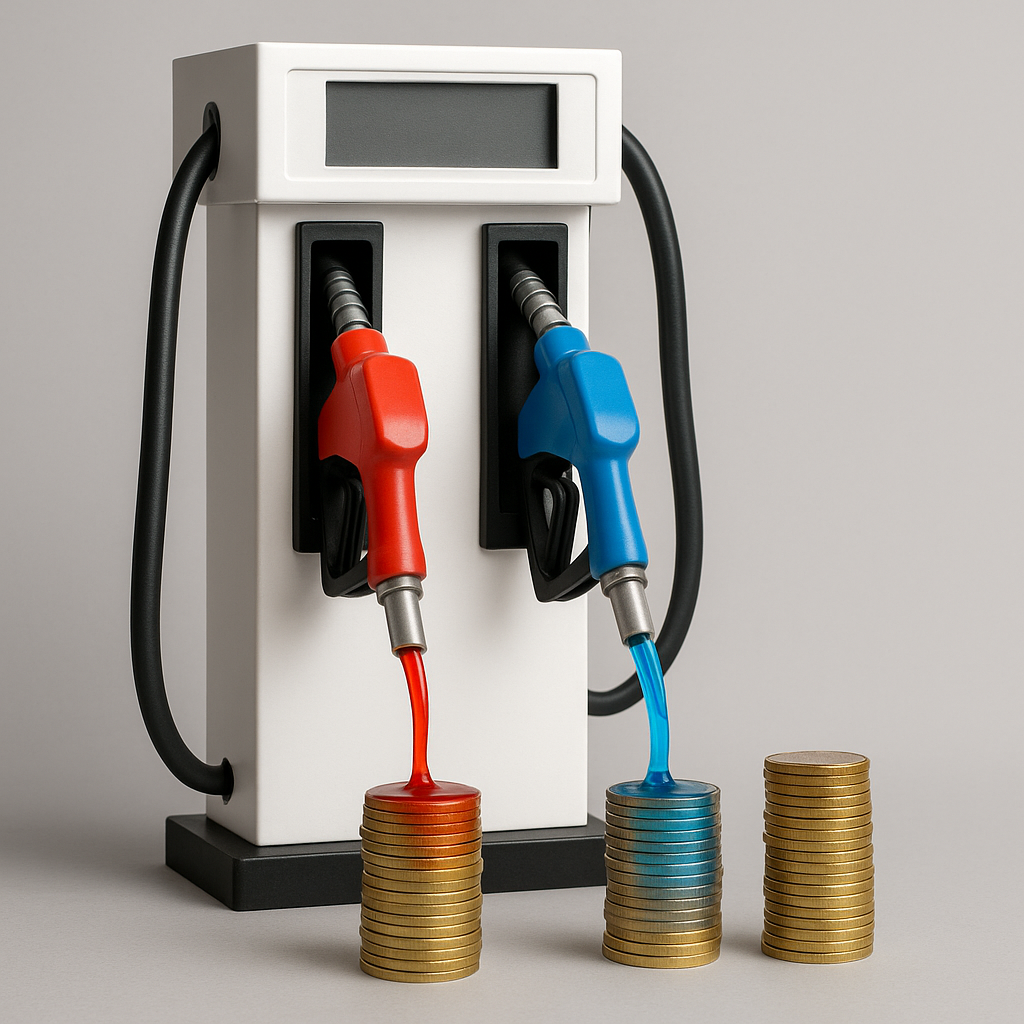
SA's fuel prices are changing: petrol up R1.05, diesel down up to R3.60. Understand why and what it means for your wallet.
South Africa's June fuel prices are a mixed bag. Petrol (95 and 93 octane) is going up by R1.05 per litre, making it more expensive for car owners. However, diesel prices are dropping significantly, by R2.80 to R3.60 per litre, which is great news for transporters and farmers. This split is due to global oil prices, the rand's value, and a government tax holiday ending. Essentially, petrol users face a pinch, while diesel users get a break.
What are the fuel price changes in South Africa for June?
South Africa's June fuel prices see petrol (95 and 93 octane) increasing by R1.05 per litre, pushing inland 95 past R27.60. Diesel prices, however, are set to decrease by R2.80 (50 ppm) to R3.60 (500 ppm), offering relief to transporters and farmers.
Get Cape Town news in your inbox
Stay updated with the latest stories from the Mother City.
The Immediate Jolt: What Wednesday’s Price Change Really Means
South Africa’s fuel gauges will spin in opposite directions from midnight Tuesday. Petrol 95 and 93 octane are expected to leap by roughly one rand and five cents a litre, pushing inland 95 past R27.60 for the first time since autumn. Diesel, on the other hand, is on track to shed between R2.80 (50 ppm) and R3.60 (500 ppm), handing transporters, farmers and taxi fleets their first meaningful discount since the war-induced spike of 2022.
The split result is rooted in arithmetic, not alchemy. A two-month “Basic Fuel Price” formula drags today’s crude and shipping numbers into June’s retail reality. While Brent has eased from the low-nineties in early May to the mid-eighties, the rand’s sideways shuffle between R18.40 and R18.70 against the dollar kept the import parity on a knife-edge. Petrol’s over-recovery was too thin to offset Treasury’s simultaneous claw-back of last year’s R1.50 levy holiday; diesel’s over-recovery was fat enough to swallow the same tax and still leave change on the table.
Consumers will feel the whiplash most at mixed-fuel forecourts where bakkies queue ahead of hatchbacks. A coastal 50-litre petrol refill will cost about R52 more; the same volume of diesel drops R140. For a 1.4-litre hatchback commuter the monthly budget stretches; for a freight rig clocking 4 km/l the saving can exceed R4 000 over a long-haul return leg from Gauteng to the coast.
Global Chessboard: Why OPEC+ Calm Clashed with Winter Stockpiles
Crude’s recent slide masks a month of geopolitical drama. Early May saw traders pricing in a potential Strait of Hormuz closure after tit-for-tat strikes near Iran’s nuclear sites. By month-end, quiet diplomacy and uninterrupted cargoes unwound the fear premium, dropping Brent back into its mid-$80 trading band. OPEC+ then confirmed it will start phasing out voluntary cuts from October, adding future barrels to the outlook and nudging forward curves into contango.
Those moves feed South Africa’s price-setter with a lag, but products diverge once regional fundamentals bite. Northern-hemisphere refiners have already blended their summer gasoline, so petrol cargoes are plentiful. At the same time, Europe and North America are restocking distillate for winter, yet Indian and Middle-East exporters have swamped the market with surplus diesel. Freight rates for 50-ppm cargoes ex-Singapore have fallen faster than those for 95-RON gasoline, widening the gap that now benefits local diesel buyers.
Currency traders added a final twist. The rand weakened only half-a-percent during the June pricing window, but that modest slip was enough to shave 12–14 cents off any over-recovery. In rand terms, a dollar-denominated cargo that landed cheaper in May still shows a higher landed cost in June, illustrating how even a quiet FX market can cap the size of a diesel gift.
Fiscal Hangover: The Tax Holiday That Bites Back
Between April and November 2023, Treasury forgave R1.50 of the general fuel levy and 75 cents earmarked for the Road Accident Fund, sacrificing R4 billion a month to keep inflation polite. Finance Minister Enoch Godongwana warned in February that the bill would come due in two equal slices: June and July. June’s slice lands this week, adding exactly R1.50 to every litre before any other adjustment.
Petrol’s pump move therefore splits into two parts: the returning levy (+R1.50) and a modest 45-cent net over-recovery credit, producing the headline R1.05 hike. Diesel enjoys the same levy rebound, but its Basic Fuel Price credit of roughly R4.50 dwarfs the tax, leaving a net decline of up to R3.60. Put differently, government giveth and government taketh away, yet the market’s generosity to diesel outweighs Treasury’s take.
The asymmetry has a political edge. Because the Road Accident Fund levy for diesel remains untouched this round, the state cushions only petrol drivers from the full R3 levy restoration. Critics call that a stealth re-election sweetener ahead of 2024 polls; Treasury counters that diesel is overwhelmingly commercial, so cheaper diesel functions as a growth stimulus rather than a consumer subsidy.
Strategic Crossroads: Does South Africa Need a State Fuel Champion?
South Africa now leans on imports for seven of every ten litres it burns, a dependency exposed when the Durban riots shut Sapref and when Transnet’s 2022 cyber-attack froze the Durban-Johannesburg pipeline for days. Mineral Resources Minister Gwede Mantashe has revived talk of a State-Owned Fuel Company that would buy, store and even refine crude on government account, arguing that a national champion could smooth shocks and keep strategic stocks.
The draft blueprint has three legs. First, acquire or lease mothballed plants - Astron Energy’s 100 000 barrel-per-day Milnerton refinery and PetroSA’s gas-to-liquids site in Mossel Bay top the list - and refurbish one into a 50 000 bpd hydrocracker capable of Euro-6 standards. Second, charter Very Large Crude Carriers for floating offshore storage, letting Pretoria bulk-buy when prices sag and release when they spike. Third, anchor retail presence through the 500-odd Engen forecourts where the Central Energy Fund already holds a minority stake, while negotiating white-label access into Shell, BP and Total networks.
Sceptics recall Eskom, SAA and the Post Office, warning that political pricing and cadre deployment could merely shift subsidies from Treasury to a fresh balance sheet. Supporters point to India’s Strategic Petroleum Reserve and China’s Unipec, arguing that a well-run importer with long-term Angolan or Nigerian crude contracts can hedge both currency and Brent risk. Either way, the conversation has reopened the bigger question: does South Africa rebuild refining capacity or double down on import agility?
Second-Order Shockwaves: Inflation, Logistics and the EV Accelerator
Because petrol outweighs diesel in Statistics SA’s consumer-basket weighting, June’s move adds an estimated 0.12 percentage points to headline inflation. That sounds modest, yet it arrives just as the South African Reserve Bank’s Monetary Policy Committee prepares for its July meeting. Governor Lesetja Kganyago has already signalled that a 50-cent rand slide could tip the scales toward another repo hike, underscoring how the rand-diesel-petrol triangle can ripple through interest rates.
Transporters face a split decision. Long-haul fleets gain immediate relief: Grain SA calculates that a maize farmer in North West spends 35 % of operating cost on diesel, so a R3 drop saves about R1 200 per hectare during planting season. Urban light-commercial operators are less lucky; 65 % of delivery vans still run on petrol, muting the benefit. Some firms are accelerating purchases of diesel-powered half-tonners, but the R30 000 engine premium requires two to three years to amortise even at today’s spreads.
Consumers aren’t waiting for policy. Naamsa data show hybrid registrations jumped 14 % month-on-month in May, while ride-hailing apps have quietly embedded a bi-weekly fuel surcharge that passes pump volatility to riders. Car-makers are weaponising uncertainty: Volvo now includes a 60-month “fuel-cost protection plan” on its XC40 Recharge, and BMW is rolling out DC fast chargers at Garden-Route towns to lure coastal holidaymakers who endured R24-plus over Easter. Each fuel spike, ironically, accelerates the electric transition that White Papers alone could not ignite.
Micro-habits matter too. Tracker telematics show jack-rabbit acceleration and late braking inflate urban consumption by up to 30 %. Maintaining correct tyre pressures alone cuts fuel burn 4 %, while smoothing the drive cycle can save a litre every 40 km for the average Cape Town commuter. Wednesday’s price reset will be old news within a month, but the behavioural tweaks it triggers can keep cash in wallets long after the gauges stabilise.
What are the fuel price changes in South Africa for June?
Petrol (95 and 93 octane) will increase by R1.05 per litre, with inland 95 octane surpassing R27.60. Conversely, diesel prices are decreasing significantly, with 50 ppm diesel dropping by R2.80 and 500 ppm diesel by R3.60 per litre. This provides relief for transporters and farmers.
Why are petrol and diesel prices moving in opposite directions?
The divergent price movements are due to a combination of factors. Global oil prices have eased, but the rand's modest weakening against the dollar prevented a larger decrease for petrol. Critically, the two-month "Basic Fuel Price" formula and the ending of a government tax holiday (R1.50 levy restoration) have a greater impact on petrol. Diesel, however, had a substantial over-recovery in its Basic Fuel Price, which was large enough to absorb the tax increase and still result in a significant price drop.
How will the price changes affect consumers and businesses?
Petrol users, particularly those with 1.4-litre hatchback commuters, will feel a pinch, with a 50-litre refill costing about R52 more. Diesel users, especially long-haul transporters and farmers, will experience significant savings. A 50-litre diesel refill could save approximately R140, and a freight rig could save over R4,000 on a long-haul return trip from Gauteng to the coast. This will impact consumer budgets and logistics costs differently.
What role did global oil markets and the rand play in these adjustments?
Global crude prices, specifically Brent, eased from early May's highs due to geopolitical calm and OPEC+'s decision to phase out voluntary cuts. This generally reduces the cost of imported fuel. However, the rand's slight weakening (about 0.5%) against the US dollar during the pricing window partially offset these gains, particularly for petrol, by increasing the rand-denominated cost of dollar-priced imports.
What is the "tax holiday" that is ending and how does it affect fuel prices?
The government had implemented a temporary reduction in the general fuel levy and the Road Accident Fund levy between April and November 2023, effectively providing a "tax holiday" of R1.50 per litre. This holiday is now ending, with the R1.50 levy being reinstated in June. This R1.50 is added back to the price of every litre of fuel before other adjustments are made, contributing significantly to the petrol price hike.
What are the broader implications of these fuel price changes?
June's petrol increase is estimated to add 0.12 percentage points to headline inflation, which could influence the South African Reserve Bank's interest rate decisions. For logistics, it creates a split, with long-haul diesel fleets benefiting immensely, while urban petrol-powered delivery vans see no relief. These price shocks are also accelerating the adoption of electric vehicles and hybrids, as consumers and businesses seek alternatives to volatile fuel costs. Furthermore, it reopens the debate about South Africa's energy security and the potential need for a state-owned fuel company.

A Russian-Spanish journalist and Cape Town native, channels his lifelong passion for South Africa into captivating stories for his local blog. With a diverse background and 50 years of rich experiences, Serjio's unique voice resonates with readers seeking to explore Cape Town's vibrant culture. His love for the city shines through in every piece, making Serjio the go-to source for the latest in South African adventures.
View all articles →