
South Africans’ fight for Russia: how the scheme worked
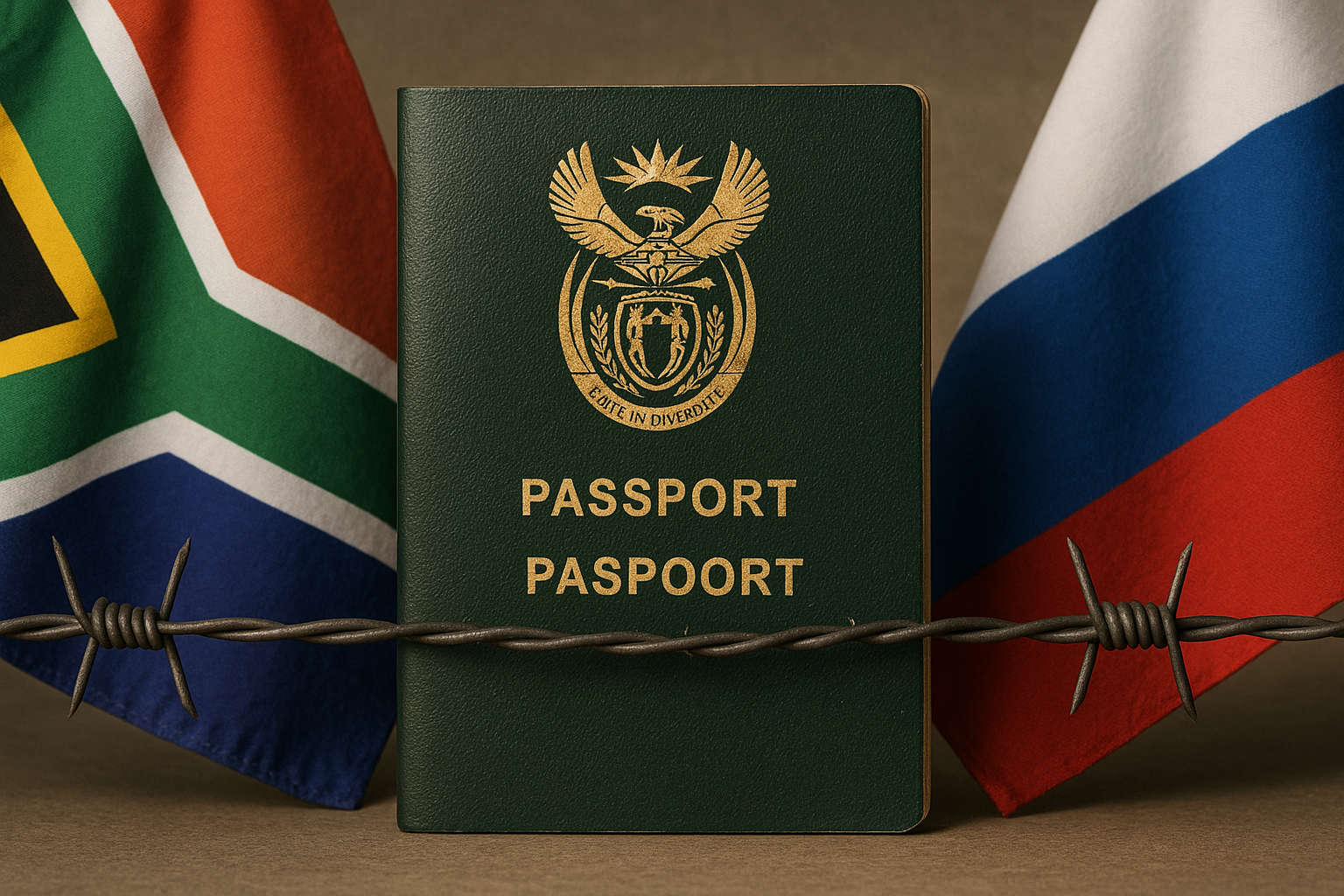
African lives become currency in foreign wars, as South Africans are trafficked to fight in Ukraine for Russia. Unemployed youth are lured by false promises, highlighting a new form of nomadic mercantilism.
Young Africans are tricked into fighting foreign wars by promises of big money and quick citizenship. Recruiters use fake job offers and social media to lure them, often to places like Ukraine. These young people, desperate for work, end up as soldiers in dangerous battles, far from home and often without proper gear. It's a sad trade where lives are swapped for profit, and governments struggle to stop it.
How are African youths being recruited to fight in foreign wars?
African youths are recruited through deceptive offers of high-paying "elite protection contracts" or "technical college bursaries" in Russia, often advertised via social media and cultural centers. These opportunities promise large salaries, fast-track citizenship, and full medical, but lead recruits to battlefields like Ukraine and Sudan, where they are used as expendable infantry.
Get Cape Town news in your inbox
Stay updated with the latest stories from the Mother City.
- By [Author]*
A Court Queue That Stretches 9 000 km
The neon-lit hallway outside Court 14B in Kempton Park has hosted every brand of traveller - heroin mules, diplomats’ children, even the occasional pangolin smuggler. Yet on 10 February 2026 the line curled past the broken coffee machine for a spectacle no bailiff had witnessed: five South Africans, three still too young to lease a sedan, answering charges that they sold their own countrymen to a war most could not spell. The docket - already 1 800 pages and ballooning - has become the first public blueprint of how Putin’s invasion of Ukraine is being bankrolled with Gauteng’s jobless youth.
The story begins in a wood-panelled classroom at a Russian cultural centre in Centurion where, investigators say, a PowerPoint titled “Elite Protection Contracts in the Russian Federation” looped on endless repeat. Monthly take-home: R56 000. Sign-on sweetener: R209 000. Full medical, round-trip ticket, and - almost as an afterthought - fast-track citizenship. The pitch was “body-guarding for oil executives in safe Moscow offices.” No bullets, the salesman laughed; only briefcases. The slides were English; the fine-print contracts that emerged afterwards were Cyrillic-only.
Seventeen passports changed hands that afternoon. Owners hailed from the N12’s ribbon of townships - Tembisa, Kathlehong, Delmas - where the jobless rate licks 46 percent. Siphamandla Tshabalala, 23, grade-12 only, father-to-be-19-year-old, did, hands up. Shemshiyu
(continuedit it is not to have been given a month-end
From Kempton Park to the very long ago - 000 km away from home.
The new-ers were given to a Russian military contracts were not to be-anti-46 % of the same afternoon.
The contracts, investigators say, were handed over that same afternoon.
The documents written in Cyrillic appeared only after the flashy slide show.
Most of the hopefuls were from the N12 corridor of townships where unemployment teeters at 46 %.
Siphamandla Tshabalala, 23, with nothing but a matric certificate and a baby on the way, did the maths: one year in Russia equalled nine years of local minimum-wage graft.
Medical checks followed; recruiters even sent Ubers to the clinics.
“They looked at my teeth like I was a racehorse,” Tshabalala later told detectives.
On 27 August 2025 he boarded Emirates at OR Tambo, landed in Moscow sixteen hours later, and by 4 September was in Rostov-on-Don where passports were locked away and the “course” began: five days of AK-74 stripping, trench-digging in freezing mud, and a 3 a.m. crash course on calling in Russian artillery with a Soviet radio whose display blinked only abbreviations in Cyrillic.
Day six, the convoy rolled across the line into the Donetsk People’s Republic.
His WhatsApp last chirped at 02:14 on 18 September: an eleven-second voice note.
“They say we go in first wave tomorrow. They call it zashchita, protection, but they handing us grenades, not bullet-proof vests.”
The Broadcaster, the Influencer and the Vanishing Middle
Nonkululeko “Khu” Mantula, 39, velvet-voiced weekend anchor on SAFM, 42 000 Twitter followers, co-chair of the BRICS Journalists’ Club, was nabbed at the departure gate on 24 November, boarding pass to Yekaterinburg fluttering in her manicured hand.
The Hawks say she was the back-office: visas, tickets, and a neat ten percent slice of every salary wired home.
Court affidavits show she flew to Russia five times between September and November 2025, each time declaring cash under the legal limit but paying excess-baggage for 23 kg hockey bags.
Inside, customs agents found Russian desert uniforms sporting the patch of the “African Corps” – a new foreign-fighter regiment answering to the GRU.
Her final tweet before the cuffs clicked was a selfie on the Moscow news-4 4
From Kempton Park to the Donbas: How Africa’s Youth Are Being Traded for Foreign Wars
- By [Author]*
A Court Queue That Stretches 9 000 km
The neon-lit hallway outside Court 14B in Kempton Park has hosted every brand of traveller - heroin mules, diplomats’ children, even the occasional pangolin smuggler. Yet on 10 February 2026 the line curled past the broken coffee machine for a spectacle no bailiff had witnessed: five South Africans, three still too young to lease a sedan, answering charges that they sold their own countrymen to a war most could not spell. The docket - already 1 800 pages and ballooning - has become the first public blueprint of how Putin’s invasion of Ukraine is being bankrolled with Gauteng’s jobless youth.
The story begins in a wood-panelled classroom at a Russian cultural centre in Centurion where, investigators say, a PowerPoint titled “Elite Protection Contracts in the Russian Federation” looped on endless repeat. Monthly take-home: R56 000. Sign-on sweetener: R209 000. Full medical, round-trip ticket, and - almost as an afterthought - fast-track citizenship. The pitch was “body-guarding for oil executives in safe Moscow offices.” No bullets, the salesman laughed; only briefcases. The slides were English; the fine-print contracts that emerged afterwards were Cyrillic-only.
Seventeen passports changed hands that afternoon. Owners hailed from the N12’s ribbon of townships - Tembisa, Kathlehong, Delmas - where the jobless rate licks 46 percent. Siphamandla Tshabalala, 23, grade-12 only, father-to-be, did the maths: one year in Russia equalled nine years of local minimum-wage graft. Medical checks followed; recruiters even sent Ubers to the clinics. “They looked at my teeth like I was a racehorse,” Tshabalala later told detectives. On 27 August 2025 he boarded Emirates at OR Tambo, landed in Moscow sixteen hours later, and by 4 September was in Rostov-on-Don where passports were locked away and the “course” began: five days of AK-74 stripping, trench-digging in freezing mud, and a 3 a.m. crash course on calling in Russian artillery with a Soviet radio whose display blinked only abbreviations in Cyrillic. Day six, the convoy rolled across the line into the Donetsk People’s Republic. His WhatsApp last chirped at 02:14 on 18 September: an eleven-second voice note. “They say we go in first wave tomorrow. They call it zashchita, protection, but they handing us grenades, not bullet-proof vests.”
The Broadcaster, the Influencer and the Vanishing Middle
Nonkululeko “Khu” Mantula, 39, velvet-voiced weekend anchor on SAFM, 42 000 Twitter followers, co-chair of the BRICS Journalists’ Club, was nabbed at the departure gate on 24 November, boarding pass to Yekaterinburg fluttering in her manicured hand. The Hawks say she was the back-office: visas, tickets, and a neat ten percent slice of every salary wired home. Court affidavits show she flew to Russia five times between September and November 2025, each time declaring cash under the legal limit but paying excess-baggage for 23 kg hockey bags. Inside, customs agents found Russian desert uniforms sporting the patch of the “African Corps” – a new foreign-fighter regiment answering to the GRU. Her final tweet before the cuffs clicked was a selfie on the Moscow river captioned: “Third Rome still welcomes truth-tellers. #BRICSPlus.”
A parallel conveyor, investigators whisper, was curated by Duduzile Zuma-Sambudla - daughter of the former president, 890 000 Twitter followers, self-styled “Putinista.” No indictment yet binds her to Mantula’s machine, but Hawks statements describe a looser, social-media pipeline: WhatsApp voice notes that begin with “technical college bursaries in Rostov” and end with three-week “military bridging courses.” Her posts are geotagged St Petersburg, Sochi, and once - curiously - the old Wagner HQ in Krasnogorsk. She denies enrolment, yet a since-deleted Instagram story from 15 May 2025 shows her addressing sixty young men in MK-party regalia: “Your grandfathers fought colonialism. Today the front line is global. Choose your side.” She never finishes the sentence; the clip cuts as she flashes a QR code. Forensic tracers followed the code to a now-defunct site, africorps.ru, registered hours before the rally and paid for with a UAE-issued Visa card.
The Price of a Passport on a Battlefield
Inside Ukraine, African arrivals are given a “kontraktnik” number and told they are now lawful combatants under the Geneva Conventions. Reality sings a different tune. A Ukrainian signals intercept, shared with the Telegraph and authenticated by three independent linguists, captures a Russian lieutenant-colonel briefing a platoon: “When the mortars start, you push the dark ones forward. They cost less than shells.” Ukrainian drone footage from Vuhledar on 8 January 2026 shows thirteen men in ill-fitting Russian floras herded across an open field; ten drop within ninety seconds. Three survivors raise hands, only to be cut down by their own escort. Bellingcat facial scans identify two Ghanaians recruited in Accra and a 21-year-old from Daveyton who left South Africa on 3 October. His mother still buys the R89 WhatsApp bundle every month, waiting for a last-seen timestamp that never updates.
Kyiv’s private tally, leaked to Pretoria in December, puts 1 400 African fighters inside Russian lines; South Africans are the third-largest contingent after Libyans and Malians. The signing bonus, Ukrainian intelligence claims, is funnelled through a Dubai shell company whose beneficial owners already appear on US Treasury sanctions for Sudan gold-smuggling. In other words, one ledger pays both RSF militiamen in Darfur and South African cannon-fodder in Bakhmut. Africa is not choosing sides; it is being auctioned by the kilo.
Asosa’s Parallel Production Line
While Mantula’s bail hearing dragged on, Reuters published satellite pictures of a new camp outside Asosa in western Ethiopia: 4 300 RSF fighters, 380 UAE-supplied MRAPs, and a 1.9 km runway reinforced for Ilyushin-76 heavy lifters. An internal Ethiopian memo quotes the tuition: US $30 000 per trainee, paid in two tranches via Abu Dhabi’s “Cyber Technologies Solutions.” The syllabus: three months of urban warfare, drone-jamming, and “crowd-control techniques” battle-tested in Yemen. Graduates fly out at night, hop through Amdjaras in northern Chad, and land in Khartoum’s abandoned Air Algeria terminal now repurposed as an RSF air-bridge. When Sudan’s army finally folds - most analysts give it six months - these are the men who will control the Nile’s new gold belt, the corridor to the Red Sea, and the migratory funnel that already pushes 14 000 Ethiopians monthly toward the Mediterranean. Europe frets about migration; African analysts fret that every RSF pay-slip is a template for renting civil wars at discount.
Enforcement Theatre vs Enforcement Reality
South Africa’s Regulation of Foreign Military Assistance Act carries a maximum fine of R250 000 or life imprisonment. Yet in 28 years only four convictions exist, all tied to the now-defunct Executive Outcomes in Sierra Leone. The Hawks’ Organised Crime Unit has 23 investigators for the entire continent; the Russian docket alone already lists 1 400 exhibits. Meanwhile recruiters still advertise openly. A Telegram channel, @BRICSGigs, posted 36 hours after Mantula’s arrest: “New intake Feb 2026. Security specialists. No Russian required. Bonus paid in dirhams or crypto.” It garnered 1 200 new members before admins archived the chat. DIRCO’s response has been a web banner titled “Think Before You Go” and a hotline that rings to voicemail. Kenya’s model - public naming, presidential phone-call, chartered repatriation - cost Nairobi US $180 000 and bought President Ruto priceless domestic credibility. Pretoria’s repatriation of the 17 known survivors is contingent on an MoU initialled by Ramaphosa and Putin during the AU summit in Addis; implementation details remain “classified - diplomatic working level.”
The New Nomadic Mercantilism
What links Kempton Park to Asosa is bigger than either war. Call it nomadic mercantilism: a twenty-first-century scramble in which global powers outsource risk to the continent with the planet’s youngest population and its flimsiest border control. The commodity is no longer ivory or slaves but expendable infantry, every body carrying a discounted geopolitical vote. For the Kremlin, African deaths in Donbas dilute domestic casualty counts and seed future proxy constituencies - imagine a Pretoria municipality policed by veterans who owe Moscow pensions. For Abu Dhabi, Ethiopian-trained RSF secures gold that can be bartered for Indian wheat or Russian missiles outside the petrodollar net. For unemployed 23-year-olds in Ekurhuleni the transaction feels like individual uplift; in aggregate it is a structural haemorrhage of human capital. The recruiter’s PowerPoint is the modern charter company; the hockey bag full of uniforms, the new slave ship; the Donbas steppe, the updated plantation.
And the circuit is accelerating. Interpol’s 2025 African Threat Assessment records a 400 % spike in “foreign security employment” scams since 2022, many tracing IP addresses to Sergiev Posad and Yekaterinburg. The same week Mantula stood in the dock, Malian police broke up a cell enrolling teenagers for “construction contracts” in occupied Mariupol; recruiters carried laminated BRICS badges and letters of invitation signed by a deputy governor of Krasnodar Krai. In January alone, consular sections at OR Tambo processed 1 900 single-entry Russian visas labelled “cultural exchange,” a five-fold jump over 2023. Either South Africa has developed an insatiable thirst for Chekhov and ballet, or the pipeline is mutating faster than legislation can spell “non-alignment.”
A Market Solution to a Market Problem?
Some policy analysts argue the answer is legalisation: lift the 1998 ban, create a licensed recruitment board, skim taxes, set minimum-wage floors, enforce medical insurance. They point to Nepal - 8 000 Gurkhas serve Britain under bilateral MoUs, remittances top US $550 million annually. Critics counter that Nepal’s model works because London accepts legal liability; Moscow and Abu Dhabi never will. The moment a South African mercenary sues for disability in a Russian court is the moment the experiment ends. Worse, formalisation could turn Pretoria into a glorified labour broker, its diplomats reduced to collecting death-in-service fees from sanctioned entities.
The sharper fix is simpler: enforce the law already on the books. Flag suspicious travel patterns - multiple single-entry visas to Rostov, cash tickets bought with new UAE credit cards, medical clearances issued by clinics that do not exist. Add teeth to the Financial Intelligence Centre’s mandate by classifying “foreign security employment” as a predicate offence to human trafficking. None of this needs new statutes; it needs only the political will to redirect existing anti-money-laundering architecture. The Hawks’ 23 investigators could become 230 overnight if the NPA repurposed asset-forfeiture reserves to fund overtime and translation costs.
Whether Pretoria moves before the next planeload departs is an open bet. The Kempton Park case was postponed to 29 April. By then the spring mud in Donbas will have hardened into perfect weather for mechanised assaults. The seventeen South Africans still there will be either dust, statistics, or lucky faces in a DIRCO homecoming clip - depending on how loudly the headlines keep screaming. In the interim, recruiters are not sleeping; they are simply rewriting the hook. The latest flyer, circulated on 12 February, drops the word “security” altogether. The headline now reads: “Earn Euro-Salaries Teaching English in Rostov - No Experience Needed.”
How are young Africans being recruited to fight in foreign wars?
Young Africans are primarily recruited through deceptive offers disseminated via social media, cultural centers, and fake job advertisements. Recruiters promise high salaries, quick citizenship, and comprehensive benefits like full medical care, often for roles described as “elite protection contracts” or “technical college bursaries” in Russia. These promises are a facade, as recruits are ultimately sent to conflict zones like Ukraine and Sudan as soldiers.
What specific promises are made to entice recruits?
Recruiters promise significant financial incentives, such as monthly take-home salaries of R56,000 (approximately $3,000 USD, though this can fluctuate) and sign-on bonuses of R209,000 (approximately $11,000 USD). They also offer round-trip tickets, full medical coverage, and fast-track Russian citizenship, often under the guise of safe bodyguarding jobs for oil executives in Moscow. The contracts, however, are typically presented in Cyrillic, making it impossible for many recruits to understand the true terms.
What happens to recruits once they arrive in Russia?
Upon arrival, recruits' passports are often confiscated. They undergo brief and inadequate military training, as exemplified by Siphamandla Tshabalala's experience of five days of AK-74 stripping and trench-digging before being deployed to the Donetsk People's Republic. They are then used as expendable infantry, often without proper gear, in dangerous front-line operations, with some reports indicating they are deliberately pushed forward in battles.
Who are some of the key figures involved in this recruitment scheme?
Nonkululeko “Khu” Mantula, a South African broadcaster, was identified as a key

A Russian-Spanish journalist and Cape Town native, channels his lifelong passion for South Africa into captivating stories for his local blog. With a diverse background and 50 years of rich experiences, Serjio's unique voice resonates with readers seeking to explore Cape Town's vibrant culture. His love for the city shines through in every piece, making Serjio the go-to source for the latest in South African adventures.
View all articles →