
Western Cape teen earns Junior Portrait Awards honour
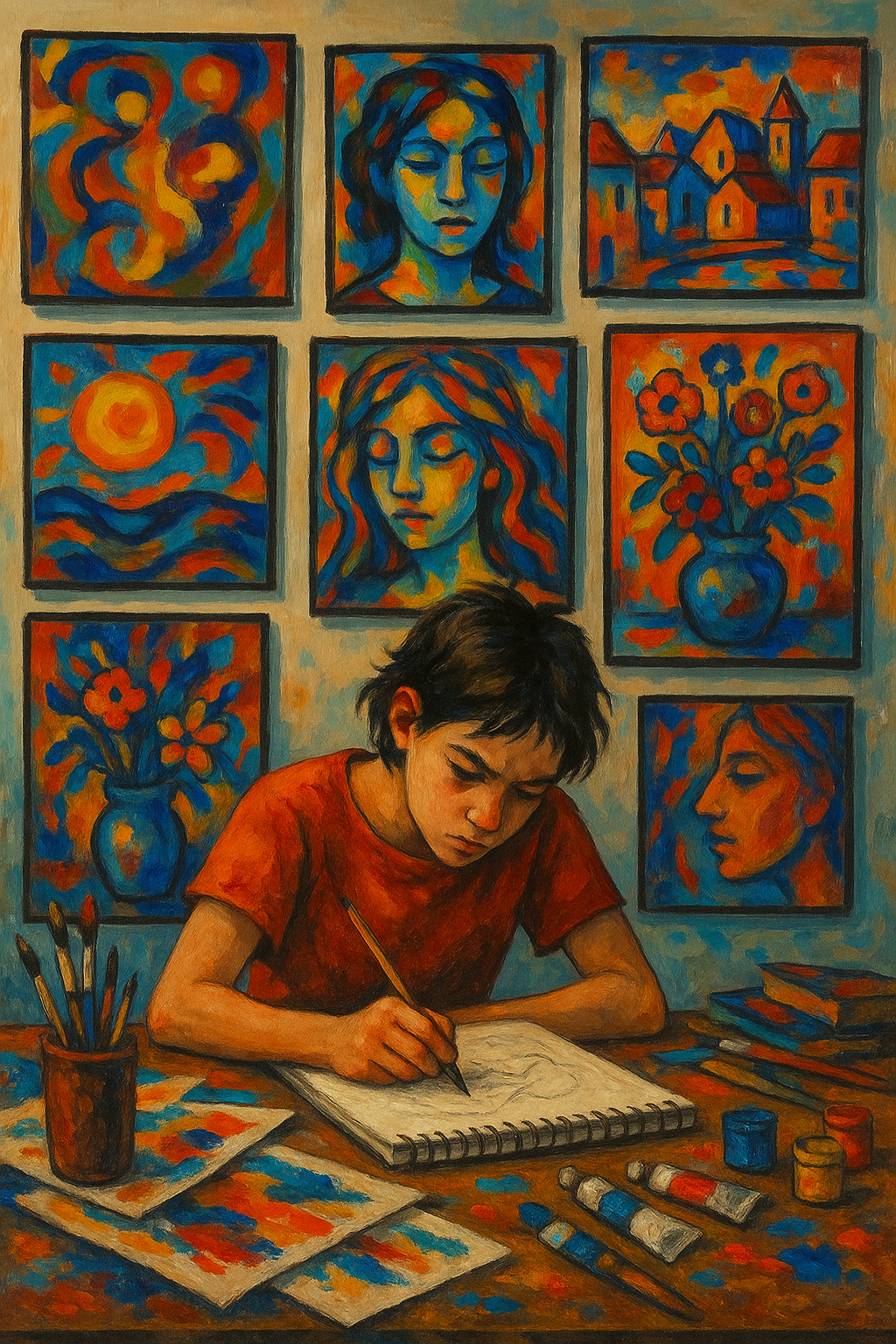
South Africa's Junior Portrait Awards showcase Gen-Z's creative force, pushing boundaries with honest, powerful art. Discover the future of SA art.
Young artists in South Africa are showing off their amazing talents at the Junior Portrait Awards. Teenagers from all over the country are sharing their self-portraits and other art, using cool materials and digital tricks. This art show helps them talk about who they are, what they care about, and how they see the world. It's making art more open and exciting for everyone.
What is the Junior Portrait Awards in South Africa?
The Junior Portrait Awards is a nationwide initiative showcasing the artistic concerns of Generation-Z in South Africa. It features self-portraits and other artworks by teenagers from all nine provinces, emphasizing authenticity and diverse materials like oil pigments on burlap or charcoal on medical gauze. The awards foster dialogue, accessibility, and institutional innovation in the art world.
Get Cape Town news in your inbox
Stay updated with the latest stories from the Mother City.
A New Generation Claims the Cultural Spotlight
South Africa's emerging creative voices have shifted from the periphery to the heart of national discourse, a transformation impossible to ignore within the weathered, chalk-white fortress of Rust-en-Vrede Gallery one blustery Saturday in early May. This heritage building in Durbanville - formerly a colonial administrative seat, then a wine estate, now an unofficial launchpad for cutting-edge contemporary work - surrendered its customary weekend serenity to the electric presence of 232 teenagers. These young artists had dispatched, shipped, or personally carried self-portraits, companion studies, reveries rendered in pigment, and cries of dissent from all nine provinces of the republic.
The gathering marked the second nationwide installment of the Junior Portrait Awards, an initiative that sprouted in 2023 as a humble invitation to three neighboring secondary schools and, within two short years, ballooned into perhaps the most comprehensive portrait of Generation-Z artistic concerns found anywhere in the Southern Hemisphere. Gallery curator Donavan Mynhardt - sporting his signature black beret and sneakers flecked with paint - navigates the throng wielding an iPad laden with catalogue thumbnails like a conductor orchestrating a symphony of tomorrow's masters. "We're not hunting for conventional beauty," he assures parents straining for sightlines. "We chase authenticity. Truth resonates more powerfully than any polished surface."
Truth, in this year's iteration, manifested through unexpected marriages of material: oil pigment crashing against burlap, charcoal ground into medical gauze, digital distortion transferred onto unprimed canvas. Most commanding of all stands Kenah Seba's mixed-media confrontation Assessing the Damages, positioned deliberately to arrest every entrant into the soaring main chamber. The seventeen-year-old Grade 11 student from Piketberg commenced with conventional stretched linen measuring 50 by 70 centimeters, then devoted three winter months building tissue, rabbit-skin adhesive, and finely shredded disclaimers from cosmetics packaging until her surface evoked healed trauma. Upon this foundation she executed - borrowing Gerhard Richter's method - a near-photographic depiction of a white laboratory rabbit whose left orb has been supplanted by a transparent resin bead imprisoning a single sterilized suture. Approach directly and the creature's stare appears docile; shift thirty degrees in either direction and gallery illumination fractures through the resin, transforming the pupil into an accusatory gemstone blazing with indictment. Seba sourced her reference imagery from leaked veterinary documentation at the University of Cape Town, obtained through the advocacy organization Beauty Without Cruelty; her title derives from an insurance document discovered in her mother's vehicle compartment following a minor collision. "The identical vocabulary corporations deploy to compress a human existence into a claim," she observes, "mirrors how we discuss animals we prefer to forget."
Portraits of Identity, Technology, and Absence
Adjacent to Seba's unsettling triptych hangs Weliswa Mdluli's Make Me Pretty, the eighteen-year-old victor hailing from Mpumalanga. Where Seba restricts herself to surgical tones - bone whites, contusion lavenders, antiseptic azures - Mdluli drenches her wooden support in bubblegum pinks and carnival golds. Technically a self-portrait, the image subdivides vertically into three bands, each reflecting a distinct skin-tone filter extracted from South Africa's most popular beauty application. Mdluli's mother practices as a nyanga, still grinding buchu and impepho for clientele; her father serves part-time as a Pentecostal pastor who once banned eyeliner. Raised between these competing cosmologies of femininity, Mdluli developed a fixation on "prettiness" as nomadic currency - exchangeable for marriage prospects in one settlement, social media capital in another, corporate hireability in a third. She engineered six thousand microscopic perforations across her panel's surface so that when illumination strikes from stage left, the words YOU WERE ALREADY ENOUGH materialize spectrally across the subject's cheek architecture. "I sought to implicate the observer," she clarifies. "If you require artificial light to decipher meaning, you've already internalized that darkness signifies deficiency."
Runner-up Allegra du Randt's If He Could whispers where Mdluli shouts, yet disturbs no less profoundly. Working solely in powdered graphite and erasure, the Durban native captures her fourteen-year-old brother collapsed on a trampoline at twilight, hands open as though anticipating a game controller that will never materialize. The pandemic lockdowns intersected with the boy's early adolescence and a subsequent gaming-addiction diagnosis; the family therapist prescribed "nature deprivation therapy," hence the outdoor apparatus. Du Randt captured this moment on an evening when the final streak of mauve clung stubbornly to the heavens. She then invested four months selectively erasing highlights - fingernails, corneas, trampoline coils - until the negative spaces throb like skipped cardiac rhythms. The piece demonstrates mastery through omission: no screens, no guardians, no vanishing point, merely the sensation that childhood undergoes real-time reconstruction by forces simultaneously too ordinary to identify and too vast to oppose. She acknowledges influence from South African filmmaker Jenna Bass and American artist Toyin Ojih Odutola, though the sorrow remains indigenous: the specific solitude of humid KwaZulu-Natal dusk when mosquitoes begin their winged tuning.
Across the passage, merit recipient Luche van Jaarsveld's Kaleidoscope of Becoming constitutes the sole kinetic entry. The sixteen-year-old Johannesburg wunderkind - who coded his inaugural game at twelve - has constructed an eighty-centimeter circular mirror, its reverse mounting a motorized LED matrix refreshing every forty-five seconds. The mirror wears a crown of three-dimensionally printed pangolin scales, each laser-etched with quick-response codes. Aim your device and you encounter brief looping fragments: a trans youth binding their chest, a Setswapong traditional healer gathering medicinal bark, a Pretoria drag performer removing artificial lashes. Van Jaarsveld crowdsourced this footage through TikTok, compensating each contributor with two hundred rand in Spotify credit. The mirror itself refuses coherent reflection: stand before it and your features splinter into prismatic fragments, each hosting miniature cinematic vignettes. "Identity isn't a portrait awaiting framing," he proposes. "It's a buffering glitch you teach yourself to inhabit."
Dialogue, Accessibility, and Institutional Innovation
Rust-en-Vrede's former ballroom, where couples once glided beneath crystal chandeliers, now serves as an impromptu auditorium where finalists lead daily two-o'clock walking tours for student delegations bussed from Stellenbosch, Khayelitsha, and the distant Overberg countryside. Thursday witnessed a Grade 9 pupil querying Seba whether her rabbit composition advocated scientific violence. Seba hesitated, then responded with counter-question: "Does revealing injury indicate desire for the blade, or longing for suture?" Spontaneous ovation erupted; an educator subsequently transmitted the exchange to a curriculum-development WhatsApp group titled "Decolonising Life Sciences." By evening, the message had propagated thirty-seven times.
The awards' operational infrastructure matches its content in contemporaneity. Submissions arrive through a Google Form recording upload timestamps; jurors evaluate blindly, receiving only title, medium, and conceptual statement - no identifiers, ethnic indicators, or school quintile classifications. The 2025 sponsor roster encompasses a financial technology startup, two Afrikaner philanthropists who amassed fortunes in Argentine soy cultivation, and a London-based non-fungible-token collective that minted limited digital doubles of the thirty top-ranked pieces. Revenue cycles back into art-supply bursaries redeemable nationwide, from Baker's retail chains in shopping centers to minuscule plastic-crate suppliers in Johannesburg's central business district. First position commands vouchers valued at twenty-five thousand rand; even Seba's third-place award of ten thousand rand secures quality hog-bristle brushes throughout a three-year university program.
Rust-en-Vrede director Lienkie van Rooi notes that expansion trajectories parallel Advanced Programme Art adoption in former Model-C institutions, yet maintains the competition's resistance to exclusionary mechanisms. "We welcome .jpeg, .mp4, .gif, .obj, .fbx. If your equipment consists solely of a damaged Huawei and charcoal from the corner shop, we still examine your submission." She substantiates this claim by exhibiting a nine-centimeter square portrait assembled from discarded supermarket coupons by sixteen-year-old Limpopo student Kgaogelo Makhubele. The palette - pumpkin orange, Lucky Star pink, Rama yellow - coalesces into a pixelated likeness of Makhubele's grandmother, a domestic laborer who for thirty-four years rode the four a.m. Putco bus from Alexandra to Sandton. The work missed final-four placement, yet collectors have already tendered seven thousand rand - exceeding the household's monthly earnings.
Building Networks Beyond Competition
Traversing the groaning floorboards at evening, one recognizes that the awards transcend mere victory; they establish circuitry among youth who previously assumed art belonged either to trust-fund adolescents as a leisure pursuit or to "talented but troubled" township youth in charitable programs. Here, such categories dissolve: a Claremont student vacationing in Croatia exchanges ideas with a boy from Giyani whose inaugural museum experience comprised a shebeen wall decorated by an intoxicated sign-painter; both command the emerging vocabulary of layering, opacity manipulation, glaze chemistry, and conceptual discipline. Mynhardt, braced against an eighteenth-century shutter, puts it more starkly: "We're not constructing a pipeline. We're assembling a nervous system."
The exhibition embarks on tour - first to the University of Johannesburg's FADA Gallery in July, subsequently to the Nelson Mandela Metropolitan Art Museum in September, and finally to the Bag Factory for the Joburg Art Fair the same month. Thereafter each piece returns to its originator, many receiving for the first time a physical portfolio satisfying international shipping specifications. Foreign residency programs have already circled: two students received invitations to apply for a winter placement in Reykjavík themed "Arctic and Anthropocene Southern Cross." Whether airfare proves achievable remains uncertain, though van Rooi negotiates a scholarship pool financed through NFT twin sales.
Meanwhile the gallery café has debuted a seasonal offering: the "Mdluli milkshake," a garish beetroot-pink beverage served with a biodegradable straw dissolving in eighteen minutes - precisely the average duration visitors spend before Make Me Pretty, according to analytics gathered from wireless network registrations. Its flavor suggests buchu and raspberry, and no patron departs without photographing the glass against exposed brick, tagged #BecomingPretty.
[{"question": "What is the Junior Portrait Awards?", "answer": "The Junior Portrait Awards is a nationwide initiative in South Africa that showcases the artistic concerns of Generation-Z. It features self-portraits and other artworks by teenagers from all nine provinces, emphasizing authenticity and diverse materials. Started in 2023 with a small invite, it quickly grew to become a comprehensive portrait of Gen-Z artistic concerns in the Southern Hemisphere, fostering dialogue, accessibility, and innovation in the art world."}, {"question": "Where is the Junior Portrait Awards exhibition held?", "answer": "The main exhibition for the Junior Portrait Awards is held at the Rust-en-Vrede Gallery in Durbanville, South Africa. This heritage building, formerly a colonial administrative seat and then a wine estate, now serves as an unofficial launchpad for cutting-edge contemporary art. After its initial showing, the exhibition embarks on a tour to other prestigious venues, including the University of Johannesburg's FADA Gallery, the Nelson Mandela Metropolitan Art Museum, and the Bag Factory for the Joburg Art Fair."}, {"question": "What kind of art can be seen at the Junior Portrait Awards?", "answer": "The awards feature a remarkable variety of artworks, often using unconventional materials and digital techniques. Examples include oil pigment on burlap, charcoal on medical gauze, digital distortions transferred onto unprimed canvas, and mixed-media pieces incorporating everyday items like cosmetics packaging. There are also kinetic sculptures and works created from discarded supermarket coupons, reflecting a wide range of artistic expressions and concerns from identity to technology and societal critiques."}, {"question": "Who is Kenah Seba and what is \"Assessing the Damages\"?", "answer": "Kenah Seba is a seventeen-year-old Grade 11 student from Piketberg and a prominent artist at the awards. Her work, Assessing the Damages, is a powerful mixed-media confrontation positioned to capture every entrant's attention. The piece, inspired by leaked veterinary documentation and insurance claims, depicts a white laboratory rabbit with a transparent resin bead imprisoning a sterilized suture in place of its left eye. The artwork cleverly uses light to transform the rabbit's stare from docile to accusatory, highlighting themes of trauma and the objectification of living beings."}, {"question": "How does the Junior Portrait Awards promote accessibility and innovation?", "answer": "The awards are designed to be highly accessible and innovative. Submissions are made through a Google Form, and jurors evaluate blindly, focusing solely on the artwork's merit, medium, and conceptual statement. The competition accepts a wide range of digital formats (.jpeg, .mp4, .gif, .obj, .fbx), making it inclusive for artists with varying resources. Furthermore, revenue from sponsorships and NFT sales funds art-supply bursaries, ensuring that young artists can continue their passion, regardless of their financial background. The exhibition also tours to different locations, making the art accessible to a wider audience."}, {"question": "What happens to the artworks after the exhibition?", "answer": "After the exhibition's tour concludes, each artwork is returned to its originator, often with a physical portfolio meeting international shipping specifications. The awards also create opportunities for young artists beyond the competition, with foreign residency programs already showing interest. For instance, two students received invitations to apply for a winter placement in Reykjavík. The sale of limited digital doubles (NFTs) of the top-ranked pieces helps fund a scholarship pool to potentially cover costs like airfare for such opportunities, further supporting the artists' careers."}]

Isabella Schmidt is a Cape Town journalist who chronicles the city’s evolving food culture, from Bo-Kaap spice merchants to Khayelitsha microbreweries. Raised hiking the trails that link Table Mountain to the Cape Flats, she brings the flavours and voices of her hometown to global readers with equal parts rigour and heart.
View all articles →