
What the couch knew
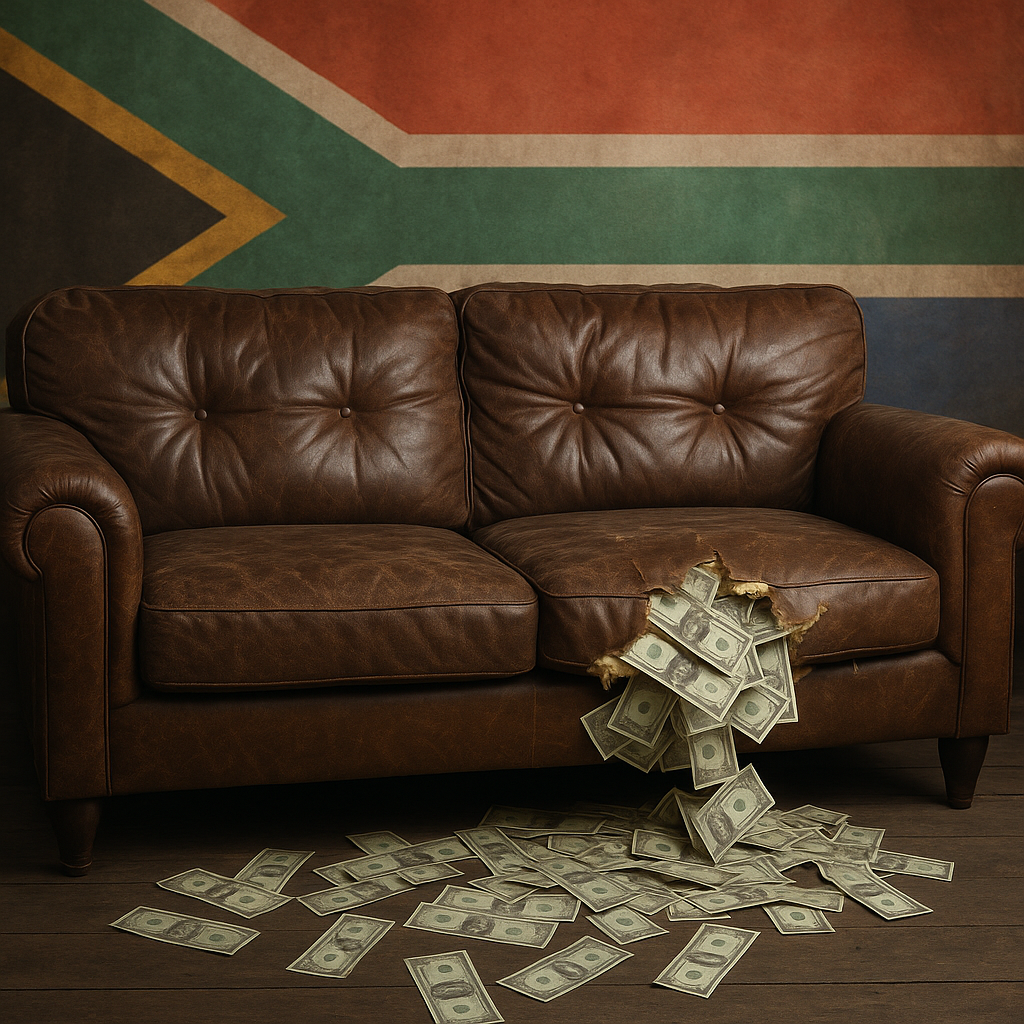
A buffalo sale, stolen couch, and visa waiver intertwine in a South African scandal, exposing corruption and political maneuvering.
In a shocking turn of events, President Ramaphosa's private game reserve became the scene of a daring theft. US$580,000, allegedly from a buffalo sale, vanished from a sofa, sparking a scandal that questions the money's origin and its unlawful entry into South Africa. A tangled web of unanswered questions, from undeclared cash to a phantom buffalo buyer, has led to a potential impeachment inquiry. Now, a US visa waiver for "persecuted Afrikaners" adds another layer of international intrigue, making the Phala Phala saga a global spectacle.
What is the Phala Phala scandal?
The Phala Phala scandal involves the theft of US$580,000 from President Cyril Ramaphosa's private game reserve in 2020. The money, allegedly from a buffalo sale, was not declared, raising questions about its origin and the subsequent handling of the theft, including allegations of a cover-up and unlawful entry of funds into South Africa.
Get Cape Town news in your inbox
Stay updated with the latest stories from the Mother City.
1. Night at the Lodge: When a Sofa Became a Vault
After dinner on 4 February 2020, while most South Africans were scanning headlines about a strange pneumonia in China, a lone figure slipped through a half-open window at Phala Phala, President Cyril Ramaphosa’s private reserve in Limpopo. Security footage shows the intruder wrestling a leather couch out of the manager’s lounge before melting into the bush with a bulky parcel tucked beneath his coat. That parcel held exactly US$580 000 in new, sequentially-numbered hundred-dollar bills, heat-sealed in plastic and wedged inside the upholstery.
Luxury lodges often keep foreign cash on hand - Middle-Eastern or Balkan trophy hunters still prefer greenbacks to bank drafts - but half a million vacuum-packed dollars is not petty change. The incident log filed the next morning simply logged “sofa damaged.” When police arrived, staff allegedly assured them “nothing valuable is missing.” No insurance claim was lodged, no case number issued, and for more than a year the theft was treated as an internal mishap.
The secret finally escaped through a domestic worker who spotted the slashed couch. She told a dismissed relative; he told a small-time wildlife trader in Naboomspruit. In February 2022 the trader posted two grainy photos - “Buffalo Bills” read the WhatsApp group’s name - showing neat bricks of cash. A Johannesburg digital forensics reporter ran optical-character recognition on the serial numbers and traced four notes to a Khartoum withdrawal dated three weeks earlier. Justice Sandile Ngcobo’s Section 89 Inquiry was born the same week.
2. The Buyer Who Never Paid the Bill
A Name Out of Africa - and Out of Thin Air
Whenever a South African scandal grows murky, a colourful foreign name usually appears. Twenty-five years ago it was a Saudi prince and an arms-deal “offset.” This time it was “Hazim Mustafa, Sudanese businessman,” supposedly the proud new owner of a breeding bull nicknamed Horus the Victor. The story sounded neat: cash for buffalo, buffalo never left, dollars disappeared.
Hazim Mustafa is real - he runs a logistics firm in Omdurman and once toyed with buying wildlife stock. Yet no buffalo travelled from Phala Phala to Sudan between 2018 and 2021. CITES export permits are publicly searchable; none list Horus. The South African Reserve Bank has no record of a cash declaration above R25 000 or of exchange-control approval for a US$580 000 transaction. Ngcobo’s team therefore ruled the cash “entered the Republic unlawfully,” diplomat-speak for smuggled.
The Paper Trail That Went Cold
Interpol confirmed Sudan never opened a case file for missing cash, and Dubai financial-intelligence links the same serial numbers to two deposits run through a money-service business known for politically exposed clients. The obvious implication: the money never followed the buffalo; it followed a different set of instructions entirely.
3. Courtrooms and Committee Rooms
63 Pages That Ask the Court to Pause Time
On 26 May 2026, President Ramaphosa’s lawyers filed case RA/2026/184 in the Western Cape High Court. They want the Ngcobo report declared irrational, Parliament gagged, and every affidavit, WhatsApp print-out and bank slip sealed until the review ends. Mbeki once sued the press, Zuma tried to muzzle thePublic Protector - neither succeeded. Ramaphosa’s request is novel: a sitting president asking a civil court to erase a looming impeachment.
The tactic stands or falls on timing. In 2024 the Constitutional Court ruled the earlier National Assembly vote to bury the matter unconstitutional; Parliament must now set up a fresh impeachment committee within 30 days. If the High Court grants even a partial delay, the committee’s clock slides into 2027, safely past local elections and the ANC national conference. The strategy is blunt but familiar: run out the clock until public anger finds a new target.
Four Pillars the MPs Must Weigh
Whether the committee meets in August depends on whether the court presses pause. If it does meet, four hard facts await:
- The Reserve Bank’s sworn statement: no legal route brought $580 000 in.
- Interpol’s reply: Sudan never reported the cash as missing.
- A private forensic trace: serial numbers match deposits in a Dubai bureau run by South African politically exposed persons.
- WhatsApp metadata: the head of the presidential VIP guard was physically at the lodge on 4 February 2020, contradicting the official timeline.
Delay them and the pillars stay locked away. Hear them and the committee must decide if the highest office in the land enjoys the same accountability as everyone else.
4. The Visa Memo and the Global Echo Chamber
From Limpopo to Landau’s Desk
While Pretoria’s legal team filed its 63-page prayer, a two-page cable landed on Deputy Secretary of State Christopher Landau’s blotter. Presidential Determination 2026-11 lifts the US refugee ceiling by 10 000 and earmarks 17 500 places for “persecuted Afrikaners.” The justification cites South Africa’s “racially motivated violence incited by government officials” and leans on odd exhibits: a renamed street here, a removed statue there. None of it meets the legal bar for “well-founded fear of persecution.”
Yet consular cables leaked to ProPublica show Johannesburg officers instructed to fast-track any file that mentions farm attacks - “political instability” and “expropriation risk” are labelled prima facie proof. In six months 6 069 South Africans entered the US refugee stream; all but three claimed Afrikaner heritage. Statistically implausible unless selection is pre-screened by ethnicity.
Grievance Entrepreneurs in Naples, Florida
Within 72 hours a Facebook page titled “Save the Boers” had raised $1.2 million in cryptocurrency for “airfare.” The admin lives in Naples, Florida; the lead donor’s listed address matches a real-estate firm once flagged for money-laundering warnings. No conspiracy needs to be assumed; the spectacle feeds itself. AfriForum and Solidariteit condemned the offer - “our place is here” - but the optics of American rescue reinforce a narrative back home that impeachment equals foreign meddling.
Symbiosis in Spectacle
The sequence is almost musical:
- 18 May: the Constitutional Court orders Parliament to restart the inquiry.
- 21 May: Landau’s memo creates the Afrikaner refugee slot.
- 24 May: Ramaphosa files the review application.
- 26 May: Washington links the programme to “systemic corruption in Pretoria.”
Neither government choreographed the steps, yet each benefits. Pretoria can now brand Parliament’s impeachment drive as Western meddling; Washington can wave the flag against a “lawless” South Africa. The truth - stolen cash, undocumented exports, and a court date - fades behind competing spotlights. In the end the only casualty might be the most fragile idea in South African life: that every citizen, president or pauper, answers to the same rules.
1. What is the Phala Phala scandal?
The Phala Phala scandal involves the theft of US$580,000 from President Cyril Ramaphosa's private game reserve in 2020. The money, allegedly from a buffalo sale, was not declared, raising questions about its origin and the subsequent handling of the theft, including allegations of a cover-up and unlawful entry of funds into South Africa. It has led to a potential impeachment inquiry against President Ramaphosa.
2. What happened during the theft at Phala Phala?
On February 4, 2020, a thief entered President Ramaphosa's Phala Phala game reserve through a window and stole US$580,000 in new, sequentially-numbered hundred-dollar bills, which were heat-sealed in plastic and hidden inside a leather sofa. The incident was initially logged as "sofa damaged," and no official police report or insurance claim was filed at the time, leading to allegations of an attempted cover-up.
3. Who was Hazim Mustafa and what was his role?
Hazim Mustafa is a Sudanese businessman who was identified as the alleged buyer of a buffalo named Horus the Victor, for which the US$580,000 was supposedly payment. However, investigations revealed that no buffalo was ever transported from Phala Phala to Sudan, and there are no records of CITES export permits for Horus. The South African Reserve Bank also has no record of the cash declaration, leading to the conclusion that the money "entered the Republic unlawfully," implying it was smuggled.
4. What legal challenges is President Ramaphosa facing regarding the scandal?
President Ramaphosa's lawyers filed a case in the Western Cape High Court to have the Ngcobo report, which found potential impeachment grounds, declared irrational. They also seek to gag Parliament and seal all related affidavits and evidence until the review ends. This legal strategy is seen as an attempt to delay an impeachment committee, potentially until after upcoming elections, by running out the clock on the parliamentary process.
5. How does a US visa waiver for "persecuted Afrikaners" relate to the scandal?
Amidst the Phala Phala scandal, a US Presidential Determination lifted the US refugee ceiling and earmarked places for "persecuted Afrikaners," citing "racially motivated violence incited by government officials" in South Africa. This move, while seemingly unrelated, adds an international dimension. It creates a narrative that South Africa is becoming "lawless" and allows President Ramaphosa's supporters to brand the impeachment inquiry as "Western meddling," thus shifting focus from the core issues of the scandal.
6. What are the key pieces of evidence against President Ramaphosa in the Phala Phala inquiry?
If the parliamentary committee proceeds, it will consider several critical pieces of evidence: the Reserve Bank's sworn statement confirming no legal route for the $580,000 to enter the country; Interpol's confirmation that Sudan never reported the cash as missing; a private forensic trace linking the cash's serial numbers to deposits in a Dubai bureau used by politically exposed persons; and WhatsApp metadata contradicting the official timeline, showing the head of the presidential VIP guard was at the lodge during the theft.

Sizwe Dlamini is a Cape Town-based journalist who chronicles the city’s evolving food scene, from boeka picnics in the Bo-Kaap to seafood braais in Khayelitsha. Raised on the slopes of Table Mountain, he still starts every morning with a walk to the kramat in Constantia before heading out to discover whose grandmother is dishing up the best smoorsnoek that day.
View all articles →