
WHO declares international emergency as Ebola outbreak kills more than 80 in DR Congo
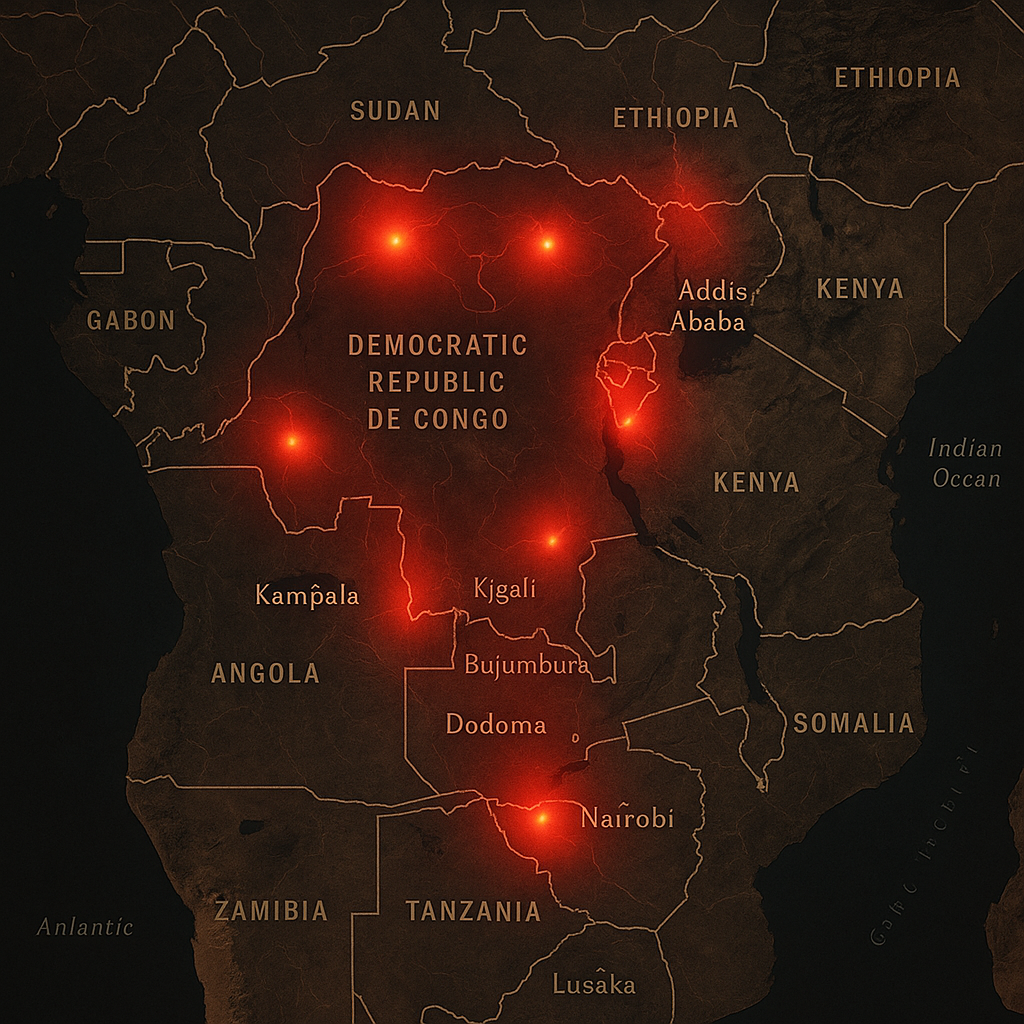
DRC faces a new Ebola crisis with the Bundibugyo strain. A stealthier virus, violence, and distrust complicate the international response.
A scary new type of Ebola, called Bundibugyo, is causing big problems in the Democratic Republic of Congo. It's not as deadly as some other kinds, but it spreads very fast and has been declared a global emergency. Doctors are worried because there's no special vaccine for this type yet, and it's happening in an area with lots of fighting, making it hard to help people. Local heroes, even widows who survived Ebola before, are using megaphones to teach people and fight misinformation, while drones help deliver supplies where roads are too dangerous. Everyone is watching to see if they can stop this tricky virus from spreading further.
What is the Bundibugyo Ebola strain currently affecting the Democratic Republic of Congo?
The Bundibugyo Ebola strain is a less familiar lineage of the Ebola virus, first identified in 2007. It causes death in about 50% of infected individuals, making it less lethal than the Zaire strain but potentially more cunning in its transmission velocity. This outbreak is a Public Health Emergency of International Concern.
Get Cape Town news in your inbox
Stay updated with the latest stories from the Mother City.
From Obscurity to International Alarm
A hemorrhagic tempest is now swirling above the steamy equatorial spine of Central and East Africa. Its opening shot came on a quiet Sunday when the World Health Organization stamped the newest Ebola episode in the Democratic Republic of Congo with the label every epidemiologist dreads: Public Health Emergency of International Concern. Surprisingly, the villain is not the notorious Zaire species that has terrorised headlines since 1976, but the far less familiar Bundibugyo lineage, a name that still draws blank stares from most doctors beyond the Great Lakes basin. First isolated in 2007 on the misty western slopes of Uganda’s Rwenzori range, Bundibugyo kills about one in every two people it infects, slotting neatly between the deadliest and mildest of its Ebola cousins. What it sacrifices in lethality, however, it seems to repay in cunning velocity.
The narrative began on 24 April when a 34-year-old nurse staggered into a modest outpatient facility in Bunia, capital of Ituri province, feverish, vomiting and bleeding. Because severe malaria and Lassa fever circulate year-round there, staff reached for familiar protocols. Only after three inmates of the same ward died within two days did anyone trigger haemorrhagic-fever procedures. By the time her blood reached the National Institute of Biomedical Research in Kinshasa, the young nurse - now retrospectively crowned patient zero - was dead. Contact tracing suggests she had earlier cleaned the wounds of a farmer who chopped up a monkey carcass found among his cassava, a textbook wildlife-to-human leap that keeps this family of viruses in circulation.
The current epicentre sprawls from Ituri’s emerald rainforest south through North Kivu to the jade shoreline of Lake Kivu, a strip of land that has been on military boil for years. The Rwanda-backed M23 militia controls several frontier posts and the strategic city of Goma, deciding who may travel the tarmac arteries and who may not. When a widow, already feverish, left Bunia’s central market in an overstuffed minibus and stepped off 200 kilometres later in Goma’s crowded Birere quarter, global ears pricked up. Lab confirmation landed within 36 hours of her arrival at Heal Africa Hospital, testimony to slicker diagnostics and to how effortlessly people slip across a border that exists mainly on maps.
Numbers, Bottlenecks and the Missing Shot
Africa CDC tallies 336 suspected infections and 88 lab-confirmed deaths, figures that almost certainly hide more than they reveal. Firefights have made whole hamlets unreachable, and WHO statisticians think only 35 percent of cases are being spotted, hinting the real caseload has already topped 900. The fog is thickened by a testing choke point: just two mobile labs - one in Beni, the other inside Goma’s airport fence - can PCR-confirm Bundibugyo. A four-hour reaction, Europe-flown reagents and daily power cuts mean results drip out, not pour.
Unlike Zaire Ebola, which faces the well-proven rVSV-ZEBOV and Ad26.ZEBOV/MVA-BN vaccines, Bundibugyo has no licensed shot. WHO keeps 5,000 investigational doses of a chimp-adenovirus prototype brewed at Oxford’s Jenner Institute, yet regulators want more immunogenicity data before green-lighting use. Lab studies in monkeys also show that the monoclonal cocktails mAb114 and REGN-EB3 - lifesavers in the 2018-20 Kivu catastrophe - neutralise Bundibugyo surface proteins only weakly. Clinicians are therefore thrown back on classic support: aggressive fluids, convalescent plasma when they can get it, and meticulous barrier nursing that demands supplies, power and trust.
For humanitarian planners the map constitutes a logistical nightmare. West from Bunia, a single laterite highway - pitted, seasonally flooded and dotted with militia roadblocks - threads 600 kilometres to Kisangani. The UN Humanitarian Air Service owns just two MI-8 helicopters cleared for red-zone flights, both presently busy evacuating wounded peacekeepers. Médecins Sans Frontières promised a 70-bed inflatable unit for Katwa on Butembo’s edge, yet a full Ebola Treatment Centre needs 4,000 levelled square metres, a permanent water source and armed perimeter security - commodities in desperately short supply.
Rumours, Roadblocks and Regional Shockwaves
Behavioural surveys reveal deep suspicion of government uniforms and foreign medical gear. A 2023 Kinshasa School of Public Health poll found that 54 percent of North Kivu respondents link Ebola vehicles to organ-harvesting rumours seeded by years of conflict propaganda. Vaccine reluctance is so entrenched that some traditional healers hawk powdered monkey bone as an antiviral amulet. Violence has already flared: on 3 June a WHO burial squad was shot at while retrieving a village chief near Komanda, forcing a 48-hour halt to safe-burial rites - the exact chasm through which the virus can gallop during mourning rituals.
Information itself has turned into contested terrain. Independent Goma radio stations run nightly phone-ins in Swahili, Lingala and Kinyarwanda, yet their transmitters are jammed whenever coverage veers toward militia politics. A TikTok clip claiming gin-and-salt-water will “incinerate” Ebola has gone locally viral. The Health Ministry has recruited popular influencers to fight fiction with five-minute reels, but only 12 percent of rural Ituri has internet access, so megaphone-wielding town criers, church sermons and market-day theatre still carry the heaviest public-health payload.
Neighbours are slamming gates. Uganda shuttered three frontier crossings and deployed rapid-response teams to Bundibugyo, Kasese and Ntoroko districts while the Entebbe Virus Research Institute sequences three imported genomes for ominous mutations. South Sudan has placed Yei and Kajo Keji on high alert; the counties shelter 60,000 Congolese refugees who have now fled both bullets and a virus. Trade arteries are hardening: cassava and palm-oil prices in Maridi have jumped 22 percent since movement restrictions began, and Kenyan port health officers in Mombasa subject every sailor with Congolese transit papers to thermal interrogation.
Science, Drones and Widows with Megaphones
Urban emergence in Goma is forcing scientists to rewrite textbook assumptions. Satellite shots show the city has swollen by 38 percent since 2018, pushing cinder-block suburbs onto fresh lava fields where bats forage at dusk. Night-market stalls now smoke with grilled Gambian pouched rats, a known Ebola carrier; one infected carcass can seed an entire informal food web. Genomic sleuths at the University of Edinburgh’s Centre for Immunity, Infection and Evolution are air-freighting five pocket-sized MinION sequencers to Goma, aiming to turn raw blood drops into publishable phylogenies in under 48 hours. Their models predict that if data can outrun the virus, isolating super-spreaders alone could push the reproductive number below one even without vaccines.
Yet every breakthrough must land in a city whose runway is capped at two wide-body jets and whose customs agents recently impounded 50 kilograms of expired PCR reagents. Fuel scarcity has grounded 40 percent of the motorcycle taxis that ferry samples and surveillance teams. WHO has therefore borrowed ranger patrol boats from Virunga National Park to skim 90 minutes across Lake Kivu to Bukavu, trimming six precarious road hours from the logistics chain.
Community cavalry is arriving from unexpected quarters. The Réseau des Femmes pour la Gestion Communautaire has trained 300 village health promoters - mostly widows who survived earlier Ebola waves - to go door-to-door with colour-coded flip charts. Their average schooling ends at fifth grade, but they speak five languages and carry moral authority no foreign expert can rent. In Komanda, one widow persuaded a respected imam to weave safe-burial guidance into Friday prayers, driving compliance sky-high in a neighbourhood that once stoned health workers.
Above the forest canopy, Belgian start-up AirScan is flying humanitarian drones whose multispectral eyes map night-time campfires and thus crowd density for a WHO dashboard refreshed every four hours. When militias block the roads, the same drones drop micro-pods of oral rehydration salts into cut-off hamlets, turning surveillance craft into mini-humanitarian air bridges. As the third week of June ticks over, a patchwork alliance - ministers, microbiologists, logisticians and widows armed with megaphones - is improvising a high-stakes experiment in global-health engineering. The planet now watches to see whether a pathogen discovered barely seventeen years ago can be caged before it hitches a ride beyond the volcanic lakes and equatorial forests that have, until now, kept its ambitions in check.
[{"question": "
What is the Bundibugyo Ebola strain and why is it a global concern?
", "answer": "The Bundibugyo Ebola strain is a less familiar type of Ebola virus, first identified in 2007. While it is less lethal than the more notorious Zaire strain (killing about 50% of those infected), it is causing alarm because it spreads very fast. The current outbreak in the Democratic Republic of Congo has been declared a Public Health Emergency of International Concern by the World Health Organization due to its rapid transmission and the challenging environment in which it's spreading."}, {"question": "How did the current Bundibugyo Ebola outbreak begin?
", "answer": "The current outbreak is believed to have started with a 34-year-old nurse in Bunia, Ituri province, who is retrospectively considered patient zero. Contact tracing suggests she cleaned the wounds of a farmer who had handled a monkey carcass, indicating a typical wildlife-to-human transmission event. The virus then spread, eventually reaching areas like Goma, a densely populated city, highlighting its rapid progression."}, {"question": "What challenges are hindering the response to this outbreak?
고려?", "answer": "Several factors are complicating the response. The region is plagued by ongoing conflict and military activity, making many areas inaccessible and creating deep suspicion of outsiders and medical interventions. There's also a lack of a specific, licensed vaccine for the Bundibugyo strain, and existing monoclonal antibody treatments for other Ebola types are only weakly effective against it. Logistical nightmares, such as poor infrastructure, limited air transport, and power cuts, further impede aid efforts and sample testing. Additionally, widespread misinformation and rumors fuel vaccine hesitancy and distrust of health workers."}, {"question": "Are there any vaccines or specific treatments available for Bundibugyo Ebola?
", "answer": "Unlike the Zaire Ebola strain, for which effective vaccines like rVSV-ZEBOV and Ad26.ZEBOV/MVA-BN exist, there is currently no licensed vaccine specifically for Bundibugyo Ebola. While the WHO has investigational doses of a prototype chimp-adenovirus vaccine, more data is needed for its approval. Standard Ebola treatments like monoclonal antibodies (mAb114 and REGN-EB3) have shown only weak effectiveness against the Bundibugyo surface proteins. Therefore, treatment largely relies on aggressive supportive care, including fluids and meticulous barrier nursing."}, {"question": "How are local communities and technology being leveraged to combat the spread?
", "answer": "Local heroes are playing a crucial role. Widows who survived previous Ebola outbreaks are using megaphones and flip charts to educate their communities and fight misinformation, leveraging their moral authority and fluency in local languages. Technology is also being deployed: drones are used to map crowd density, deliver essential supplies to cut-off areas, and help navigate dangerous terrain. Scientists are using portable sequencers to rapidly analyze blood samples and track the virus's evolution, aiming to identify super-spreaders to contain the outbreak."}, {"question": "What impact is this outbreak having on neighboring countries?
", "answer": "The rapid spread of the Bundibugyo strain is causing regional alarm. Neighboring countries like Uganda and South Sudan have implemented heightened border controls, deployed rapid-response teams, and placed areas with large Congolese refugee populations on high alert. Trade routes are also being affected, leading to increased prices for essential goods. Kenyan port health officers are also conducting thermal screenings for sailors with Congolese transit papers, indicating widespread concern about the virus crossing borders.", "bold": true}]
Hannah Kriel is a Cape Town-born journalist who chronicles the city’s evolving food scene—from Bo-Kaap spice routes to Constantia vineyards—for local and international outlets. When she’s not interviewing chefs or tracking the harvest on her grandparents’ Stellenbosch farm, you’ll find her surfing the Atlantic breaks she first rode as a schoolgirl.
View all articles →