
WHY ARE CHINESE CARS GAINING GROUND?
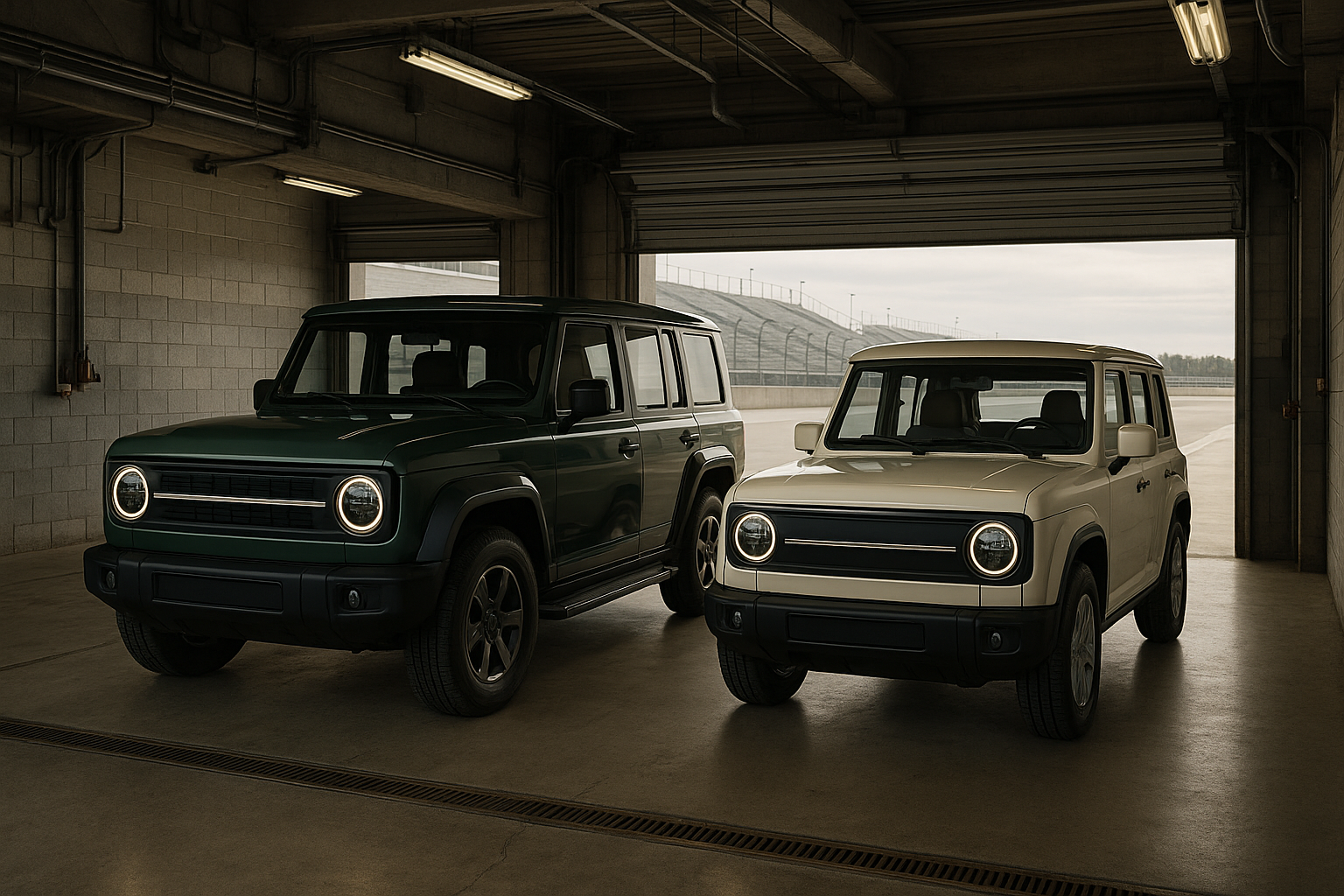
iCAUR lands in SA with electric retro SUVs. Explore market timing, pricing, tech, and the crucial safety debate around these new EVs.
iCAUR, Chery's new electric car brand, just launched in South Africa with cool retro-looking SUVs.
These cars, the V23 and 03T, mix old-school style with modern electric power, made just for places like South Africa.
They are cheaper than some rivals, and they come with good warranties and plans to make owning an EV easy.
iCAUR is also building a charging network and promises strong safety, even though local safety tests are still being worked out.
This new brand is making a big splash, showing that electric cars are here to stay in South Africa.
What is iCAUR and what vehicles does it offer in South Africa?
iCAUR is Chery's new electric-only vehicle brand, launched in South Africa. It offers two retro-styled EV SUVs: the compact V23 and the larger 03T. These vehicles feature nostalgic designs with modern electric powertrains, designed specifically for right-hand-drive markets.
Get Cape Town news in your inbox
Stay updated with the latest stories from the Mother City.
A New Brand Hits Kyalami
One look at the badge and you feel you’ve seen it before: the four letters i-C-A-U-R place the word “car” between two vowels, a subtle wink at Chinese parent Chery without actually spelling it. Two weeks ago the pit garages of the Kyalami Grand Prix Circuit became the unlikely runway for the marque’s debut. In front of the assembled media stood the V23 and the longer 03T - both boxy silhouettes, blunt fronts, circular LED lamps framed in gloss-black and rooflines that deliberately evoke the square-shouldered 4×4 heroes of the 1980s. Under the nostalgic panels sits a skateboard floorpan called the S5X-EV, which Chery claims is its freshest global battery architecture.
The scene was pure theatre: concrete floors echoing under neon strips, the whir of tyre-warmers replaced by the hushed click of EV coolers. Visitors circled the cars like vintage art at a gallery, smartphones raised to capture the pastel-hued paintwork - Karoo Dust, Drakensberg Slate, Cango Cobalt and Amarula Cream - names chosen to resonate on local soil.
Product Line-up, Power and Range
iCAUR is Chery’s electric-only sandbox, kept separate from the petrol and hybrid portfolios of sister labels Omoda and Jaecoo. You won’t find these vehicles on a Beijing forecourt; the programme was designed for right-hand-drive countries in South-East Asia, Latin America and, first out of the gate, South Africa.
The V23 rides on a 2 650 mm wheelbase, with 190 mm of ground clearance and a sealed battery housing certified IP68, letting it ford 400 mm of water. Output choices run from 100 kW in the entry Air trim to 150 kW in the long-range Pro+. Battery chemistry splits between a 47 kWh lithium-iron-phosphate pack and a 63 kWh nickel-manganese-cobalt unit. Step up to the 03T and you gain 200 mm of extra body length and an available third seat row. Its range-topping dual-motor flagship throws 250 kW and 510 Nm at the tarmac, rocketing from rest to 100 km/h in 5.9 seconds.
Pricing Sweet Spot and Ownership Costs
Sticker shock - or the lack of it - was the first talking point in the Kyalami paddock:
- V23 Air opens at R519 900, slipping roughly R40 000 under the GWM Ora 03 and almost R100 000 beneath the BYD Atto 3, yet stands R70 000 above the bargain-priced JAC e-JS4.
- 03T kicks off at R639 900, locking horns with the Volvo EX30 Single Motor Extended Range, though the Swede’s import burden softens any bragging rights.
Chery’s finance desk, backed by Absa, markets a “fuel-switch plan” that equalises monthly instalments with equivalent petrol SUVs once the pump-price saving is tallied. The calculator uses inland 95-octane at R25/litre and 15 000 km a year, arriving at a net monthly bill of R6 800 for the V23 Air versus R7 050 for a 1.5-litre turbo rival.
Tech Cockpit, Charging Web and Real-World Range
Digital Cabin and Driver Aids
Slide inside and the retro vibe continues - matte-anodised toggle switches, knurled rotary knobs - yet the electronics are purely 2024. A 15.6-inch OLED central display hosts Chery’s Intelligent Cockpit 4.0, running on an open-source Android branch that receives over-the-air tweaks every six weeks. A 10.25-inch digital instrument cluster can morph into faux analogue gauges for nostalgia lovers. Wireless Apple CarPlay and Android Auto are baked in, while the voice assistant “KAI” understands prompts in any of 11 South African languages. The training set came from a three-week TikTok crowdsourcing sprint.
Level-2 assistance is standard across the board: eight ultrasonic sensors, three millimetre-wave radars and a forward mono-camera feeding Mobileye’s EyeQ5 chip. The net result is adaptive cruise, lane centring, traffic-jam pilot up to 60 km/h and a parking routine that can memorise garage paths as long as 100 m.
Charging Ecosystem and Road-Trip Reality
Before the first customer key is handed over, iCAUR has stitched up a memorandum of understanding with GridCars and Rubicon. Every existing 80 kW and 150 kW DC station on the N1, N2 and N3 corridors is now open to owners. A three-year GridCars subscription sits baked into the purchase price; RFID tags also work across roaming partners Chargify and Jaguar PowerWay.
On an 80 kW DC post, the 47 kWh pack scoots from 30 % to 80 % in 28 minutes; the 63 kWh pack needs 38 minutes. Plug into an 11 kW home wallbox and either battery is full by breakfast. Laboratory WLTP figures claim 315 km for the V23 Air and 420 km for the Pro+; however, Gerotek engineers logged an average of 275 km at a steady 120 km/h with cabin climate locked at 22 °C. Not headline-grabbing, but respectable for the segment.
Platform Strength, Safety Scrutiny and Worry-Free Ownership
Engineering Bones and Safety Backdrop
Chery engineers boast that the skateboard chassis twists at 28 000 Nm/deg, matching premium European C-segment EVs. An aluminium extrusion lower frame marries a high-strength-steel upper shell to handle offset frontal and small-overlap crashes that dominate NCAP protocols. The styling team still had to squeeze a 400 mm-thick battery between the axles without raising the roofline sky-high. Their compromise - a cab-rearward silhouette and slightly taller greenhouse - delivers ample headroom yet preserves the toy-truck stance of a mini FJ Cruiser.
But a storm cloud formed in late March when Automobile Association CEO Bobby Ramagwede revived a long-running grievance: the gulf between European NCAP and the self-certification allowed under South Africa’s UN-ECE system. South Africa’s rating programme, dormant since 2017, may yet be revived; the Department of Transport has promised a feasibility study within twelve months. Until then, buyers are advised to mine Latin or ASEAN NCAP scores for near-identical derivations.
Evidence Behind the Curtain
European journalists recently spied the V23 in zebra wrap outside TÜV SÜD’s Munich crash labs, signalling that Euro NCAP testing could begin late in 2024. Leaked Chinese social-media clips show a 64 km/h deformable-barrier run: brake-pedal intrusion 80 mm, A-pillar deflection 22 mm, door-opening force 480 N. Side-pole impacts are cushioned by a waffle-pattern aluminium rocker-panel honeycomb and dual-row curtain bags that stay inflated for 5.5 seconds - vital in multi-roll events. iCAUR SA’s product planner Thabang Mokoena insists that every car sold here carries the identical “global safety pack,” pending official stars.
Warranty, Service Network and Residual Prospects
Peace-of-mind credentials stack up as follows:
- Battery: eight years or 160 000 km
- Motor and power electronics: seven years or 150 000 km
- Rest of the vehicle: five years or 100 000 km
A five-year or 60 000 km maintenance plan is bundled in, with technician re-certification twice a year at the Pretoria West training centre, complete with CAT III high-voltage rigs and an isolated 1 000 V bench.
TransUnion Auto forecasts 56 % value retention at 36 months/60 000 km - trailing the Toyota Corolla Cross yet edging ahead of the Haval Jolion. The forecast hinges on battery health: Chery guarantees 77 % capacity to 160 000 km and offers refurbishment or outright replacement if the threshold slips.
Sales Footprint, Fleet Pull and Environmental Loop
At launch, customers can walk into 18 “brand clinics” embedded within existing Chery dealerships from Ballito to Stellenbosch. Each outlet packs at least two EV-qualified technicians and at least one public 150 kW DC charger. Ten standalone iCAUR stores will follow in 2025, reaching secondary cities such as Polokwane and East London. Infrastructure spend over three years pushes past R1.2 billion, including a semi-knocked-down body-in-white facility in Port Elizabeth slated for 2026.
Mining giants Anglo American Platinum and Sibanye-Stillwater are already running pilot V23s at tailings sites near Rustenburg, lured by the 400 mm wading depth and zero tail-pipe emissions. Corporate lessor Avis Budget has signed for 300 units, swapping out Kia Seltos petrols on 36-month cycles. For companies, Section 12B of the Income Tax Act allows 125 % first-year depreciation on EVs priced under R900 000 - a direct tax-year saving.
Battery life is a cradle-to-grave story. Chery has teamed with EnviroServ and uYilo e-Mobility to route every end-of-life pack to a hydrometallurgical plant in Atlantis, Cape Town. Lithium, cobalt, nickel and manganese are harvested at 88 % yield and shipped back to Chery’s new LFP facility in Anhui province. A QR code laser-etched on each pack tracks origin, chemistry and mileage, satisfying Basel Convention rules.
The Market Snapshot and What Comes Next
On the first retail Saturday after launch, the Kyalami showroom tallied 87 test drives, 38 credit applications and 23 confirmed orders - 70 % for the V23, 30 % for the 03T. Average buyer age: 39; 60 % female; and 82 % elected the R2 500 home-charger bundle instead of R1 200 worth of public-charge credits. By 4 p.m. the demo cars were sipping electrons under the 150 kW charger every thirty-five minutes, a preview of the daily rhythm South Africa’s EV ecosystem is about to inherit, one dealership at a time.
What is iCAUR and what vehicles does it offer in South Africa?
iCAUR is Chery's new electric-only vehicle brand, launched in South Africa. It offers two retro-styled EV SUVs: the compact V23 and the larger 03T. These vehicles feature nostalgic designs with modern electric powertrains, designed specifically for right-hand-drive markets.
What are the key design philosophies behind iCAUR vehicles?
iCAUR vehicles, specifically the V23 and 03T, blend retro, boxy silhouettes with modern electric technology. They feature blunt fronts, circular LED lamps, and rooflines that evoke 1980s 4x4s. The interior maintains this retro-modern theme with matte-anodised toggle switches and knurled rotary knobs, alongside a 15.6-inch OLED central display and a 10.25-inch digital instrument cluster.
How does iCAUR's pricing compare to competitors, and what ownership benefits are offered?
iCAUR vehicles are competitively priced, with the V23 Air starting at R519,900, positioning it below some rivals like the GWM Ora 03 and BYD Atto 3, though above the JAC e-JS4. The 03T starts at R639,900. iCAUR offers a "fuel-switch plan" to equalize monthly installments with petrol SUVs, comprehensive warranties (8 years/160,000 km for the battery, 7 years/150,000 km for motor/power electronics), and a 5-year/60,000 km maintenance plan. Corporate buyers also benefit from Section 12B tax deductions.
What are the technical specifications and range of the iCAUR V23 and 03T?
The V23 rides on a 2,650 mm wheelbase with 190 mm ground clearance. Power outputs range from 100 kW to 150 kW, with battery options of 47 kWh (LFP) or 63 kWh (NMC). The 03T is 200 mm longer and offers a dual-motor flagship with 250 kW and 510 Nm, achieving 0-100 km/h in 5.9 seconds. WLTP ranges are 315 km for the V23 Air and 420 km for the Pro+, with real-world testing showing approximately 275 km at 120 km/h.
What is iCAUR doing to support charging and infrastructure in South Africa?
iCAUR has partnered with GridCars and Rubicon to provide access to existing 80 kW and 150 kW DC charging stations across major corridors. A three-year GridCars subscription is included with purchase, and RFID tags work with roaming partners like Chargify and Jaguar PowerWay. For home charging, an 11 kW wallbox can fully charge the batteries overnight. Fast charging from 30% to 80% takes 28 minutes for the 47 kWh pack and 38 minutes for the 63 kWh pack on an 80 kW DC post.
What is iCAUR's stance on safety, and what warranties are provided?
iCAUR emphasizes strong safety, stating that all vehicles sold in South Africa carry an identical "global safety pack." While local safety tests are currently under review in South Africa, iCAUR's chassis is engineered for high torsional rigidity, and European NCAP testing is anticipated. Standard safety features include Level-2 driver assistance with adaptive cruise control, lane centring, and traffic-jam pilot. Warranties include 8 years/160,000 km for the battery, 7 years/150,000 km for the motor and power electronics, and 5 years/100,000 km for the rest of the vehicle. A 5-year/60,000 km maintenance plan is also included.

Tumi Makgale is a Cape Town-based journalist whose crisp reportage on the city’s booming green-tech scene is regularly featured in the Mail & Guardian and Daily Maverick. Born and raised in Gugulethu, she still spends Saturdays bargaining for snoek at the harbour with her gogo, a ritual that keeps her rooted in the rhythms of the Cape while she tracks the continent’s next clean-energy breakthroughs.
View all articles →