
Boeing 737 completes rare Antarctica landing after Cape Town departure
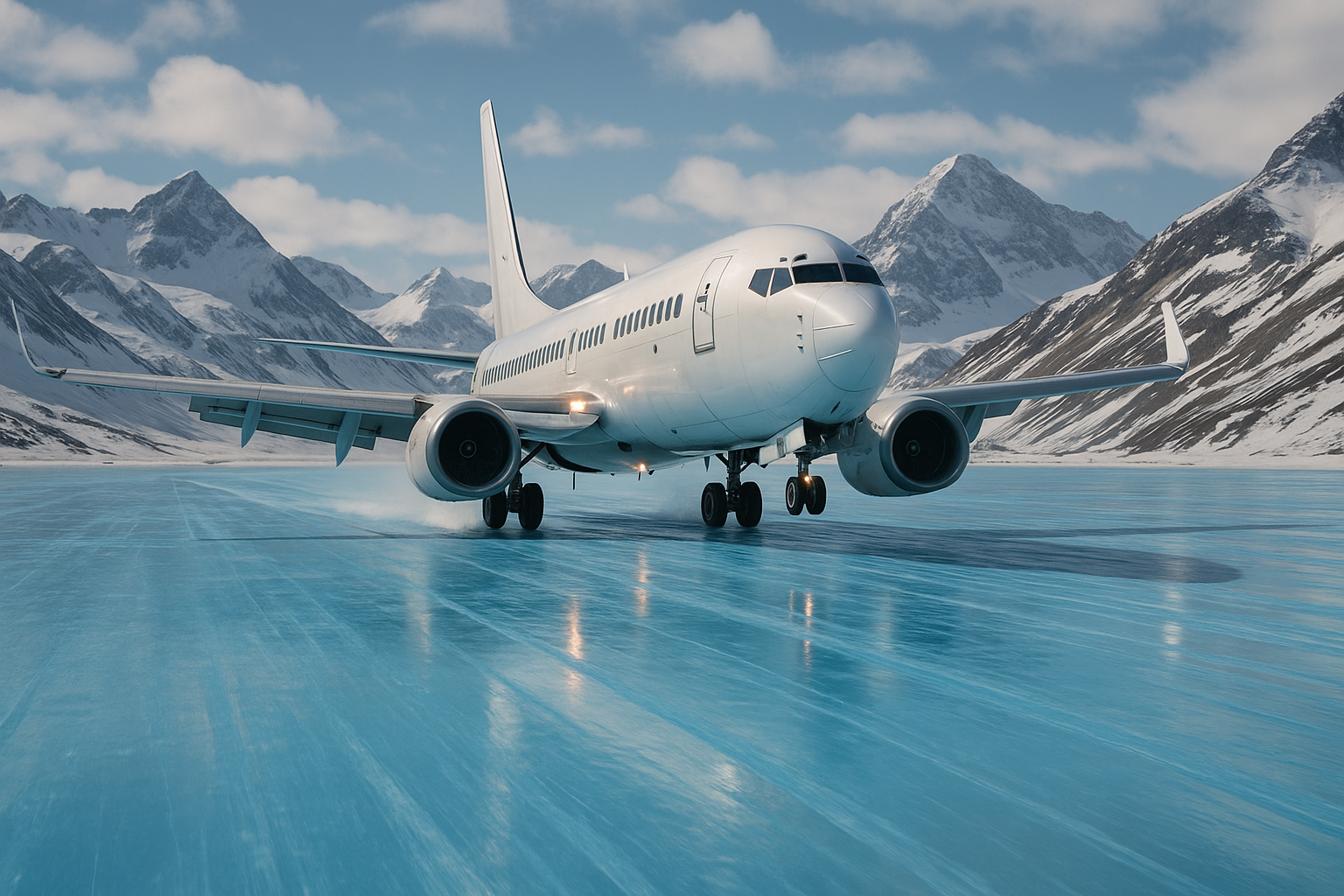
Explore the extreme engineering and unique challenges of operating a 737 on Antarctica's moving ice runway at Troll Research Station.
The Troll Airfield in Antarctica is unique because it's built on a moving ice sheet. Every year, a special team uses radar to find cracks in the ice and then a big old snow-planer called Ericsson smooths the runway super flat. They even leave a tiny bit of snow on top to make sure planes can land safely without slipping. This amazing process keeps the runway ready for planes, even though the ice underneath is always shifting!
How is the Troll Airfield maintained despite being on a moving ice sheet?
The Troll Airfield, located on a kilometer-thick, slow-moving ice slab, is maintained through an annual process. Each December, a joint Norwegian-American survey convoy uses ground-penetrating radar to detect new crevasses. An antique snow-planer, "Ericsson," then levels the 3,000-meter strip to within five centimeters, creating a polished, sapphire-like surface with a micro-layer of snow for optimal friction.
Get Cape Town news in your inbox
Stay updated with the latest stories from the Mother City.
1. A Living Plate of Ice – How a Highway is Reborn Every Year
More than two hundred kilometres inland from the sea-ice cliffs of Jutulstraumen, the Troll Research Station sits on a slow-motion river of ice a kilometre and a quarter thick. That slab is not static; it slides seaward at a walking pace of three metres every twelve months. Because the frozen highway the Norwegians call “Troll Airfield” is cut from the same moving mass, its geometry changes daily. Each December a joint Norwegian-American survey convoy fires ground-penetrating radar down the 3 000-metre strip, hunting crevasses that have crept sideways since the last scan. A harmless hairline fracture in March can park itself under the touchdown zone by September, so the team redraws the safe corridor from scratch.
Once the sub-surface map is clean, a bright-orange antique clears the stage. “Ericsson,” a 1954 Swedish snow-planer, lumbers across the ice on twin four-metre steel skis. At twenty-eight tonnes the machine sounds obese, yet the weight spreads so wide that a booted human exerts more pressure per square centimetre. Ericsson planes the surface to within five centimetres of design elevation - tighter than many public roads - because a 737’s nose-gear tyre, half-frozen at –30 °C, loses nearly a third of its normal flex and will hammer on any pebble bigger than a tennis ball.
The finished lane looks like polished sapphire. Crews leave a micro-layer of beaded snow: too glassy and rubber will hydroplane; too coarse and tread blocks can freeze to the ground on rollout. That balance is checked by dragging a thirty-kilogram steel shoe shod with fresh Dunlop airline rubber at thirty kilometres per hour. If the meter spits out a friction “mu” of 0.30 or better, the runway is declared open; last season the gauge read 0.34, good news for the arriving 737.
2. Fuel That Thinks It’s Jelly – Cold-Soaked Kerosene and the Heaters That Save a Flight
Jet-A is a liquid only down to –40 °C; go three degrees lower and it clouds into waxy slush. The Boeing departed Cape Town carrying seventeen tonnes chilled to –36 °C, but four hours south of the convergence line the outside air sank to –71 °C. Unchecked, the centre tank would have started to gel ninety minutes before the crew even sighted the coast - too late to divert anywhere except the Southern Ocean.
To keep the boost pumps breathing, technicians strap two 400-watt silicone band heaters around each pickup, hardware normally reserved for Alaskan helicopter gearboxes. Power is drawn from the APU, backed by a lithium-ion brick rated for –60 °C. The heaters sip less energy than a pair of hair-dryers, yet without them fuel-flow would twitch, engines would hiccup, and the logbook would record an expensive turnaround.
Cold-soak discipline starts long before departure. In Cape Town the fuel farm drops truck-loading temperature to –36 °C so the tanks begin the flight already sub-zero; every degree the heaters don’t have to claw back is a margin earned. By the time the 737 levels at flight-plan latitude, the probes show the kerosene hovering at –38 °C - liquid enough to burn, thick enough to remind engineers why they pack electric blankets.
3. A Flight Deck Dressed for Winter – Windshields, Wool and the £180 000 Crack That Mustn’t Happen
The forward windshield heat exchanger is certified to –55 °C, a threshold the stratosphere laughs at. Drop the glass to –70 °C, then flash it to +10 °C with anti-ice film, and thermal shock can spider the outer ply. A replacement pane, freight, and an idle aircraft bill about £180 000, so crews pamper the windows instead. Cockpit lights dim to reduce glare, descent rate eases by two hundred feet per minute, and windshield heat stays off until the wheels kiss the ice. Pilots accept a temporary frost ring in the corners, cheaper than a cracked sheet.
Finger warmth is equally vital. Norwegian long-johns and wool mid-layers are standard, but fingertips still freeze while dialing baro corrections. Each pilot plugs electrically heated gloves into the 28-volt cigar-lighter socket - an outlet marketed for passenger iPads - so they can twist knobs without numb stumbles.
The seat-belt sign is not the only warning that matters. Reverse-thrust is capped at seventy percent N1 until sixty knots, enough to keep compressor stators from icing yet low enough to avoid blasting loose granules into the intakes. Smartwings’ polar addendum runs to thirty pages; every clause is the child of an earlier scar.
4. A Strip That Bobs With the Ocean – Tides, Tech and Tomorrow’s 737 Freighter
Antarctica is not a continent free of tides; it merely hides them under ice. The Troll runway rises and falls 1.2 metres every day as the Southern Ocean breathes beneath the floating sheet. Approach charts therefore list two threshold elevations - “high” and “low” - updated weekly by GPS static survey. On the February flight the tide was ebbing; selecting the low value gifted the 737 an extra eighty centimetres over the bamboo pole that doubles as localiser antenna. Land three hours earlier and the crew would have needed a two-degree steeper glide to clear the same pole, a geometry the autopilot does not keep in memory.
Weight matters on the way home, but passengers are only part of the story. Thirty-eight people boarded in Cape Town; six weeks later twenty-six climbed back. Even so, zero-fuel weight fell by 780 kg, because every resident exhales roughly a kilogram of water vapour daily that ends up as frost on walls, ceilings, and door seals. Crews attack the white fuzz with heat guns, collect the melt in jerry-cans, and dump it into the snow to meet Norway’s grey-water rules. Only when the cabin is frost-free can the performance computer certify a safe take-off from the 3 000-metre strip.
Looking ahead, Norway’s logistics consortium has already inked a deal for a 737-800BCF freighter that can haul twenty-three tonnes - eight more than today’s MAX 8 - non-stop from Perth to Troll thanks to extra belly tanks. Simultaneously, Airbus plans to station a Zephyr S solar UAV at sixty-five thousand feet for ninety-day shifts, relaying ADS-B and Iridium traffic so the 737 can drop archaic HF position reports. If the tandem works, Antarctica shifts from an episodic curiosity to a scheduled freight market, and the ice runway that drifts with the continent will finally earn a slot on the global air-cargo timetable.
How is the Troll Airfield maintained despite being on a moving ice sheet?
The Troll Airfield, located on a kilometer-thick, slow-moving ice slab, is maintained through an annual process. Each December, a joint Norwegian-American survey convoy uses ground-penetrating radar to detect new crevasses. An antique snow-planer, "Ericsson," then levels the 3,000-meter strip to within five centimeters, creating a polished, sapphire-like surface with a micro-layer of snow for optimal friction.
What unique challenges does extreme cold pose for aircraft fuel at Troll?
Jet-A fuel, typically used in aircraft, begins to cloud and form waxy slush at temperatures below –40 °C. Given that outside air temperatures in Antarctica can drop to –71 °C, aircraft flying to Troll Airfield must use specialized silicone band heaters attached to the fuel boost pumps. These heaters, usually reserved for Alaskan helicopter gearboxes, prevent the fuel from gelling, ensuring a continuous flow to the engines. Fuel is also pre-cooled to –36 °C in Cape Town to maximize the effectiveness of these heaters.
How do pilots protect aircraft windshields and themselves from extreme cold during flights to Troll?
Aircraft windshields are vulnerable to thermal shock at the extreme Antarctic temperatures. To prevent a costly £180,000 crack, pilots dim cockpit lights to reduce glare, decrease descent rates, and keep windshield heat off until just before landing. They accept a temporary frost ring rather than risking damage. For personal comfort and functionality, pilots wear Norwegian long-johns and wool mid-layers, and use electrically heated gloves plugged into the aircraft's 28-volt sockets to maintain dexterity for operating controls.
How does the moving ice sheet impact the Troll Airfield's elevation and landing procedures?
Antarctica's floating ice sheet, on which Troll Airfield is built, experiences daily tides, causing the runway to rise and fall by 1.2 meters. Consequently, approach charts list two threshold elevations – "high" and "low" – updated weekly via GPS static surveys. Pilots must account for these tidal changes, as landing at different tidal phases can significantly alter the required glide path to clear obstacles like the localizer antenna.
What measures are taken to manage aircraft weight and ice accumulation on return flights from Troll?
On return flights, even with fewer passengers, aircraft zero-fuel weight decreases significantly. This is partly due to the fact that station residents exhale water vapor that freezes as frost inside the aircraft cabin over time. Crews meticulously remove this frost with heat guns and collect the meltwater, dumping it into the snow to comply with environmental regulations. The cabin must be completely frost-free before the performance computer can certify a safe takeoff from the 3,000-meter runway.
What are the future plans for Troll Airfield to enhance cargo and communication capabilities?
Norway's logistics consortium is investing in a 737-800BCF freighter, capable of hauling 23 tonnes (8 more than current aircraft) non-stop from Perth to Troll, thanks to additional belly tanks. Concurrently, Airbus plans to deploy a Zephyr S solar UAV at 65,000 feet for 90-day shifts. This UAV will relay ADS-B and Iridium traffic, allowing the 737 to eliminate archaic HF position reports. These advancements aim to transform Antarctica from an episodic destination into a scheduled global air-cargo market.

Sarah Kendricks is a Cape Town journalist who covers the city’s vibrant food scene, from township kitchens reinventing heritage dishes to sustainable fine-dining at the foot of Table Mountain. Raised between Bo-Kaap spice stalls and her grandmother’s kitchen in Khayelitsha, she brings a lived intimacy to every story, tracing how a plate of food carries the politics, migrations and memories of the Cape.
View all articles →