
Braille signs open coast to all
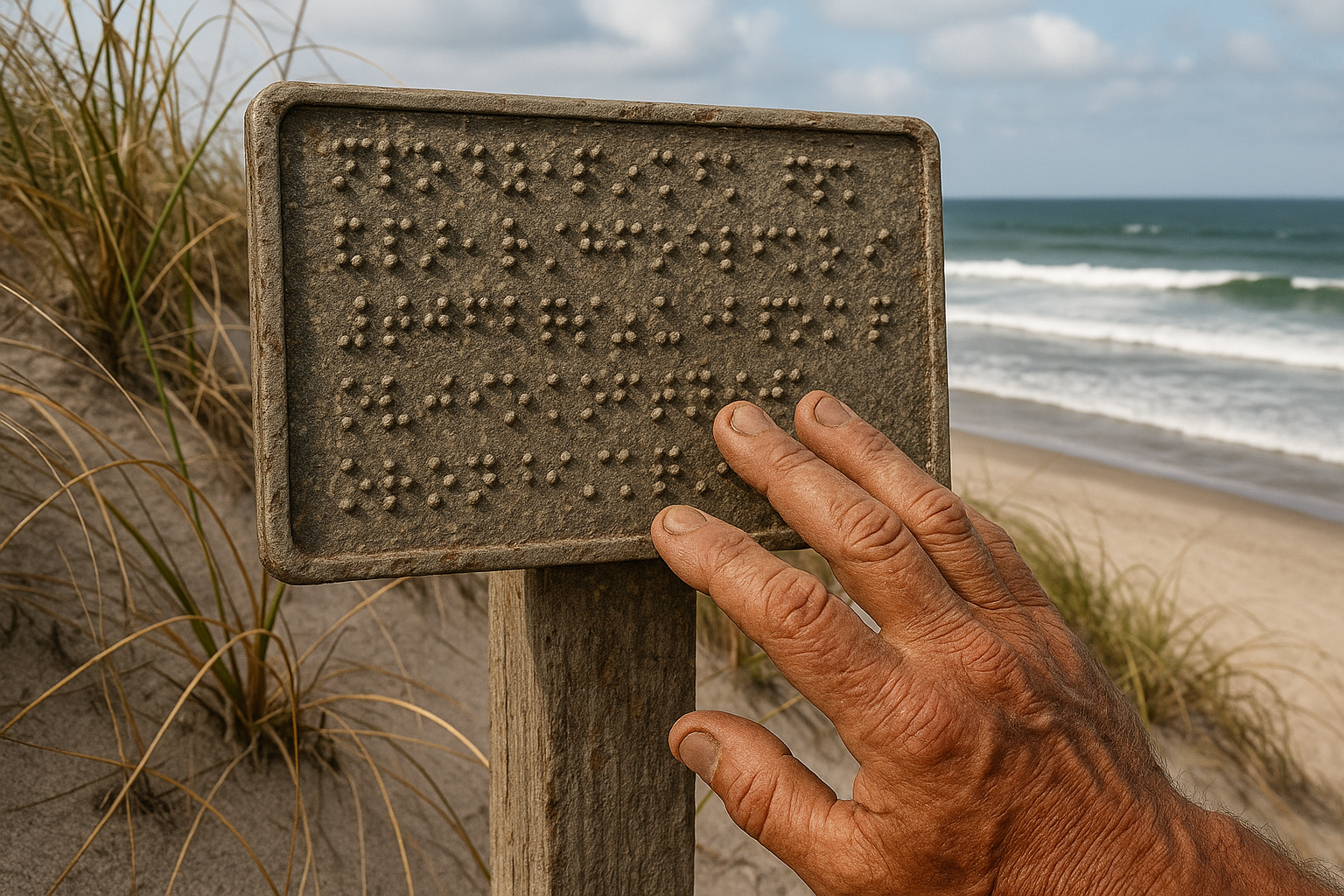
A single Braille sign at Eerste Steen, South Africa, is revolutionizing accessibility, blending ecology, tech, and community.
South Africa is changing the game with a cool new invention: coastal Braille! It's not just words; it turns beach info into something you can touch, smell, and hear. Imagine feeling the wind's direction or smelling prawn, all from a special sign. This amazing idea means everyone, even those who can't see, can now really explore and enjoy the beautiful South African coast. It's making beaches welcoming for absolutely everyone, and it's spreading fast!
What is coastal Braille?
Coastal Braille translates environmental information into a tactile and multi-sensory experience for visually impaired individuals. It converts complex ecological data, like wind direction, shell curvature, and species identification, into 180 words and includes sensory elements such as scent and sound. This innovative approach redefines beach access in South Africa.
Get Cape Town news in your inbox
Stay updated with the latest stories from the Mother City.
The Ridge Where Two Oceans Meet – and a New Door Swings Open
A low dune-crowned ridge inside Blaauwberg Nature Reserve divides Cape Town’s postcard skyline from the wild West Coast. Locals call the spot Eerste Steen, “first stone,” after a 1700s milestone that once measured the wagon road to Saldanha. On 11 February the picnic lawns gained a slate-grey lectern hardly taller than a beach chair. Joggers glanced, shrugged, carried on. Anele Jaxa, a 17-year-old from Athlone School for the Blind, stepped forward, fingers outstretched. Raised dots spelled out milkwood canopies, rain-frog hideouts, salt-sticky leaves. For the first time she did not wait for someone else to tell her what the view looked like; the view spoke for itself.
The panel’s arrival was deliberately quiet - no ribbon-cutting celebrities, no flashing cameras. Yet its ripples are already travelling faster than the gales that scour this coastline each summer. By April an estimated 1,200 sets of fingertips will have brushed across its surface, translating terrain into language that needs no eyesight. Pensioners who lost vision to diabetes, toddlers still learning the six-dot code, surfers with tunnel vision, and field-rangers on rest days: all are adding wear marks that will, in 24 years, erode the dots flush with the sheet. The replacement cycle has already been budgeted; the bigger story is how a sliver of plastic and aluminium nudged an entire country to rethink “beach access.”
No legislation paraded the sign into existence. Instead, a conservation NGO, a university design studio, a commercial bank and a handful of blind teenagers crowdsourced a micro-solution that piggy-backed on existing bylaws. The result is a working prototype that turns a single boardwalk node into a launchpad for 280 more Blue-Flag and Green-Coast sites. If the model keeps spreading, South Africa’s 3,000 km shoreline could become the longest continuous Braille trail on earth - without a single new act of Parliament.
Translating a 42-Page Plan into 180 Words You Can Feel
Standard Braille spells words; coastal Braille must spell wind direction, shell curvature, the difference between a dune antlion and a kelp hopper. WESSA’s design crew, industrial-engineering students from Stellenbosch University’s Sustainability Institute, began by shredding the reserve’s 42-page environmental-management plan into bite-sized sensory facts. One hundred and eighty words survived. Each draft was read aloud, picked apart and re-typed by a focus group recruited by Blind SA - surfers with retinitis pigmentosa, pensioners with diabetic retinopathy, Grade-9 kids with albinism who already knew how quickly well-meaning text can sound patronising.
Version 1 tried poetic metaphors (“milkwood leaves are Nature’s Tupperware”). The jury vetoed it. Version 2 leaned on eco-jargon (“phenological carbon sequestration”). Another thumbs-down. Version 3 served hard numbers - leaf length, trunk circumference, grams of carbon stored per square metre - then invited touch: “Crush a leaf; smell sun-dried prawn.” That passed. The text shrank to 180 words, yet every noun was field-checked against something a fingertip or nostril could verify. Surfers suggested adding grain-size ranges so beach-casters could “read” which bait works where. Birders demanded onomatopoeia for oyster-catcher calls. The final cheat-sheet is a marriage of atlas and kitchen: botany you can taste, zoology you can hear, geology you can stub your toe against.
Language politics arrived last. Afrikaans Braille swaps some English symbols; isiXhosa needs Grade-2 contraction to stop agglutinative verbs from spilling off the sheet. Rather than print three panels, engineers invented a rotating collar at the base. Twist left for Afrikaans, right for isiXhosa, centre for English. A soft detent clicks every 30°, confirming choice without vision. The device is tiny, but it is the first mechanical tri-language Braille switch on record - open-licensed so cash-strapped municipalities from Maputo to Mumbai can 3-D-print their own.
Sand, Salt and UV Rays: Materials That Survive Teenagers and Tempests
Coastal signs die twice: first by vandal boredom, then by salt-laden gales that scour paint down to bare metal. The Eerste Steen panel is a triple-decker sandwich. The face is ultra-high-molecular-weight polyethylene, the same slick stuff used on artificial knees. A 40-watt fibre laser pops each dot 0.48 mm high - an extra 0.08 mm to stay readable beneath calloused roofer fingers. The core is aluminium honeycomb, light enough to carry in a backpack yet rigid enough not to drum when the southeaster hits 180 km/h. Rivets are torqued to 12 newton-metres so the sheet stays mute; visually impaired visitors often home in on the panel by listening for a change in wind tone.
A fluoropolymer clear-coat adds friction comparable to fine sand-paper, preventing the glazed slip that makes cheap hotel-Braille unreadable. Engineers staged a week-long torture test: one panel in a salt-fog chamber, another in a UV oven, a third peppered with skateboard kicks. Only the kicks left marks, and only for the first 24 hours; teenagers lost interest once they realised nothing peeled off. Maintenance is deliberately low-tech. A bucket of soapy water and a soft brush once a month keep the dots salt-free. If the surface ever dulls, a quick swipe with a butane torch re-flows the polymer and restores friction - no parts to import, no special tools.
Flip the board and you’ll discover a near-infrared QR code invisible to human eyes. Phone cameras set to IR mode can read it, launching a geofenced audio layer: dawn bird counts, noon hush, midnight spring-tide surge recorded with binaural microphones. Stream it more than 500 m away and you get a 30-second teaser; inside the perimeter you receive the full three-minute track. The payoff is subtle - real surf continues underneath, so users hear both the live beach and its ghost soundtrack. Musicians donated stems on Creative Commons; WESSA merely packaged them into an acoustic breadcrumb trail.
Rand, Ruin and Replication: How Inclusion Becomes an Asset Class
Nedbank’s green-bond bean-counters found a way to treat the Braille panel as collateral. The arithmetic is simple: a recycled-polyethene board saves 0.4 tCO₂ compared with painted steel. Multiply by the bank’s internal carbon price (ZAR 307 per tonne) and the panel earns itself a 4.2 % internal rate of return - enough to fund replacement every seven years without fresh donor cash. Scale the model across 280 Blue Flag and Green Coast beaches and you conjure a ZAR 1.8 million security pool, a slice of which can be pledged against bigger adaptation loans such as dune restoration or sea-wall upgrades. Inclusion becomes an asset; accessibility morphs into infrastructure.
Municipal bean-counters like what they see. Cape Town’s coastal by-law already obliges new signage to pass an environmental checklist. WESSA legal fellow Chumani Mokoena drafted a one-page accessibility protocol that piggy-backs onto the same checklist - no new statute, just an extra tick-box. Published for comment on 1 March, the clause could make Braille-and-audio interpretation the default for every permit issued after July. Durban and Nelson Mandela Bay want copies; both ran mirror workshops even before Eerste Steen launched. The template is now bigger than one NGO or one city - any metro with a coastline and a green-bond framework can photocopy the deal.
Then came the spill-over no spreadsheet predicted. Within 48 hours a Bloubergstrand Airbnb host messaged Blind SA requesting Braille welcome folders. A surf shop asked whether wetsuit sizes can be tagged tactilely; a craft brewery wants Braille pump-clips for beer taps. Economists call it the ambient-accessibility dividend: once people witness inclusion working in public space, they retrofit the private sector at their own expense. Tactile paving started the same way in Japan; today every Tokyo vending machine has Braille buttons installed by manufacturers, not government. South Africa’s coast could become the continent’s largest demonstration site, seeding micro-upgrades that cost the fiscus nothing.
When the Sign Wears Out, the Idea Will Already Be Everywhere
Accelerometers hidden in the stand listen for anything above 0.5 g - storm surge or opportunistic theft. When triggered, a WhatsApp group of 40 visually impaired “Braille Rangers” receives an audio alert; whoever is nearest earns ZAR 200 in airtime for an onsite inspection. The loop converts beneficiaries into custodians and shrinks maintenance budgets. By September local schools will send Grade-10 learners on CAPS-mandated ecology excursions; a 15-minute scavenger hunt satisfies the curriculum’s practical component. On new-moon Saturdays astronomers cool sand with buckets of seawater so barefoot visitors can “hear” cosmic background radiation hiss between grains while 3-D printed constellation plates map the sky overhead.
Even Table Mountain’s legendary light pollution is included. Because the west coast still offers Magellanic Clouds to the naked eye - ableist phrase duly noted - red-LED headlamps and tactile star charts now let blind visitors trace Orion’s belt as three Braille “l” characters pressed into thermoplastic. The milkwood will still drop leaves, the Cape rain frog will still burrow, and the Atlantic will still fling cold breakers across the dunes. The panel itself will lose 0.02 mm of dot height each year; in 24 years the text will be smooth and illegible. By then copies will span the coastline, replacement capital will be baked into green-bond coupons, and a new generation of teenagers - sighted or not - will know that accessibility is not charity but standard coastal infrastructure. When that happens the original sign can quietly retire; its sentence will already be finished by thousands of fingertips still travelling south and north along the salt-stung edge of the continent.
What is coastal Braille?
Coastal Braille is an innovative system that translates environmental information into a tactile and multi-sensory experience for visually impaired individuals. It converts complex ecological data, such as wind direction, shell curvature, and species identification, into 180 words and includes sensory elements like scent and sound. This approach aims to redefine beach access and make South African beaches welcoming for everyone.
Where was coastal Braille first implemented?
The first coastal Braille panel was quietly installed on February 11th at Eerste Steen, a low dune-crowned ridge within the Blaauwberg Nature Reserve in Cape Town. This specific location is significant as locals call it "first stone," referencing a 1700s milestone.
How does coastal Braille provide a multi-sensory experience?
Coastal Braille goes beyond just raised dots. It incorporates sensory elements like scent (e.g., crushing a leaf to smell sun-dried prawn), sound (onomatopoeia for bird calls, and a geofenced audio layer with ambient recordings), and tactile information (grain size, leaf length, trunk circumference). It allows users to read about botany they can taste, zoology they can hear, and geology they can feel.
What materials are used for the coastal Braille panels and how durable are they?
The panels are a triple-decker sandwich designed for extreme durability. The face is made from ultra-high-molecular-weight polyethylene, similar to material used in artificial knees, with dots popped 0.48mm high. The core is lightweight yet rigid aluminum honeycomb. A fluoropolymer clear-coat adds friction, and the panels are resistant to salt-fog, UV, and even skateboard kicks. Maintenance is low-tech, requiring only soapy water and a brush, and the polymer surface can be restored with a butane torch.
How does the multi-language feature work?
Engineers designed a rotating collar at the base of the panel, creating the first mechanical tri-language Braille switch on record. Users can twist the collar left for Afrikaans, right for isiXhosa, and center for English. A soft detent clicks every 30 degrees, confirming the chosen language without requiring vision.
How is the coastal Braille initiative funded and sustained?
Nedbank's green-bond framework treats the Braille panel as collateral, as each recycled-polyethylene board saves 0.4 tCO₂ compared to painted steel. This generates a 4.2% internal rate of return, enough to fund replacements every seven years. Furthermore, a one-page accessibility protocol is being integrated into existing coastal by-laws in municipalities, making Braille and audio interpretation a default requirement without new legislation. This model encourages private sector adoption, creating an "ambient-accessibility dividend" where businesses independently incorporate accessibility features.
Thabo Sebata is a Cape Town-based journalist who covers the intersection of politics and daily life in South Africa's legislative capital, bringing grassroots perspectives to parliamentary reporting from his upbringing in Gugulethu. When not tracking policy shifts or community responses, he finds inspiration hiking Table Mountain's trails and documenting the city's evolving food scene in Khayelitsha and Bo-Kaap. His work has appeared in leading South African publications, where his distinctive voice captures the complexities of a nation rebuilding itself.
View all articles →