
Cinergy powers One Piece Season 2 with clean energy in boost for SA film industry
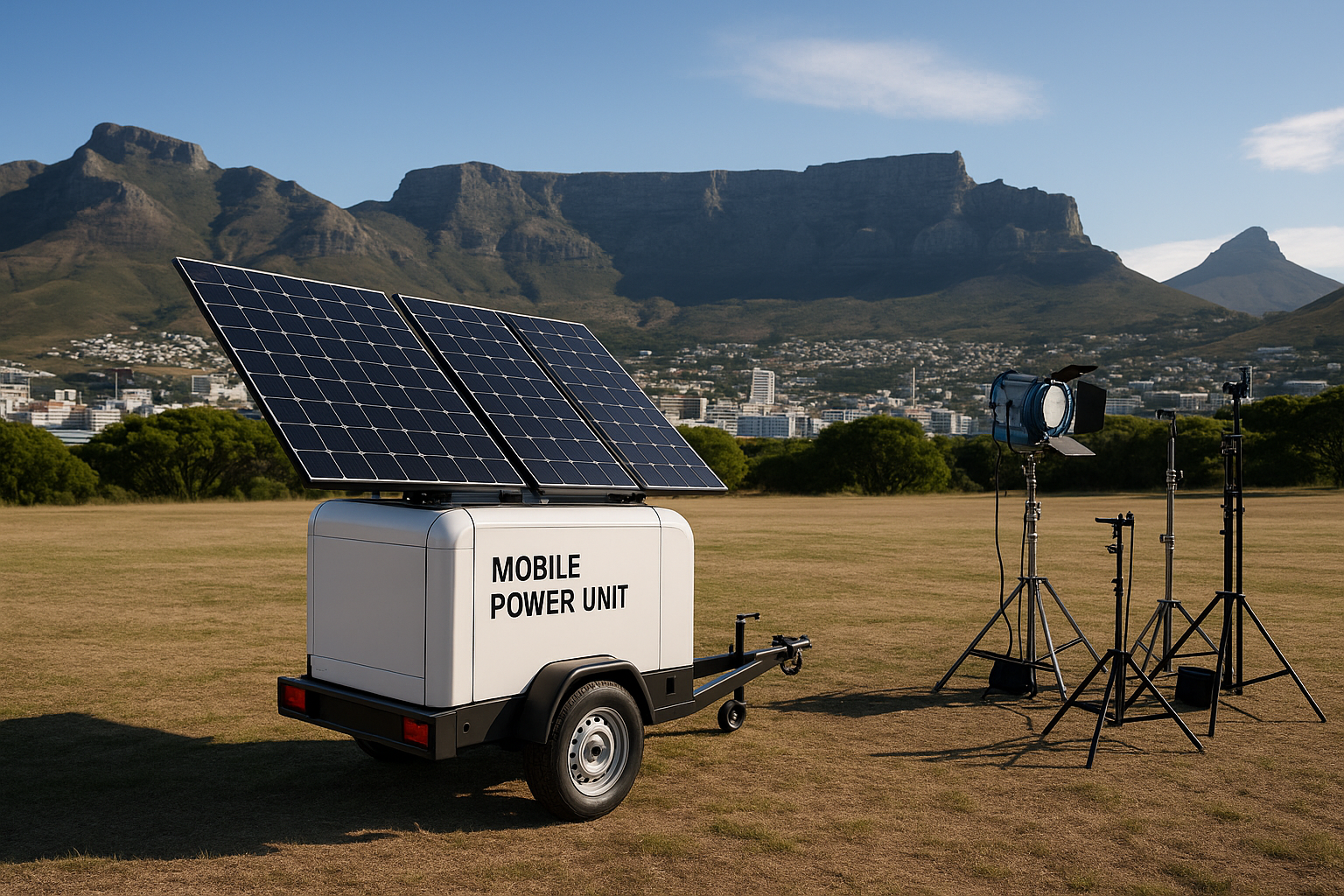
Cinergy's mobile clean-energy units quietly powered Netflix's "One Piece" Season 2, replacing diesel with solar power on set.
Imagine a world where movie sets hum with the quiet magic of nature, not the roar of diesel! Cinergy's solar-powered trailers made this a reality for Netflix's "One Piece" in sunny Cape Town. These silent wonders soaked up the sun's rays and stored them in giant batteries, keeping cameras rolling and lights shining without a single puff of pollution. It was a game-changer, saving tons of CO2 and proving that clean energy can power even the biggest pirate adventures!
How did Cinergy's silent trailers power the Netflix "One Piece" set in Cape Town?
Cinergy's silent trailers, powered by solar energy and advanced battery storage, kept Netflix's "One Piece" production running in Cape Town without diesel generators. These mobile power hubs offered 99.8% uptime, significantly reduced carbon emissions by 93 tonnes, and provided reliable, clean electricity for all on-set needs.
Get Cape Town news in your inbox
Stay updated with the latest stories from the Mother City.
1. When the Only Noise Was Birds: Kicking the Diesel Habit
Cape Town Film Studios has echoed with the growl of war rigs and the thud of helicopter blades, yet during six months of filming Netflix’s second season of “One Piece” the loudest visitors were a squad of screeching hadeda ibises. The hush came from a deliberate choice made in late 2023: the streamer’s global sustainability squad issued a tender demanding “base-load electricity with zero diesel burn” for its biggest African shoot ever. Only one local bidder promised 99.8 % uptime without a sip of fossil fuel - Cinergy Mobile Power, an outfit that had opened its doors eleven months earlier.
The absence of throbbing generators rewrote daily life on set. Sound mixers stopped begging for “engine off” windows, assistant directors quit juggling refuelling windows, and accountants stopped sweating the diesel price curve. In their place arrived two mobile power hubs that looked like ordinary curtain-sider trailers yet carried enough stored sunshine to keep 18 k HMI lights, LED walls and on-set render nodes humming from first shot to wrap.
Word spread fast. Crew members who once boasted about generator horsepower began comparing kilowatt-hours harvested from the sky. Sustainability slipped out of the compliance folder and into craft-service chatter, proving that clean tech can change culture faster than any memo.
2. Built for a Country That Can’t Keep the Lights On
South Africa suffered blackouts on 335 days in 2023. In that climate, keeping cameras rolling is harder than keeping them in focus. Abe Cambridge - previously a UK solar financier - teamed up with Brad Briscoe, a rigging gaffer whose credits range from “Dredd” to “Raised by Wolves”. Together they convinced two Cape family offices to seed a company able to park a road-legal power plant behind a Mercedes Actros and have 270 kW ready before the coffee urn boils.
Their brief was brutally simple: survive national outages, fit through a studio boom gate at dawn, and never ask a diesel bowser for help. The resulting fleet is a Lego kit of lithium-iron-phosphate bricks, each rack sealed in a climate-controlled, sound-damped shell. A hydraulic roof unfurls into a 150 kW solar awning that tracks the sun like a yacht seeking wind, while a 120 kW inverter stack delivers three-phase 380 V clean enough for motion-control rigs.
Because the law limits trailer weight to 18 t, every component earned its place through a grams-per-watt audit. The finished rigs tow like standard freight, yet arrive with enough juice to run a small village - or one very energy-hungry pirate ship.
3. The Ledger of Silence: 78 Tonnes of CO₂ That Never Happened
Netflix’s production calendar covered 107 studio days and 28 location hops across the Overberg and West Coast. Cinergy fielded two configurations:
-
Studio Base-Camp – 400 kWh battery plus 150 kWh rooftop harvester
– 5 808 operating hours
– 312 kW peak draw (LED wall, balloon lights, render farm)
– 62 % of demand met directly by sun; remainder topped up on cheap off-peak tariffs
– 28 000 litres of diesel left in the ground
– 78 tonnes of CO₂ never exhaled -
Beach Buggy Unit – 90 kWh pack plus 60 kW folding array
– Towed behind a 4×4 to coastal dunes
– Fed carpentry tools, welders and two 10 kW espresso makers
– 5 500 litres of diesel avoided
– 15 tonnes of CO₂ saved
Add the two and you get 93 tonnes - equal to yanking 31 passenger cars off South African roads for a year. Accountants grin just as hard: the streamer locked its “power-as-a-service” tariff at 135 c/kWh in July 2023, when diesel sat at R23/litre. By December, pump prices had leapt to R25.40, pushing bulk-set deliveries past R27. The hedge saved roughly R1.1 million - cash that quietly financed the green premium.
4. From Whisper-Quiet Sets to Blueberry Fields: The Ripple Effect
Silence bought speed. Without a 78 dB generator under the coconut palms, sound mixers captured dialogue while the wind slept; director Marc Jobst noted that complex ship-deck resets finished 30 % faster because no one waited for engines to cycle. Noise monitors on the backlot averaged 42 dB(A) - roughly the hum of a kitchen fridge - so the only reason to yell “cut” was acting, not machinery.
Data kept everyone calm. A WhatsApp bot pinged department heads live state-of-charge numbers; producers received alerts if draw topped 80 % for more than five minutes, letting them shed non-critical loads before lunch. Second-by-second logs, exported later to RE100-compliant CSV files, satisfied auditors without a single spreadsheet headache.
The hardware’s second life is already sprouting. After wrap, the 90 kWh beach unit powered 120 Christmas-market stalls in De Hoop, saving the local council R18 000 in genset hire. Disney+, Apple TV+ and Warner Bros. have all requested specs for their own African shoots, and Cinergy is stacking 1 MWh “Lego blocks” into 40-foot containers to meet 1 MW peak demand.
Come 2025, sodium-ion cells will replace lithium, trimming weight and banishing cobalt. A 50 kW hydrogen cartridge will slot into the fifth-wheel cavity for week-long cloud banks, fuelled by green H₂ from Sasolburg. And when batteries fade to 80 % capacity, they will migrate to rural police stations as CCTV backup, proving that yesterday’s film star can be tomorrow’s security guard.
[{"question": "
How did Cinergy's silent trailers power the Netflix 'One Piece' set in Cape Town?
\nCinergy's silent trailers, powered by solar energy and advanced battery storage, kept Netflix's 'One Piece' production running in Cape Town without diesel generators. These mobile power hubs offered 99.8% uptime, significantly reduced carbon emissions by 93 tonnes, and provided reliable, clean electricity for all on-set needs."},{"question": "Why did Netflix choose Cinergy's solar-powered trailers for 'One Piece' in Cape Town?
\nNetflix's global sustainability squad issued a tender specifically demanding 'base-load electricity with zero diesel burn' for its biggest African shoot ever. Cinergy Mobile Power was the only local bidder that could guarantee 99.8% uptime without using fossil fuels, aligning with Netflix's environmental goals and addressing South Africa's frequent power outages."},{"question": "What were the benefits of using Cinergy's silent trailers on set, beyond environmental impact?
\nBeyond significant CO2 reductions, the silent trailers eliminated the noise of diesel generators, allowing sound mixers to capture dialogue more easily and reducing the need for 'engine off' windows. Assistant directors no longer had to manage refueling schedules, and complex ship-deck resets finished an estimated 30% faster. The quiet environment also improved crew morale, shifting focus from generator horsepower to kilowatt-hours harvested from the sky."},{"question": "How did Cinergy's technology address South Africa's unreliable power grid?
\nCinergy's trailers were specifically designed to operate in a country prone to blackouts, as South Africa experienced outages on 335 days in 2023. The mobile power hubs feature robust lithium-iron-phosphate battery bricks, climate-controlled and sound-damped shells, a hydraulic 150 kW solar awning, and a 120 kW inverter stack. This design ensures they can provide continuous, clean power even during national grid failures, fitting through studio boom gates and never requiring diesel assistance."},{"question": "What was the environmental and financial impact of using Cinergy's solar power for 'One Piece'?
\nCinergy's solutions prevented 93 tonnes of CO₂ emissions, equivalent to taking 31 passenger cars off South African roads for a year. This was achieved by avoiding the consumption of 28,000 liters of diesel for the studio base-camp and 5,500 liters for the beach buggy unit. Financially, Netflix locked in a 'power-as-a-service' tariff at 135 c/kWh, saving approximately R1.1 million (South African Rand) compared to the rising diesel prices during the production period."},{"question": "What is the future outlook for Cinergy's technology and its 'second life'?
\nCinergy's hardware is designed for a long lifespan and repurposing. After the 'One Piece' wrap, a 90 kWh beach unit powered 120 Christmas market stalls, saving the local council significant costs. Other major studios like Disney+, Apple TV+, and Warner Bros. have expressed interest. Cinergy is scaling up with 1 MWh 'Lego blocks' for 1 MW peak demand, planning to integrate lighter sodium-ion cells by 2025, and exploring 50 kW hydrogen cartridges for extended cloudy periods. Used batteries will eventually be repurposed for community assets like rural police stations for CCTV backup, extending their utility and environmental benefit."}]
Thabo Sebata is a Cape Town-based journalist who covers the intersection of politics and daily life in South Africa's legislative capital, bringing grassroots perspectives to parliamentary reporting from his upbringing in Gugulethu. When not tracking policy shifts or community responses, he finds inspiration hiking Table Mountain's trails and documenting the city's evolving food scene in Khayelitsha and Bo-Kaap. His work has appeared in leading South African publications, where his distinctive voice captures the complexities of a nation rebuilding itself.
View all articles →