
Gibbons and Bone shine at 2026 Cape Town Cycle Tour
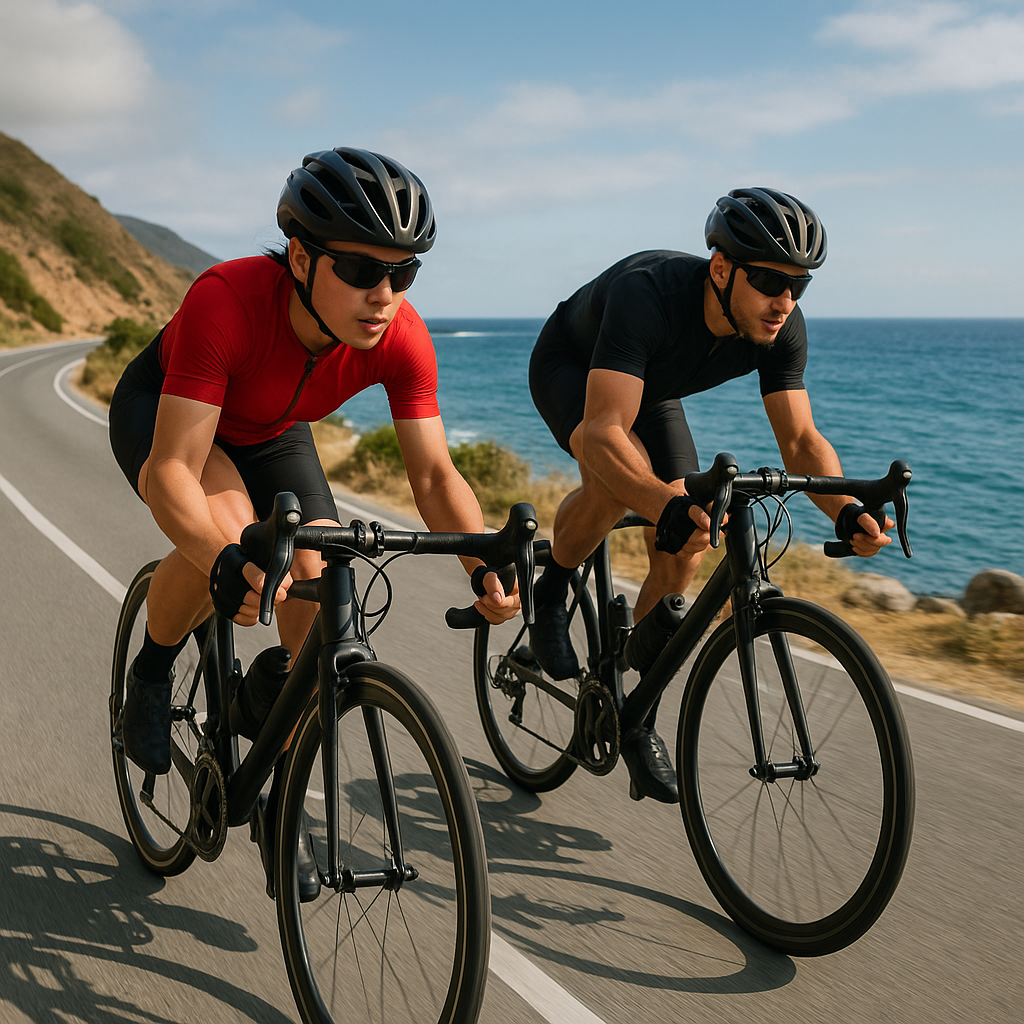
Experience the Cape Town Cycle Tour: a vibrant mix of festival and fierce competition. Relive the drama, wind, and triumphs.
The Cape Town Cycle Tour is a 109 km bike race, but it's much more than that. It's a huge party where professional riders and everyday people cycle together, battling strong winds and beautiful views. Everyone has their own story, from fast sprints to personal challenges, making it a big celebration of the city and its spirit.
What is the Cape Town Cycle Tour?
The Cape Town Cycle Tour is a 109 km cycling event, embodying a mix of professional racing, community participation, and a celebration of the city's spirit. It's an annual referendum on identity, marked by challenging winds, scenic routes, and countless personal stories, contributing significantly to the local economy and culture.
Get Cape Town news in your inbox
Stay updated with the latest stories from the Mother City.
1. Dawn on the Grid: Where Accountants and Pros Share the Same Breath
The city stirred while the Atlantic still wore a pewter cloak. At 05:00 temporary barricades rattled onto Hertzog Boulevard, turning eight traffic lanes into a living tapestry of neon club kits, charity capes and corporate matching tees. Marshals jogged backwards, flicking fingers to count waves in English, Afrikaans and isiXhosa, their hi-vis bibs catching the glow of choppers already thudding overhead. A jazz trio hired by a bike shop blasted a tongue-in-cheek “Eye of the Tiger” across the Grand Parade, the brass section competing with the hiss of CO₂ cartridges as tyres gained their morning pressure.
No one waited for sunrise to feel the buzz. Timing chips, no bigger than a postage stamp, circled every left ankle - equalisers that let the hobbyist from Durbanville line up three metres behind a Belgian WorldTour guest. Both riders heard the same countdown, but only one studied the elastic snap of the front group, ready to catapult at 5:58 sharp. That snap would stretch down Nelson Mandela Boulevard, the field folding into a human piston before the first water table even lifted its flap.
By the time Devil’s Peak blushed pink, the early break had already drawn its membership list: twelve silhouettes skimming the barrier like low-flying aircraft. Third in line sat Ryan Gibbons, visor up, fingers draped over the hoods in the relaxed shrug of a man who learned his trade between Flemish cobbles and Basque gradients. Local papers had spent weeks rehearsing his home-coming script - hostel kitchens, Roubaix ribs, the lot - but none captured the millimetre hop his rear wheel gave as it floated over the first cat-eye outside the CBD. In that hop you could read two passports: the European calm of the shoulders, the Cape cross-wind roll of the torso.
2. Wind as Prosecutor: Chapman’s Peak and Suikerbossie Deliver Verdicts
Gibbons paid the wind tax upfront, hugging the exposed edge to buy insurance. Beyond the tollgates the race re-gelled: twenty-eight riders, Toyota-Specialized Imbuko dictating tempo, Jaedon Terlouw’s yellow-black gilet a warning flag at the nose. Next came Suikerbossie - 5.2 km at five per cent, laughable on paper, murderous in a hair-dryer. No attacks, just the silent erasure of anyone whose watts-per-kilo could not match the headwind’s appetite. Gibbons counted pedal strokes in Afrikaans - een, twee, drie - until the road finally crested and the Atlantic opened like a reward.
While the men’s race dissected itself kilometre by kilometre, the women’s script flipped inside the opening forty-five. Lisa Bone, chemical-engineer-turned-pro, had fed route data, wind roses and 30-second power slices into a laptop weeks earlier. The algorithm pointed to a false flat after Llandudno where a right-hand bend gifts a four-second wind-shadow. At 07:42 Bone clicked up two sprockets, lifted the pace from 39 to 46 km/h and watched the elastic snap. Only Daria Pravilova and Kate Courtney clawed across, the trio rotating like a team-pursuit squad. Gap: ten seconds, then fifty-two by Noordhoek’s white barn. Behind, cross-winds stretched the peloton into four shredded ribbons and team cars accidentally formed moving walls. Bone crossed Green Point in 2:06:26 - averaging almost 52 km/h - numbers that belong in a men’s UCI 1.1 dossier.
3. The Final Equation: Roundabouts, IPAs and Half-Wheel Glory
Back with the men, the chessboard shrank to two kings and a handful of pawns entering Cape Town Stadium’s shadow. One roundabout, two traffic islands, a 200 m drag with the breeze now at four o’clock. Terlouw’s last lieutenant swung off at 350 m, gifting Gibbons a choice: shelter or wind. He chose the latter, launching at 63 km/h and peaking at 68. A photo freezes them - bikes tilted like snapped protractors, background a lime-green World Cup stripe - Gibbons nosing it by half a wheel. 2:33:06. First local male winner since 2017. In the VIP tent he accepted a craft IPA whose label sported a bicycle-chain protea, a coincidence too Capetonian to script.
Away from the podium, the event’s true circulatory system throbbed on. Parents towed toddlers in trailer pods; a 72-year-old grandfather clicked down-tube shifters on a 1982 Peugeot; Khayelitsha nurses in scrubs raised nebuliser money. Suikerbossie’s unofficial aid station sold boiled eggs and orange wedges - tolerated because, as one marshal shrugged, “kindness doesn’t read the rulebook.” On Red Hill a rider knelt still clipped in, proposing to a laughing partner while balancing on one titanium leg. By noon Green Point morphed into an open-air tech expo: QR kiosks spat out finish certificates, strangers swapped Strava files over Bluetooth, and the smell of chain lube married boerewors smoke in a perfume unique to the Mother City.
Wind data off Mouille Point later showed 42 km/h gusts, adding roughly fourteen minutes to the median time. Mechanics tallied 43 snapped hangers, 112 punctures, two rims that taco-ed on the timing mat. Medical staff treated 23 hyponatremia cases - proof that Cape Town’s dry air tricks people into over-drinking. Yet the inconvenience translated into R340 million for the local economy, 96 % CBD hotel occupancy and a 30 % March spike in commuter-bike sales, a phenomenon shops call “the post-Tour impulse.”
4. After the Echo: Medals, Memories and a City that Refuses to Choose
Afternoon shadows lengthened and helicopter blades gave way to the whirr of 4 mm Allen keys in the bike-park tent. Riders queued for free safety checks while a jazz trio - different musicians, same cheek - replayed “Eye of the Tiger” on acoustic guitars. Each finisher received a medal that doubled as a bottle-opener, a nod to the city’s talent for merging utility with celebration.
No single storyline monopolises the day. Instead, thousands of satellite narratives orbit the same 109 km ribbon: the moment the wind bent, the gel that arrived at glycogen zero, the stranger who pushed you back into the echelon. Traffic engineers note an eleven-minute commuter delay; economists count R340 million; physiologists record 52 km/h female averages and 68 km/h sprint peaks. Yet the real ledger is carried home in jersey pockets: salt-stained numbers, finish-time selfies, the faint whiff of sun-cream and chain oil that will, next March, drag the same riders back to another gun-metal dawn.
The Cape Town Cycle Tour refuses to declare itself merely race, parade or municipal ballet. It is all three, and none - an annual referendum on who we are when stripped to helmets and heartbeat. Until the barricades clatter again, the stories keep pedalling through suburban braais and office WhatsApp groups, proof that a strip of coastal asphalt can hold more plot twists than a bookshelf, provided the wind remembers to blow.
[{"question": "
What is the Cape Town Cycle Tour?
", "answer": "The Cape Town Cycle Tour is a 109 km cycling event in Cape Town, South Africa. It's a unique blend of professional racing and public participation, known for its challenging winds, scenic routes, and vibrant atmosphere. It's considered a significant cultural and economic event for the city."}, {"question": "Who participates in the Cape Town Cycle Tour?
", "answer": "The tour attracts a diverse range of participants, from professional cyclists like Ryan Gibbons and Lisa Bone to everyday individuals, including hobbyists, charity riders, and even a 72-year-old grandfather on a vintage Peugeot. The event is inclusive, allowing people from all walks of life to share the same course."}, {"question": "What are some of the iconic challenges of the route?
", "answer": "The route is renowned for its challenging natural elements, particularly the strong winds that can significantly impact riders. Key climbs include Chapman's Peak and Suikerbossie, which, despite their seemingly moderate gradients, become particularly demanding when battling headwinds."}, {"question": "What makes the Cape Town Cycle Tour unique?
", "answer": "Beyond being a race, the tour is a massive celebration of Cape Town's spirit. It's characterized by its 'wind, wheels, and a thousand tiny epics,' where every participant has a personal story. The event fosters a sense of community, with informal aid stations, on-the-spot marriage proposals, and a lively atmosphere from dawn till dusk, merging competitive sport with communal festivity."}, {"question": "How does the Cape Town Cycle Tour impact the local economy?
", "answer": "The event has a substantial positive impact on the local economy. For instance, it generated R340 million, led to 96% CBD hotel occupancy, and caused a 30% spike in commuter-bike sales in March, a phenomenon local shops dub 'the post-Tour impulse.' It's a significant tourism driver for the city."}, {"question": "What kind of stories emerge from the event?
", "answer": "The tour is a tapestry of personal narratives. From the strategic brilliance of professional riders navigating wind and terrain to the heartwarming stories of individuals riding for charity, an elderly participant completing the course, or even a marriage proposal mid-race. These individual 'epics' contribute to the overall legend of the Cape Town Cycle Tour."}]
Aiden Abrahams is a Cape Town-based journalist who chronicles the city’s shifting political landscape for the Weekend Argus and Daily Maverick. Whether tracking parliamentary debates or tracing the legacy of District Six through his family’s own displacement, he roots every story in the voices that braid the Peninsula’s many cultures. Off deadline you’ll find him pacing the Sea Point promenade, debating Kaapse klopse rhythms with anyone who’ll listen.
View all articles →