
Plan ahead: Road closures for the Cape Town Cycle Tour 2026
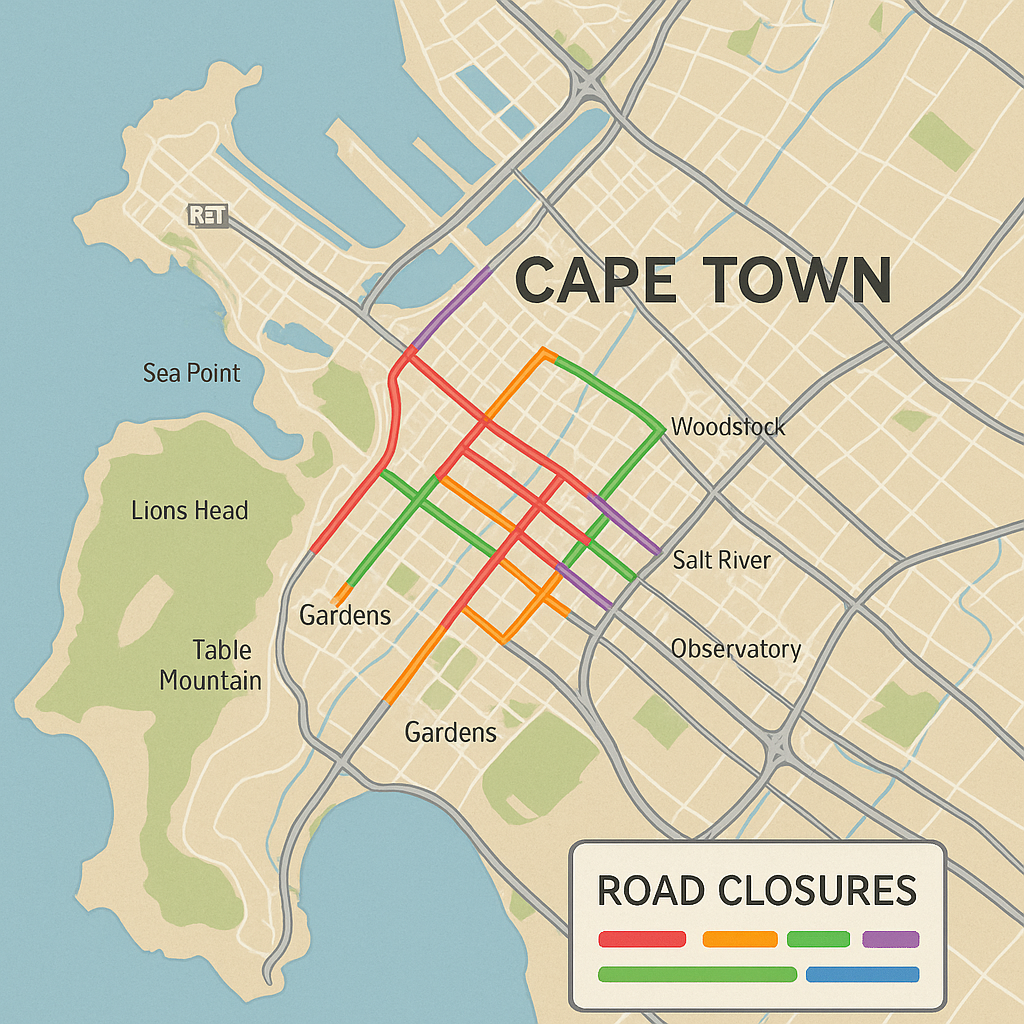
Uncover the intricate, four-day transformation of Cape Town for the annual Cycle Tour. From AI traffic control to resourceful locals, explore the hidden logistics behind this iconic 109km race.
Cape Town goes all out for its big bike race! They set up a super high-tech control center, like something from NASA, to watch the whole 109 km route. Thousands of barriers are put up, and roads close everywhere, sometimes even for days. They even check cliff-sides for loose rocks, all to make sure 35,000 riders are safe. It's a huge, amazing plan that changes the whole city!
What extensive preparations are made for Cape Town's 109 km bike race?
Cape Town's 109 km bike race involves meticulous four-day preparations, including setting up a high-tech control center for real-time route monitoring, deploying 4,200 K-Barrier blocks, orchestrating complex road closures and detours, and conducting cliff-face safety checks. The event transforms the city into a logistical operation, ensuring safety and efficiency for 35,000 riders.
Get Cape Town news in your inbox
Stay updated with the latest stories from the Mother City.
Wednesday Night – The Countdown Starts in a Container Maze
While most Capetonians sleep, a forgotten athletics stadium in Green Point turns into a mission-control that would make NASA jealous. Inside a ring of rust-coloured shipping containers, 40 planners stare at a wall of LED tiles that repaint the entire 109 km route every 90 seconds. Green bands mean traffic still flows; amber warns of rolling closures; red shouts “sterile corridor”. The in-house software - staff nicknamed it “Peloton” - swallows 1.3 million Bluetooth pings an hour from matchbox-size beacons glued under every third manhole between the Grand Parade and Smitswinkel Bay. If a sensor feels a tyre where no bicycle should be, a motorbike marshal receives a push-to-talk alert and is guaranteed to be on scene within four minutes. Last year the average was 3 min 42 sec; the 2026 target is sub-180 seconds and a fresh batch of 200 cc bikes is already parked on the stadium grass, tanks brim-full.
The container village never truly powers down. From Wednesday 22:00 onward the ops crew works 22-hour shifts, surviving on a strict diet of filter coffee, peanut-butter sandwiches and the knowledge that 35 000 riders, three television helicopters and an entire metro depend on them staying awake. Wall clocks are set to “race time” (UTC+2) and synchronised every hour with the South African Astronomical Observatory - because when the starter’s pistol cracks at 06:15:00 on Sunday, even a one-second drift on the LED maps could send a marshal to the wrong side of the mountain.
By dawn on Thursday the stadium car park looks like a military depot: 4 200 white K-Barrier blocks stacked like Lego, 28 000 cable-ties colour-coded by length, 1 200 rolls of red “NO ENTRY” tape and 900 litres of biodegradable degreaser waiting for the post-event clean-up. Everything is bar-coded, QR-tagged and photographed from three angles so that, when the city wakes up again on Monday, not a single bolt is unaccounted for. Outsiders think the Cycle Tour is a Sunday bike race; insiders know it is a four-day logistics war that starts in a container maze.
Thursday Sunrise – Hand-to-Hand Barrier Ballet and the First Detours
At 05:58 the sun spikes over Devil’s Peak and Fritz Sonnenberg Road becomes the first sacrifice. Forty temporary workers form a silent human conveyor, passing 11 kg steel segments hand-to-hand until the ribbon is closed in 18 minutes flat. Watching from balconies, early-dog walkers describe it as “oddly beautiful”, like a military drill performed by ballet dancers. By 06:30 the first luminous orange detour board pops up on Helen Suzman Boulevard, funnelling motorists onto the elevated freeway where 17 CCTV cameras already feed two control rooms - one in the stadium, one in Bellville - creating a redundancy loop that can survive a power cut, a fibre break or an enthusiastic baboon.
Inside the cordon the real chess game begins. Lindiwe Mbele hitches her espresso kiosk to a friend’s pickup and relocates 200 m south-east, swapping postcard views of the lighthouse for a sidewalk outside Virgin Active. She has pre-ground 30 kg of beans the night before, vacuum-sealed them in 250 g bricks and written “CYCLE TOUR SPECIAL – R20 OFF” on a scrap of cardboard. By Sunday afternoon she will have sold 1 800 flat whites, half of them to Brazilian tourists who arrived convinced the event was “just a bike race” and left mumbling about the best caffeine on the continent.
Meanwhile, road crews zip-tie laminated diversion maps to every lamp pole. The maps are printed in three languages and include a QR code that downloads an offline GPS file - because the planners know that when 40 000 extra cars are pushed into side-streets, the mobile network will buckle. By 09:00 the first complaint lands on the city’s WhatsApp line: a resident furious that his usual 4 km commute has become 11 km. Operations staff reply with a pre-written apology, a link to the GPS file and a voucher for free coffee at the Green Point café that stays open 24 hours for exactly this purpose. The ballet is finished, but the PR dance has only begun.
Friday Night – Ghost Streets, Water-Filled Walls and Cliff-Hanging Geckos
When the CBD clocks strike 19:00, Castle Street empties like a movie set after the director yells “cut”. Cinema-goers at the Prestwich Memorial sprint for the last parking tickets while 28 drama students - hired because they’re good at following stage directions - wrap red bunting around lamp poles. By 22:00 the only traffic is a convoy of 14 flat-bed trucks outside the Drill Hall. Their cargo: 4 200 hollow K-Barrier blocks that will be filled with 180 litres of water each, morphing into an instant 750-ton wall by sunrise. A single block weighs 11 kg empty; filled, it stops a delivery truck dead. Engineers call it “passive defence”; locals call it “the white snake”.
Sixty kilometres away, on the cliffs above Chapman’s Peak toll plaza, two rope-access geckos (their real job is wind-turbine maintenance) rappel head-first down the sandstone. Every shard larger than a fifty-cent coin is circled with UV spray; anything loose risks skittering under 35 000 carbon wheels come Sunday. They work by head-torch, communicating with gestures learned on North Sea oil rigs. At 01:00 a support van arrives with flasks of hot chocolate labelled “Cliffhangers – Caffeine Division”, courtesy of the Hout Bay Neighbourhood Watch who figure that even dare-devils deserve a sugar spike.
Back in town the “white snake” is already humming. Each block carries an NFC tag; a marshal with a tablet can tap it and know exactly when it was filled, by which truck and whether the lid seal is still intact. If a drunk driver ploughs into the wall, sensors record impact force and send an alert within 30 seconds. The system was tested in 2024 when a stolen SUV hit the barrier at 70 km/h; the car was totalled, the barrier barely scuffed, and the Trust earned a quiet nod from the insurance industry. By 03:00 Saturday the CBD is silent except for the gurgle of water pumps and the occasional clink of carabiners echoing off Chapman’s cliffs.
Saturday Afternoon – Tow-Truck Wars and the Last Mercedes to Scarborough
At 14:00 three municipal pick-ups cruise Victoria Road like carnival barkers, loudspeakers blaring in isiXhosa, Afrikaans and English: “Move your car or meet Wingfield.” The threat is real - last year 113 vehicles were impounded, each owner forking out R1 850 plus R45 per kilometre towed. Drivers from 17 private companies patrol on commission: R120 per car. Competition for the easy pickings near Clifton 4th Beach is fierce; some residents retaliate by scattering tacks or erecting fake disabled bays. The Trust counters with QR-coded permits verified in person; no blue badge, no mercy.
By 17:00 the last public vehicle allowed on Chapman’s Drive rumbles through: a midnight-blue 1974 Mercedes-Benz 280 CE belonging to an 83-year-old retired naval commander. Marshals salute; he reciprocates with the same crisp flick he once used on frigates in the Roaring Forties. Thirty minutes later the toll gates are chained and baboons invade the empty tarmac, skittering across warmth still radiating from the afternoon sun. Locals swear the primates can sense the impending human swarm; researchers from UCT’s Baboon Unit simply note that traffic-free asphalt is an ideal playground.
Night falls on a city already unrecognisable. In Camps Bay the cul-de-sac of Geneva Drive turns into a pop-up market: teenagers blast 90s Eurodance, a grandmother flips pancakes, and a man in a neon jacket sells second-hand cycling jerseys at R50 apiece. Streetlights stay on, but no cars pass; the only movement is the flicker of braai fires and the low hum of generators powering espresso machines. Somewhere in the darkness 38 street-sweepers queue, tanks filled with 28 000 litres of reclaimed water, waiting for the final rider to cross the line so they can undo in eight hours what took four days to build. The city is holding its breath, and the countdown to the starter’s pistol has never felt so loud.
What extensive preparations are made for Cape Town's 109 km bike race?
Cape Town's 109 km bike race involves meticulous four-day preparations, including setting up a high-tech control center for real-time route monitoring, deploying 4,200 K-Barrier blocks, orchestrating complex road closures and detours, and conducting cliff-face safety checks. The event transforms the city into a logistical operation, ensuring safety and efficiency for 35,000 riders.
How does the race ensure rider safety along the 109 km route?
Rider safety is paramount and is ensured through several measures. A high-tech control center, nicknamed "Peloton," monitors the entire 109 km route, processing 1.3 million Bluetooth pings an hour from beacons to detect any anomalies. If an unauthorized tire is detected, motorbike marshals are dispatched within minutes. Additionally, cliff-sides, particularly above Chapman's Peak, are meticulously checked for loose rocks by specialized rope-access teams, and 4,200 water-filled K-Barrier blocks are strategically placed to create a robust, passive defense, capable of stopping a delivery truck.
What is the role of the "Peloton" software and the control center?
The "Peloton" software is a sophisticated in-house system used in the mission-control-like setup at Green Point. It processes 1.3 million Bluetooth pings per hour from route-embedded beacons, repainting the 109 km route on LED tiles every 90 seconds to show traffic flow, warnings, and sterile corridors. This real-time monitoring allows for immediate deployment of motorbike marshals if a tire is detected where it shouldn't be, aiming for a response time of under 180 seconds.
How does Cape Town manage traffic and detours during the race preparations?
Traffic management begins days before the race, with roads closing and detours being implemented. As early as Thursday morning, key roads like Fritz Sonnenberg Road are closed using human chains to deploy steel segments. Luminous orange detour boards are placed, and motorists are funneled onto elevated freeways monitored by CCTV. Laminated diversion maps with QR codes for offline GPS files are zip-tied to lamp posts, and a dedicated city WhatsApp line handles resident complaints, providing apologies and free coffee vouchers for inconvenience.
What unique measures are taken for road closures and barrier deployment?
Road closures are a complex "barrier ballet." Starting Wednesday night, 4,200 K-Barrier blocks are prepped, and by Friday night, these hollow blocks are filled with 180 liters of water each, creating a 750-ton "white snake" wall. Each block has an NFC tag for tracking its status. Additionally, local businesses like espresso kiosks are provided with information to relocate, and residents are warned to move their cars through loudspeakers, with impoundment as a consequence for non-compliance.
How does the city ensure a smooth post-event clean-up and return to normalcy?
The city plans for the post-event clean-up with the same meticulous detail as the setup. All barriers and equipment, such as K-Barrier blocks, cable-ties, and tape, are bar-coded, QR-tagged, and photographed for easy accounting and retrieval. After the last rider crosses the finish line, 38 street-sweepers with 28,000 liters of reclaimed water are ready to undo the four-day build-up in just eight hours, aiming to return the city to normalcy swiftly and efficiently.

Tumi Makgale is a Cape Town-based journalist whose crisp reportage on the city’s booming green-tech scene is regularly featured in the Mail & Guardian and Daily Maverick. Born and raised in Gugulethu, she still spends Saturdays bargaining for snoek at the harbour with her gogo, a ritual that keeps her rooted in the rhythms of the Cape while she tracks the continent’s next clean-energy breakthroughs.
View all articles →