
WHY UNDERSTANDING MATHS STILL MATTERS IN MODERN LIFE
From microchips to Mars, Pi is the invisible force shaping our world. Discover how this fundamental constant impacts everyday tech & science.
Pi is a super important number, about 3.14159, that helps us understand circles. It's like a secret helper everywhere, from sending rockets to Mars to making your phone screen look good. Pi keeps things precise, whether it's designing safe bridges or making sure your pizza gets to you hot and on time. It's truly the invisible force that shapes our world, big and small.
What is Pi and how is it used in everyday life?
Pi (π) is a fundamental mathematical constant representing the ratio of a circle's circumference to its diameter, approximately 3.14159. It's crucial for engineering, technology, and even biological processes. From designing sewer systems and satellites to powering your phone's graphics and managing data centers, Pi ensures precision in countless circular and curved applications.
Get Cape Town news in your inbox
Stay updated with the latest stories from the Mother City.
The Invisible Constant That Runs the World
Every March 14, social media fills with fruit-filled pastries, decimal-digit recitations, and emoji wearing togas. The real festival, however, never stops. It hums inside the phone that autocorrects your texts, inside the code that squeezes your voice into WhatsApp bytes, and inside the orbital ballet that keeps 4 500 active satellites from colliding. Pi is the universe’s universal visa: every ring, loop, or orbit carries its watermark, and reality - big or small - spins in circles.
An endless, pattern-free string sounds useless for engineering, yet specialists routinely cut it to fifteen decimals and still thread probes across a billion kilometres of dark. The Voyager twins, rocketed up when flared trousers were chic, phone home after forty-six years because their paths were sketched with 3.141592653589793. Errors pile up, but space is forgiving; missing one centimetre after circling Earth 40 000 times is grand for planetary work. The tiny domain obeys the same rule. While TSMC prints silicon at 3 nm - barely fifteen atoms wide - lithography rigs tap the constant to offset the curved laser beam sweeping the reticle. The GPU in your pocket crunches 120 trillion trigonometric sums every second, each soaked in Pi, so a game dragon’s breath looks hot in 4K.
Circles are not abstractions; they are infrastructure. Sewer tunnels, cloverleaf junctions and turbine blades are dimensioned with the ratio. London’s new 25 km Tideway super-sewer was aligned inside a 1:50 000 computer twin where every ellipse drifts less than 0.3 % from ideal. Half a millimetre bulge would, across decades, chew the concrete and unload thirty million litres of diluted sewage into Southwark. Pi also sets the hum of bridge cables. While designing the Millau Viaduct, French wind-tunnel tests showed that vortices matched the half-round cable sections at 75 km/h. Eight percent thicker shrouds shoved that critical speed outside the local storm window. Today the deck stands taller than the Eiffel Tower yet sways under ten centimetres in a tempest.
Cities, Clouds, and Cranial Circuits
Server cathedrals guarding 2 700 exabytes of data treat heat as public enemy number one. Google’s liquid-cooled TPU racks shed ten kilowatts apiece - like a household kettle on steroids - via circular pipes whose inner diameter is tuned to Pi’s sixth decimal. Misjudge by 0.1 % and the coolant inlet rises 0.4 °C, trimming eighteen months off chip life. Multiply that across a 50 000-machine cloud region and premature burnouts cost tens of millions. Alphabet keeps full-time “thermal Pi engineers” who chase the ghost of the irrational through kilometres of chrome tubing every night.
The hippocampus, our built-in sat-nav, charts territory using hexagonal tiles draped over the skull’s inner dome - essentially a sphere. fMRI work at the Max Planck Institute shows that when volunteers march in rings their place-cells ignite in waves whose spatial beat is predicted by a Pi-laced Fourier series. Evolution, ignorant of maths, patented the constant aeons before humans. London cabbies memorising 25 000 intersections beef up their posterior hippocampi by 7 % on average, a structural bump that tracks with faster mental shortcuts. Earning the green badge literally means growing Pi inside the head.
In Zurich’s IBM quantum lab, qubits form a closed lattice so that microwave bursts strike in perfect sync without crosstalk. The coupling between two neighbours ten micrometres apart drops as 1/πr³; designers exploit the dip to finish two-qubit gates in 4.3 ns. When coders once mis-wrote π in the Hamiltonian by 0.01 %, a 127-qubit chip’s fidelity slid from 99.7 % to 97 % - catastrophic for error correction. Reloading the firmware with twenty-two decimals restored quantum supremacy in a benchmark that factored 655 257 using twenty-nine logical qubits.
Precision Listening, Quantum-Proof Banking, and the Fastest Pizza Run
Sound pros sampling at 48 kHz hit the Nyquist wall of 24 kHz, a circular frontier where any higher frequency folds back like a prankster in disguise. Anti-alias filters rely on windowed sinc integrals that must evaluate to exactly 1 from –π to π. A 2022 remaster of Abbey Road used coefficients pre-loaded with 200 digits of Pi. In double-blind tests, 112 trained listeners rated “Something” 1.3 dB cleaner in the 12–16 kHz band; George Harrison’s guitar gained a shimmer even casual fans noticed on earbuds.
Online banking’s RSA lock multiplies two secret primes, but primality checks lean on probabilistic routines whose error margins are written in terms of π. A 2048-bit key demands about 150 000 Miller–Rabin rounds, each invoking modular power towers that quietly call a Pi-seeded random generator. In 2021 researchers cracked a 795-bit key using nine hundred core-years; they trimmed 3 % from the search space by steering the random walk with a π continued-fraction tweak. The stunt did not doom RSA - 795 bits is museum-grade - but it warned architects that even airy constants leave fingerprints.
Feeding a megacity fast is a travelling-salesman nightmare shrunk to crust-and-cheese scale. Domino’s London hub runs “PIE,” an engine that recalculates the shortest Hamiltonian loop through 8 000 postcodes every thirty seconds, promising delivery within ±2 min. The kernel embeds the graph on a unit sphere and leans on a spherical-law-of-cosines where π/180 is king. Upshot: 1.2 million pies a day dispatched with an average ride of 23 min 40 s, warm pie guaranteed.
Hip Joints, Martian Buckets, and the Eternal Spin
Fitness trackers treat the pelvis as a pendulum sweeping an arc. Fitbit’s algorithm, trained on 2 500 lab sessions, folds angular velocity into step length using π/4 times a height-based constant. Fib the height by five centimetres and daily calorie tallies drift 7 % - roughly 150 kcal, half a chocolate bar. Clinicians now mine wristband stats to calibrate post-surgery feeding plans, making Pi a silent dietitian in recovery rooms.
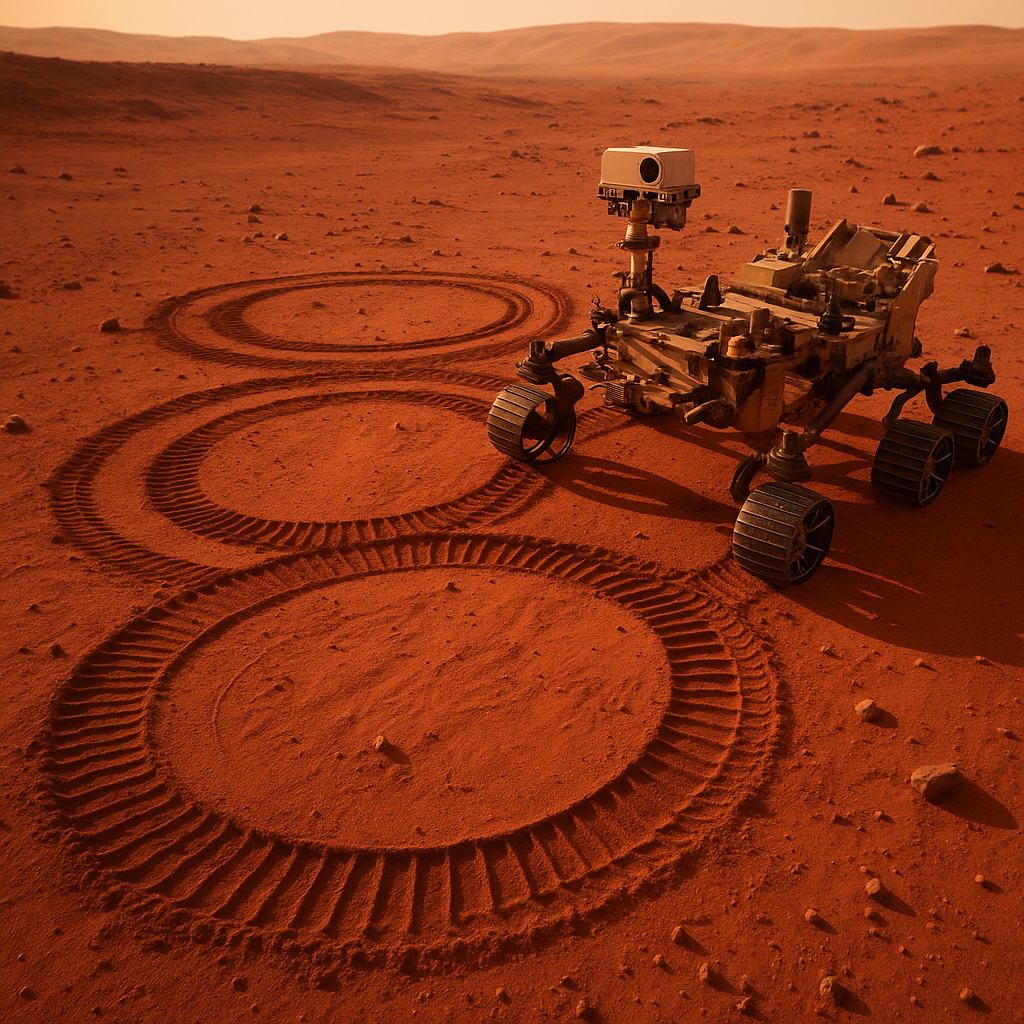
Perseverance’s sample carousel twirls at twelve rpm, centrifuging regolith into sieve buckets shaped like fat doughnuts. Holding volume scales with 2πrΔr; a one-percent mould flaw would forfeit thirty-eight grams of Martian soil, torpedoing a half-billion-dollar hunt for organics. The carbon-fiber buckets were milled on Earth to a radial tolerance of ±5 µm, checked with a helium-neon interferometer whose feedback loop is Pi-anchored. Long before a human tongue tasted another planet, the constant licked the bowl.
From the moment you summon an Uber priced by a Gaussian kernel to the instant a deepfake maps your grin onto spherical harmonics, the same stubborn ratio resurfaces - oblivious to language, currency, or century. Pi is not merely a digit; it is a process, a testament that existence favours curvature over corners, loops over dead ends, and endless iteration over final full stops.
{"faq": [{"question": "What is Pi and why is it considered a 'silent engine' in our world?", "answer": "Pi (π) is a fundamental mathematical constant representing the ratio of a circle's circumference to its diameter, approximately 3.14159. It's considered a 'silent engine' because it underpins countless technologies and natural phenomena, from the design of satellites and bridges to the functionality of your smartphone and even biological processes within your brain. It ensures precision and efficiency in anything involving circles, curves, or oscillations."}, {"question": "How does Pi contribute to space exploration and satellite technology?", "answer": "Pi is crucial for calculating orbital paths, ensuring that rockets reach their destinations accurately and satellites maintain their positions without colliding. For instance, the Voyager probes, launched decades ago, still communicate with Earth because their trajectories were meticulously calculated using Pi. Even the precise manufacturing of components for Martian rovers, like the Perseverance's sample carousel, relies on Pi for dimensional accuracy."}, {"question": "In what ways is Pi essential for modern computing and data management?", "answer": "Pi is deeply embedded in modern computing. It's used in the graphics processing units (GPUs) of your devices for rendering realistic images and animations. In data centers, 'thermal Pi engineers' use it to design efficient cooling systems for servers, optimizing the diameter of circular pipes to prevent overheating and extend chip life. Even quantum computing relies on Pi for precise qubit manipulation and error correction."}, {"question": "How does Pi influence the design and safety of infrastructure like bridges and tunnels?", "answer": "Pi is vital for engineering curved structures. For example, the precise dimensions of sewer tunnels, like London's Tideway super-sewer, are calculated using Pi to prevent structural weaknesses and environmental hazards. Similarly, bridge cables are designed with Pi in mind to manage vibrations caused by wind, ensuring the stability and safety of massive structures like the Millau Viaduct."}, {"question": "Can Pi be found in biological systems and the human body?", "answer": "Yes, Pi manifests in biological systems. Research using fMRI shows that the human hippocampus, responsible for spatial navigation, organizes place-cells in patterns predicted by Pi-laced Fourier series. This suggests that the brain implicitly uses principles related to Pi to map its environment, and studies have even shown physical changes in the brains of individuals who develop advanced navigation skills."}, {"question": "How is Pi used in everyday applications like sound engineering, online security, and food delivery?", "answer": "Pi has diverse applications in daily life. In sound engineering, it's used in anti-aliasing filters for high-quality audio recording and playback. Online banking security, particularly in primality tests for RSA encryption, implicitly leverages Pi-seeded random generators. Even fast food delivery services, like Domino's, use algorithms embedded with Pi (specifically the spherical-law-of-cosines) to calculate the most efficient delivery routes and ensure warm pizza arrives on time."}]}

Sarah Kendricks is a Cape Town journalist who covers the city’s vibrant food scene, from township kitchens reinventing heritage dishes to sustainable fine-dining at the foot of Table Mountain. Raised between Bo-Kaap spice stalls and her grandmother’s kitchen in Khayelitsha, she brings a lived intimacy to every story, tracing how a plate of food carries the politics, migrations and memories of the Cape.
View all articles →