
Blue dragons hit Muizenberg shore
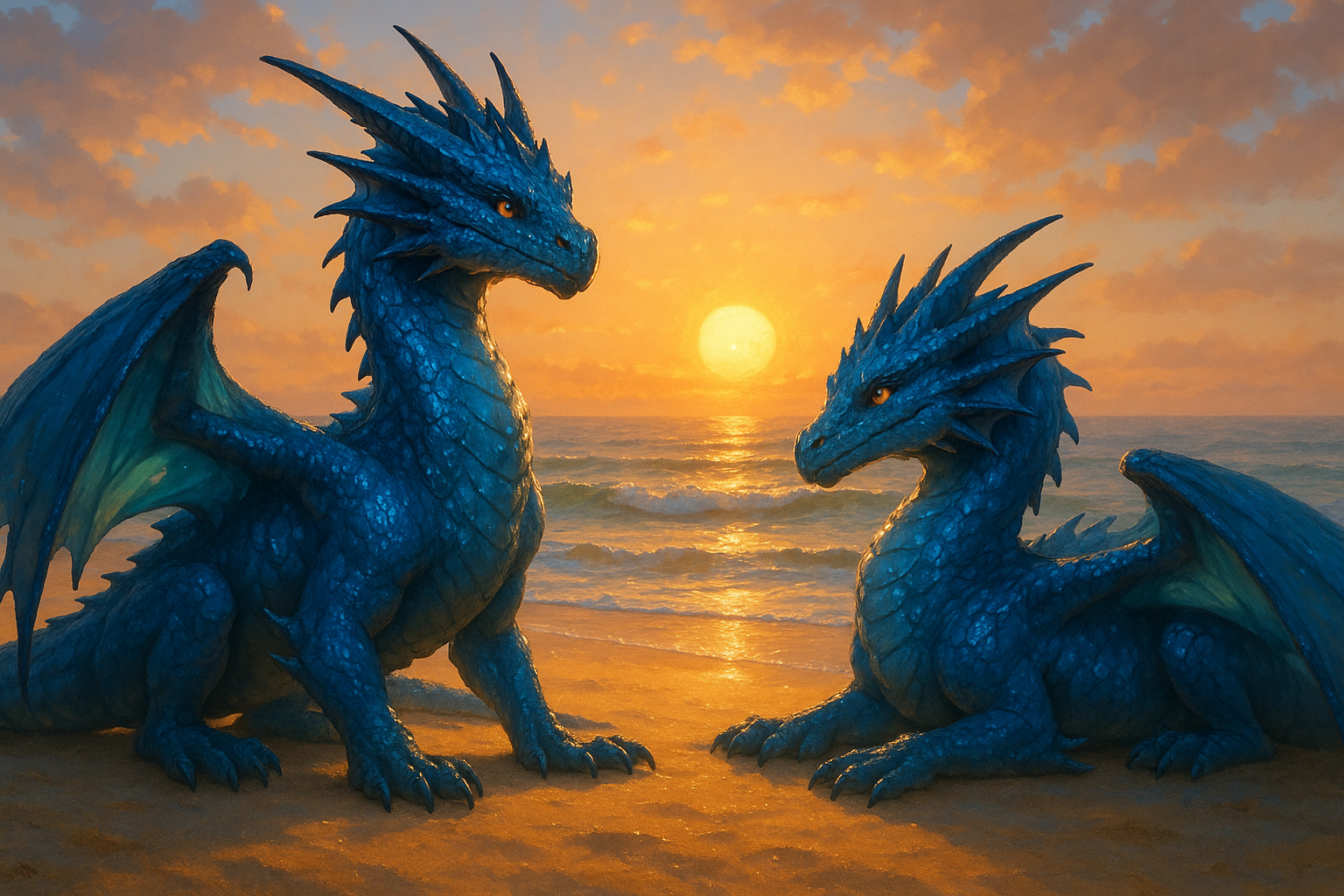
Blue dragons, venomous sea slugs, invade Muizenberg beach. Learn about their anatomy, toxic sting, and why they wash ashore.
Muizenberg's beach became a shimmering treasure chest as tiny, electric-blue sea slugs, known as blue dragons, washed ashore. These beautiful creatures, no bigger than a pinky nail, captivated onlookers with their sapphire bodies. However, their dazzling appearance hid a dangerous secret: they carry potent stinging cells from their prey, the Portuguese man-of-war. What started as a magical sight soon turned into a public health incident, as curious beachgoers discovered the painful sting of these living jewels.
What are blue dragons and why are they dangerous?
Blue dragons (Glaucus atlanticus) are small, electric-blue sea slugs that float on the ocean surface. They are dangerous because they feed on venomous Portuguese man-of-war and store the stinging cells, concentrating the toxins. Touching a blue dragon can result in a painful sting, often compared to an electric wasp, causing intense pain, swelling, and other reactions.
Get Cape Town news in your inbox
Stay updated with the latest stories from the Mother City.
Dawn of the Drifting Dragons
Just after sunrise, Muizenberg’s biscuit-coloured shoreline looked like someone had upended a treasure chest. Electric-blue specks, no wider than a pinky nail, glittered between footprints and paw-marks, halting runners, dog-walkers and dawn-patrol surfers mid-stride. Each droplet-shaped body flashed sapphire as the breeze rippled its six wing-like flaps, structures no longer than apple pips yet vivid enough to belong in a fantasy film. Word spread faster than the tide: “Come see the living jewels.”
By 07:30 the tally between the famous Victorian bathing boxes and the half-buried concrete of the old tidal pool had passed 120. Phones were already buzzing with screenshots and GPS pins. To most onlookers the scene was pure magic; to marine scientists it was a neon-coloured alarm bell. Glaucus atlanticus, better known as the blue dragon sea slug, had ridden an overnight surge of southerly wind and two-metre swell straight onto the Cape Peninsula. Social-media groups lit up with warnings and wonder in equal measure, and the city’s beach-loving public received an impromptu lesson in oceanic roulette.
The slugs kept arriving in pulses, delivered by each fresh wave. Children tried to scoop them into shell buckets, unaware that the sparkling toys were chemically armed. Lifeguards sprinted along the waterline, loudhailers crackling with requests to admire without touching. Within an hour the first sting report reached the medic tent: a teenage body-boarder who had brushed a specimen with the back of his hand described “a hot injection followed by a cramping throb that shot up my wrist.” The sapphire tide had turned from spectacle to public-health incident in the time it takes to drink a takeaway coffee.
Built for the Surface World
Look closely and the slug’s body is a feat of physics. A gas-filled stomach chamber - internally lined with magnetic crystals - works like a personal barometer and compass, rolling the animal so its brilliant cobalt back faces the sky while a mirror-silver underside stares downward. Predators glancing up or down meet matching shades of sea and light, an optic vanishing trick biologists call reverse counter-shading. Six feathery outgrowths on each flank act as mini hydrofoils, letting the creature tack across the breeze the way a yacht trims its sails. Microscopic skin glands ooze a slick of mucus barely thicker than a soap film, cutting surface tension and drag so effectively that engineers study it for ship-hull coatings.
Every detail screams lifestyle specialization. Blue dragons never willingly leave the thin skin between air and water; even mating takes place belly-side-up on the ocean’s ceiling. Eggs - tiny white spirals of up to 160 embryos - are glued to drifting objects, ideally the gas-filled floats of their favourite prey. Hatchlings emerge ready-made surface sailors, inheriting both the colour scheme and the chemical arsenal that makes their parents famous. Far from the sluggish, lettuce-like garden variety sea slugs of tidal pools, these are open-ocean acrobats that treat gravity as a mild suggestion rather than a law.
Evolution has also fine-tuned their appetite. Unlike most shell-less molluscs that scrape algae or nibble polyps, Glaucus is a high-seas bandit targeting one of the sea’s most feared drifters: the Portuguese man-of-war. The mismatch is comic - a three-centimetre gymnast attacking a creature whose stinging filaments can trail longer than a city bus - yet the slug wins through precision strikes and chemical trickery. Its digestive tract identifies, sorts and stores intact stinging cells, moving them like guided missiles to the wing tips where they wait for anything foolish enough to squeeze them.
Predator Turned Poison Pill
The dragon’s criminal brilliance lies in theft at the cellular level. While ripping mouth-sized chunks from a man-of-war’s tentacle, it avoids triggering a full venom discharge by using lightning-quick bites that sever before nerves react. Nematocysts - the microscopic harpoons - pass un-fired into the slug’s gut, where cilia ferry them through tiny conveyor belts into storage pouches called cnidosacs. There they sit, still alive, like cocked guns in a holster. Scientists have measured toxin concentrations per gram of slug tissue that exceed those of the original jelly by a factor of three, making the hunter more dangerous than the hunted.
Human skin learns this the hard way. A casual poke compresses the cnidosacs and 700 nanoseconds later a barbed thread punches through the epidermis under pressure equal to that needed to dent copper. The injected cocktail includes phospholipases, histamine-releasing peptides and a recently mapped peptide dubbed glaucotoxin-9 that blocks pain-regulating potassium channels. Victims compare the feeling to an electric wasp followed by a slow, spreading burn. Red wheals blossom within minutes; sensitive individuals report throat tightness or spikes in blood pressure. Lifeguard stations now stock heat packs and vinegar sprays, while medics prep antihistamines and, for severe cases, intravenous fentanyl.
First-aid advice has evolved with experience: rinse only with seawater, because fresh water or alcohol causes unfired cells to explode; apply heat at 43–45 °C for half an hour to denature venom proteins; avoid rubbing, which drives barbs deeper. Beach managers have printed interpretive signs in English, Afrikaans and isiXhosa, and loudspeakers repeat warnings every thirty minutes. Yet the best protection remains distance. As one toxicologist put it, “admire the sapphire, respect the dagger.”
Ocean Highways and Beached Armadas
These mass strandings are not cosmic accidents; they are postcards from a vast, invisible conveyor belt. Blue dragons ride the Agulhas Leakage, pulses of warm, salty Indian Ocean water that slip around Cape Agulhas when the Southern Annular Mode swings negative. Throw in a cut-off low-pressure cell spinning counter-clockwise south of the continent and surface winds shove floating organisms north-westward - straight onto Cape Town’s western beaches. Historical records show similar events in 1983, 1998, 2010 and 2016, all within a six-week window of late summer, and all matching years when the Indian Ocean Dipole was strongly positive.
Satellite sensors detected a +1.8 °C sea-surface hotspot at 34.5 °S, 19.8 °E the night before the Muizenberg landing - an oceanographic smoking gun that steered drifting fauna toward False Bay like a neon arrow. Model runs predict that if Thursday’s forecast cut-off low materialises, 50 km/h on-shore winds could deliver a second wave of dragons anywhere between Strandfontein and Hermanus. Two solar-powered Sofar drifters nicknamed “Blue Sox” are already broadcasting position, temperature and pressure every fifteen minutes to refine track forecasts that could reach as far east as Gqeberha.
Remove the predators and the food web wobbles. Lab work in Auckland shows one dragon can polish off two to three man-of-war floats per week, trimming local jelly densities by forty percent. Fewer jellies mean more safe haven for juvenile clupeid fish that hide among the stinging tentacles, potentially altering next season’s sardine recruitment. Conversely, when thousands of slugs rot on the sand they fertilise the beach. Stable-isotope readings of stranded tissue reveal nitrogen signatures as rich as seabird guano, fuelling blooms of scavenging beetles and isopods that in turn draw sanderlings and white-fronted plovers. Rangers have already logged record counts of these small waders probing the high-tide wrack.
How to Help Without Getting Hurt
The South African Association for Marine Biological Research has fired up its “Slugs & Bugs” WhatsApp hotline. Citizen scientists are urged to snap each find beside a coin or matchstick for scale, drop a GPS pin, and state whether bright-white egg spirals are present. Because Glaucus is a simultaneous hermaphrodite that mates reciprocal-style, strandings often feature pairs still locked together; noting the ratio of couples to singles tells researchers whether the event is a reproductive swarm or a dying diaspora. Never handle specimens - even nitrile gloves can compress cnidosacs and inject venom through latex. Slip a plastic card or shell beneath an animal if relocation is essential, and always use seawater.
For those who prefer armchair contributions, an environmental DNA sampler now sits off Kalk Bay, pumping twenty litres of surface water every hour through a filter that is flash-frozen at −20 °C. Over the next fortnight scientists will scan these cartridges for traces of Glaucus DNA, quantifying population pulses long after the last sapphire flake has vanished from view. Data will feed Lagrangian models that could one day warn municipalities of incoming dragons the same way we now track hurricanes or red tides. The goal, says project lead Dr. Nandi Mbele, is “to swap surprise for science, and fascination for foresight.”
And fascination shows no sign of fading. A Cape Town surf label has already mocked up limited-edition boardshorts printed with micro-CT scans of actual cerata geometry; five percent of proceeds will bankroll monthly beach clean-ups. Children trade biodegradable “dragon cards,” each QR code launching a thirty-second TikTok on nematocyst mechanics. Portuguese fishermen once dried the slugs, ground them into powder and mixed the residue with beeswax to fashion luminescent blue candles believed to ward off shipwreck; Japanese haiku anthologies cite the “ai-no-tatsu” as the first whisper of autumn gales. Today the legend lives on in smartphone galleries and lifeguard bulletins alike - proof that even the smallest, most delicate drifter can command the attention of an entire coast if it arrives wearing sapphire armour and carrying hidden daggers.
[{"question": "
What are blue dragons and why are they dangerous?
", "answer": "Blue dragons (Glaucus atlanticus) are small, electric-blue sea slugs that float on the ocean surface. They are dangerous because they feed on venomous Portuguese man-of-war and store the stinging cells, concentrating the toxins. Touching a blue dragon can result in a painful sting, often compared to an electric wasp, causing intense pain, swelling, and other reactions. These stings are more potent than those from the Portuguese man-of-war itself, as the blue dragon concentrates the venom."},{"question": "
Why did blue dragons wash ashore in Cape Town?
", "answer": "Blue dragons washed ashore in Cape Town due to a combination of oceanographic and weather conditions. They ride the Agulhas Leakage, pulses of warm Indian Ocean water. This, combined with southerly winds and two-metre swells, along with cut-off low-pressure cells, pushed these floating organisms onto the Cape Peninsula's beaches. Historical records show similar events often occur in late summer."},{"question": "
What should I do if I see a blue dragon on the beach?
", "answer": "If you see a blue dragon on the beach, admire it from a safe distance but do not touch it. These creatures carry potent stinging cells. Lifeguards and marine scientists advise against handling them, even with gloves, as the stinging cells can still penetrate. If relocation is essential, carefully slide a plastic card or shell underneath the animal and move it using seawater."},{"question": "
What should I do if I get stung by a blue dragon?
", "answer": "If you get stung by a blue dragon, the first-aid advice is to rinse the affected area only with seawater (avoiding fresh water or alcohol as these can trigger more stinging cells). Apply heat at 43–45 °C for about 30 minutes to denature the venom proteins. Avoid rubbing the sting, as this can push the barbs deeper. Seek medical attention if symptoms are severe or persist, as reactions can include intense pain, swelling, and in sensitive individuals, throat tightness or blood pressure spikes."},{"question": "
How do blue dragons manage to eat Portuguese man-of-war without being stung themselves?
", "answer": "Blue dragons have evolved a clever mechanism to feed on Portuguese man-of-war. They use lightning-quick bites that sever chunks of the man-of-war's tentacles before its nerves can react and trigger a full venom discharge. Their digestive system then sorts and stores the intact stinging cells (nematocysts) in specialized pouches called cnidosacs at their wing tips, effectively turning their prey's weapon into their own, making them even more dangerous."},{"question": "
Are blue dragon strandings common, and what is being done to track them?
", "answer": "Mass strandings of blue dragons are not cosmic accidents; historical records indicate similar events have occurred in Cape Town in 1983, 1998, 2010, and 2016, often linked to specific oceanic and weather patterns. Scientists are actively tracking these events using satellite sensors, oceanographic models, and even citizen science initiatives like WhatsApp hotlines for reporting sightings. Environmental DNA samplers are also being used to quantify population pulses and predict future strandings, aiming to provide early warnings to municipalities."}]
Sizwe Dlamini is a Cape Town-based journalist who chronicles the city’s evolving food scene, from boeka picnics in the Bo-Kaap to seafood braais in Khayelitsha. Raised on the slopes of Table Mountain, he still starts every morning with a walk to the kramat in Constantia before heading out to discover whose grandmother is dishing up the best smoorsnoek that day.
View all articles →