
Mother-and-daughter duo discover world’s largest coral colony on Great Barrier Reef
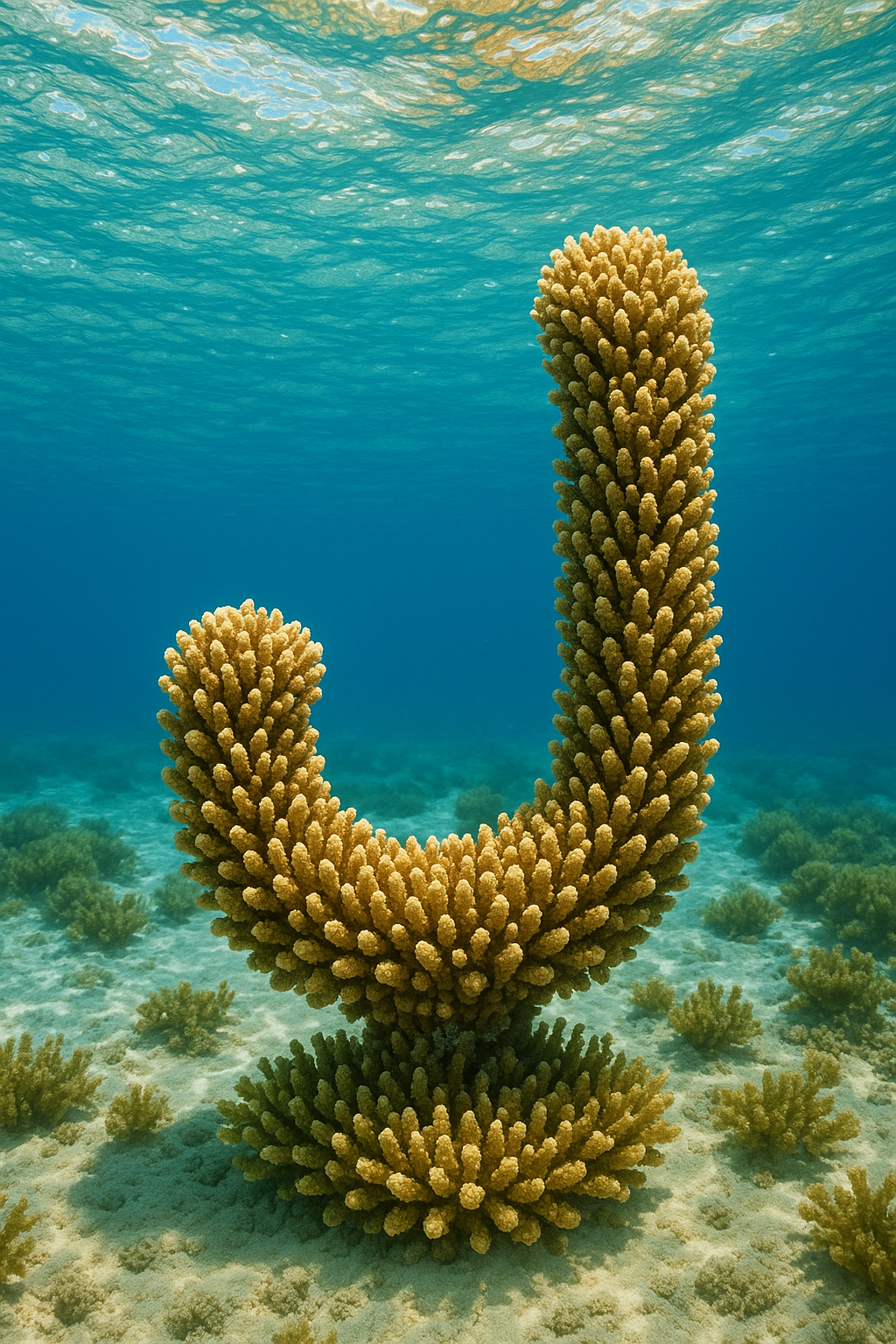
Discover the largest coral colony ever found on the Great Barrier Reef, a 500-year-old marvel defying climate change.
Sophie Kalkowski-Pope and her mother Jan Pope made an amazing discovery: the world's biggest single coral colony! This giant coral, called a Pavona clavus, is like a massive, ancient city underwater, stretching 111 meters and covering an area as big as ten house blocks. It's incredibly old, maybe 400 to 550 years, and has survived many dangers thanks to a special spot on the Great Barrier Reef that keeps it cool. This amazing find helps scientists learn how to protect corals and even build new ones, giving hope for the future of our oceans.
What is the largest coral colony ever discovered?
The largest known single coral colony is a Pavona clavus, stretching 111 meters and covering 3,876 square meters. This "Coral Colossus" is located off an un-named outer-central reef on the Great Barrier Reef, Australia. It is estimated to be between four and five and a half centuries old, a true survivor of various environmental changes.
Get Cape Town news in your inbox
Stay updated with the latest stories from the Mother City.
1. A Morning That Changed the Map
On a glass-calm spring tide in late 2023, Sophie Kalkowski-Pope and her mother Jan Pope dropped off the edge of an un-named outer-central reef. They carried nothing fancier than a slate, a GoPro and a fibreglass tape measure, yet sixty minutes later they had triggered the formal certification of the planet’s largest known single coral colony.
The creature they met is not a thicket of branching staghorns or a meadow of plates - it is one uninterrupted animal. Shaped like an ochre-brown question mark, the Pavona clavus stretches 111 m from horn to horn and blankets 3 876 m² of seabed, the footprint of ten Australian suburban house blocks. From the air it looks like a pale glyph carved into indigo; at snorkel depth it feels like swimming above a medieval fortress, every buttress and crenellation poured from the same genetic mould.
Jan, 62, an underwater photographer with 7 000 dives logged since 1978, stumbled on the ridge a week earlier while chasing sweetlips through sun-beams. “I kept kicking and kicking but the wall never stopped,” she laughs. “When I checked my gauge I’d been riding one coral for eighteen minutes.” She surfaced, rang Sophie - marine-ops coordinator for the citizen-science NGO Citizens of the Reef - and vowed to come back with tape and a plan.
Their return dive was almost laughably low-tech: one fin-kicks the perimeter while the other holds the zero end, pausing every body-length to jot depth, rugosity and tissue health. Where the crest dipped they spooled off nylon, criss-crossing the saddle until the living rampart resembled a giant dot-to-dot puzzle. Two-hundred-and-fourteen way-points, forty-two minutes of 4-K footage and 1 300 stills were enough for the University of Queensland to sense something exceptional had been found.
2. From Fibreglass to Digital Twin
Field glory dies fast in reef science; the next fortnight vanished under fluorescent office lights. Engineers at Queensland University of Technology’s Centre for Robotics fed the footage into structure-from-motion photogrammetry code originally written for mine-hunting drones. By pairing images snapped two seconds apart, the software coughed up a point-cloud so dense that individual polyp mouths - each one millimetre across - popped into view at full zoom.
Serena Mou, the research engineer who shepherded the data, says the micro-detail matters because corals build millimetre-high ridges that bleed wave energy. Lose those ridges to bleaching and you also lose the hydrodynamic hide-outs they create for fish larvae. The finished 3-D mesh carries 1.8 billion triangles, geolocated to within three centimetres thanks to post-processed drone GPS.
Dropped into the open-source ReefCloud atlas, the model becomes a permanent digital twin. Any future survey - professional ROV, weekend snorkeller or orbiting satellite - can be stacked on top, letting scientists watch calcification, erosion or disease march across the colony almost in real time.
3. Why This Giant Survived
Big makes headlines, but big, old and healthy makes scientists salivate. Pavona clavus is a slow, massive "brain" coral, laying down skeleton at roughly six to eight millimetres a year. The colony’s 3.2 m apex therefore clocks in at four to five and a half centuries, a settler from the age when Ming-dynasty admiral Zheng He roamed the Indian Ocean.
Its escape from the crown-of-thorns plagues of the 1980s, the cyclone swells of 2006 and 2011, and the back-to-back marine heatwaves of 2016, 2017 and 2020 comes down to a lucky oceanographic quirk. The reef perch sits on a narrow ribbon where the outer shelf plunges into the Queensland Trough. Every tidal cycle shoves 2.5 million cubic metres of nutrient-rich water through a 700-m gap, creating a perpetual cool-water Jacuzzi that shaves midday temperatures by 1.2–1.8 °C compared with neighbouring flats.
Temperature loggers deployed for eighteen months show the colony has not suffered a single eight-day spell above the local bleaching threshold of 29.7 °C - a feat almost unmatched along the reef’s 2 300-km span. Add a south-easterly orientation that blocks the dominant storm vectors of Cyclone Yasi and you get a Goldilocks micro-climate: enough current to feed polyps, enough chill to dodge heat shock, enough topographic armour to blunt cyclone punch.
4. Life in the Calcium City
Although genetically one individual, the coral is anything but a monoculture. Shaded underhangs cradle feathery nephthid soft corals; sun-blasted crests are mown by surgeonfish; inside the moat enclosed by the "J", gangs of juvenile grey reef sharks practise circling manoeuvres.
A twilight ROV transect two weeks after the reveal counted 114 fish species, 37 mobile invertebrates and 12 kinds of macro-algae living on or just above the Pavona. Genetic fin-clips showed many recruits originated from reefs 30–60 km away, confirming the colony’s role as a stepping-stone in larval super-highways.
5. Crowds Powering the Census
The discovery was no fluke; it was embedded in the Great Reef Census, a crowd-sourced monitoring blitz that has rallied 12 000 boaties, divers, Indigenous rangers and even coastal hairdressers since 2020. Volunteers receive a one-page shot list - top-down, oblique, horizon visible - and adopt a 5 × 5 km grid cell each October.
Images pour into ReefCloud where an AI pre-sort tags hard coral, soft coral, algae or rubble; humans then validate ten per cent, sharpening the network in a virtuous loop. So far the census has chewed through 65 000 high-resolution mosaics covering fourteen per cent of the Great Barrier Reef, work that would have cost government agencies an estimated AU $14 million if done by research vessels.
Sophie calls the workflow "conservation at Instagram speed," but the data are bricks-and-mortar serious: 318 high-value "recovery reefs" still pumping out coral larvae have been pinpointed, information now baked into Australia’s billion-dollar reef-restoration roadmap.
6. Shielding the Superlative
Fame can kill. Iconic sites from Belize’s Blue Hole to Raja Ampat’s "Passage" have been scarred by anchors, souvenir hunters and clumsy fins once GPS coordinates hit the internet. For that reason Citizens of the Reef, Queensland Parks & Wildlife and the Marine Park Authority agreed to fuzz the Pavona’s location to the nearest minute of arc - an 1.8-km anonymity buffer.
Enforcement is light-touch yet high-tech: two solar-powered wave-glider drones prowl the outer shelf, logging acoustic signatures of every vessel longer than six metres. Linger more than thirty minutes inside the buffer and rangers receive a ping they can answer by helicopter within forty-five minutes. Since February only one yacht has strayed; a radio warning sent it on its way.
7. Giants in the Global Coral Hall of Fame
Marine biologists never miss a chance for superlatives. The previous record-holder was a 33-m-wide Pavona clavus documented off Colombia in 2013; before that, a 29-m Porites in American Samoa held the crown since the 1970s. Both are now dwarfed by the Australian titan.
"Largest" can be measured differently. In the Maldives, Porites lutea forms kilometre-circumference "micro-atolls," but those rings are patchworks of thousands of genetically distinct colonies. The Red Sea’s 800-year-old "Immortal Coral" is older yet smaller. The new find therefore keeps the title for sheer surface area of a single genet, while hinting at how many unmapped titans still hide in the twilight zone between reef crest and abyss.
8. Reading the Climate Archive
Even as champagne corks flew, researchers rushed to extract a 4-m-long core from a sheltered flank. The 18-kg rod is a 400-year diary of rainfall and temperature: each annual band locks in trace elements that rise and fall with river runoff and sea warmth.
Early X-ray fluorescence at Australia’s nuclear science labs shows a barium spike after 1875, matching the advent of intensive farming in the Burdekin catchment, and a cadmium peak in 1946, likely wartime mining effluent. The skeleton’s chemistry could therefore supply pre-industrial baselines for water-quality law - evidence in courtroom battles between farmers, conservationists and politicians.
9. Engineering the Living Seawall
Coastal engineers facing rising seas wonder whether calcium-carbonate masons could one day replace concrete. Flume tests at Delft University show the Pavona’s ribbed architecture can bleed off 68 % of incoming wave energy.
3-D printed reef units nicknamed "PavBricks," cast from the colony’s sinusoidal blueprint, are now being seeded with coral fragments in pilot sites in the Maldives and Miami. Early numbers show nubbins attach twice as fast as on flat blocks. If the trend holds, the Great Barrier Reef’s accidental colossus may inspire living breakwaters that grow with sea-level rise instead of crumbling before it.
10. The Waiting Game
For now the coral keeps its slow-motion rhythm, thickening by a thumbnail each year. Satellite SST alerts feed directly to Sophie’s phone; if the mercury tops 29.2 °C for three straight days she can charter a boat within twenty-four hours to drape shade cloth and deploy sodium-bicarbonate buffers - first-aid tactics born during the 2020 mass bleaching.
Most researchers wager the fortress walls and the oceanographic moat will outfox the next El Niño heat pulse. Somewhere inside the ramparts new polyps are budding, adding their own fleck of aragonite to the largest single genome on the reef - a quiet, calcium-carbonate retort to the drumbeat of ecological doom.
[{"question": "
What is the Coral Colossus and who discovered it?
\nThe Coral Colossus is the world's largest known single coral colony, a Pavona clavus, stretching 111 meters and covering 3,876 square meters. It was discovered by Sophie Kalkowski-Pope and her mother Jan Pope during a dive in late 2023 on the Great Barrier Reef.
\n","answer": ""},{"question": "How old is the Coral Colossus and where is it located?
\nThis massive coral colony is estimated to be between 400 and 550 years old. It is located off an un-named outer-central reef on the Great Barrier Reef, Australia. Its age means it has survived numerous historical events and environmental changes.
\n","answer": ""},{"question": "What makes this coral colony so special and how did it survive?
\nThe Coral Colossus is special not only for its immense size and age but also for being a single, uninterrupted animal, unlike many other large coral formations. Its survival is attributed to a unique oceanographic quirk: its location on a narrow ribbon where the outer shelf plunges into the Queensland Trough creates a perpetual cool-water environment, protecting it from heatwaves and cyclones. It also has a south-easterly orientation that blocks dominant storm vectors.
\n","answer": ""},{"question": "How was the Coral Colossus measured and documented?
\nSophie and Jan initially used low-tech methods like a fibreglass tape measure and a slate. Following their discovery, engineers at Queensland University of Technology used advanced photogrammetry code to create a detailed 3D digital twin of the coral, featuring 1.8 billion triangles and geolocated to within three centimeters. This model allows for precise monitoring of its health and changes over time.
\n","answer": ""},{"question": "What is the significance of this discovery for coral research and conservation?
\nThis discovery provides valuable insights into coral resilience and longevity, helping scientists understand how corals can survive significant environmental stressors. The detailed digital twin and ongoing monitoring contribute to the open-source ReefCloud atlas, aiding in the identification of high-value 'recovery reefs' and informing reef-restoration strategies. The unique ribbed architecture of the Pavona clavus is even inspiring the design of 'PavBricks' for living seawalls.
\n","answer": ""},{"question": "How is the location of the Coral Colossus being protected?
\nTo protect the Coral Colossus from potential damage due to increased human activity, its exact GPS coordinates have been deliberately

Tumi Makgale is a Cape Town-based journalist whose crisp reportage on the city’s booming green-tech scene is regularly featured in the Mail & Guardian and Daily Maverick. Born and raised in Gugulethu, she still spends Saturdays bargaining for snoek at the harbour with her gogo, a ritual that keeps her rooted in the rhythms of the Cape while she tracks the continent’s next clean-energy breakthroughs.
View all articles →