
Watch: Elephant seal makes unexpected visit to Palmiet Beach
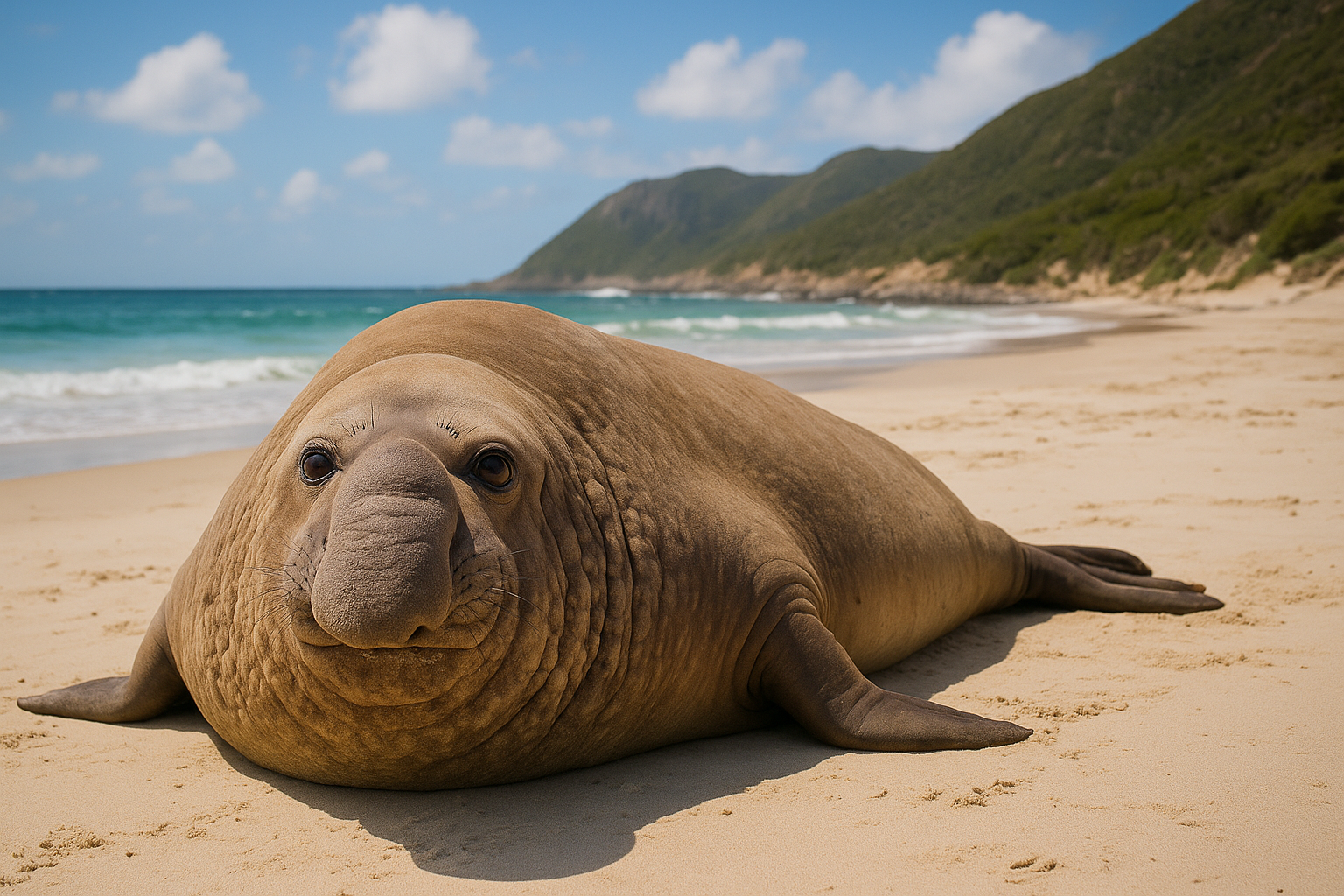
A wandering elephant seal turned a South African cove into a classroom on coexistence, chemistry, and 4000kg of blubber-powered curiosity.
{"summary": "Imagine a huge, trunk-nosed seal, bigger than a car, taking a wrong turn and ending up on a sunny South African beach! This giant visitor, usually found near Antarctica, became a sensation. People flocked to see it, learning about its incredible ability to dive deep and hold its breath for ages. After a few days of being the star attraction, the colossal seal simply swam back into the ocean, leaving behind an unforgettable memory."}
What is an elephant seal?
Elephant seals are massive marine mammals, with males reaching up to four tonnes, known for their distinctive trunk-like proboscis. These deep-diving pinnipeds can hold their breath for over an hour, have blubber that regulates body temperature, and conserve moisture through their unique noses, making them highly adapted to marine life.
Get Cape Town news in your inbox
Stay updated with the latest stories from the Mother City.
How a wrong turn carried a four-ton seal into a Western Cape hamlet - and turned a strip of sand into a pop-up university on blubber, breath-holds and neighbourly respect.
Dawn of the Unexpected Trunk-Nosed Tractor
Palmiet Beach woke up ordinary: apricot light, quartz grains pinging under sneakers, oystercatchers trading yodels with the first cast of the surf-casters. By coffee-cup-empty o’clock the script flipped. A slab-sided shadow - bigger than a bakkie, wet-slate grey - surfed the last wave, bulldozed a torso-shaped trench above the spring-tide line and flopped like a comma onto the pale page of sand. Within sixty minutes the parking lot looked like a birders’ convention minus the etiquette: tripods, bazooka lenses, toddlers on parental shoulders, a dachshund in a shark-clad hoodie.
No-one present guessed the visitor’s passport: a population that spends nine-tenths of existence south of the Roaring Forties, hauling out only on the rugby-stadium-sized beaches of South Georgia, the Falklands or the fang-shaped Kerguelen group. For a young adult male Mirounga leonina to pop up on the 34th parallel is the marine equivalent of bumping into a polar bear on the Champs-Élysées - technically doable, yet rare enough to empty a biologist’s diary for the week.
While WhatsApp pings ricocheted, Dr Greg Hofmeyr’s laptop at the Port Elizabeth Museum was already plotting GPS breadcrumbs. Two decades and 312 flipper tags told the tale: a 2022 tag from Bird Island in Algoa Bay matched the scar map streaming in from the Overstrand ranger. Code-named “BI42M,” the seal had last been logged 1.2 km beneath the Antarctic Circumpolar Current, holding its breath for 77 minutes. Its southernmost fix, −54.8°, sat 2,000 km from the nearest craft-beer tap.
Teen males usually “practice-migrate” in austral winter, riding the Agulhas leakage around the Cape before U-turning home. BI42M missed the exit, surfed a warm-core eddy and beached himself at Africa’s seaside wine farms. Translation: a GPS-guided wrong turn dumped a 1.8-ton backpacker outside a vineyard tasting room.
Physiology of a Black-Muscled Dive Machine
Tape measures pegged the traveller at 3.8 m and roughly 1,800 kg - about two-thirds of what he could weigh if he dodges orcas and long-line hooks for another decade. Prime bulls routinely surpass four tonnes, their noses inflating into trunk-like hoses that blast baritone threats across half a kilometre of beach. That proboscis doubles as a life-support gadget: it reclaims exhaled moisture, letting a beach-master fast for ninety consecutive days without a sip of fresh water.
Skin is a self-regulating wetsuit. Microscopic gas glands coat the fur with lubricant, collapsing clingy air pockets so the owner can plunge 2 km without the bends. Myoglobin crowds the muscle fibres at 30 % by mass, dyeing the tissue almost obsidian and stockpiling more on-board oxygen than any other air-breathing vertebrate carries. What looks like a dozing mountain of blubber is, in hydrodynamic slang, a low-drag, high-octane submarine choosing to recharge in public view.
That blubber itself is a carbon vault. Over a ten-year lifespan one seal shuttles roughly 2.5 t of carbon from surface to abyss via sinkable scats and carcasses - equal to taking two petrol cars off the road. While BI42M snored, he was still doing planetary overtime as a fuzzy climate courier.
Municipal Playbook versus Smartphone Tsunami
By mid-morning the Overstrand environmental squad had run its wildlife-hoop routine: orange cones, laminated A4 notices - “REST AREA, KEEP OUT.” The buffer, 20 m, was no thumb-suck; it matches the measured rush-distance of an irate juvenile Mirounga on sand (2 m/s for 15 m), giving Instagram thrill-seekers 7.5 seconds to rethink life choices before 1,800 kg of opinion arrives. Dean O’Neill, the municipal manager, fronted the crowd in three languages, cycling the refrain: “Eyes only, no selfies inside the ring.”
Shark-Watch volunteers rotated as “seal stewards,” logging air temp, gust speed, head-counts. A vet nurse hung a dextrose-saline bag as insurance, but a skin-pinch test said BI42M was merely on shore-leave; no fences rose, leaving the runway clear for a voluntary departure. Pinniped ethicists applaud: barricades can spark capture myopathy, a fatal stress spiral.
TikTok, of course, mocks cordons. Within hours #PalmietPinniped amassed 1.7 million views, many showing teens prone beside the mound for scale. One influencer live-streamed a “blubber-breath meditation,” promising followers “the raw hertz of a heart that dines with colossal squid.” Algorithms handed fame to proximity, biology begged for distance. The council retaliated with geo-targeted push alerts: “Zoom saves lives.” Nearby, an ice-cream vendor moulded caramel bars into trunk shapes; they sold out by noon - proof that conservation and capitalism can share a freezer shelf.
Night Watch, Squid Beaks and a Quiet Goodbye
Darkness did not empty the sand. Astro-photographers arrived craving the money shot: Milky Way, bioluminescent surf, megafauna silhouette. To keep the beach dark, rangers borrowed thermal monoculars - dual-use tech that also spots abalone poachers. On night two the infrared screen lit up with two heat signatures wriggling behind the dune; intervention revealed not smugglers but university students calibrating a star-tracker. A modern twist: conservation gadgets expose the innocent as readily as the guilty.
Dogs posed the gravest threat. A seal’s defensive side-swipe bites at 1,200 N, enough to pulp a retriever’s skull. Bylaws insist on leashes, yet holidaymakers confuse “beach freedom” with constitutional right. Stewards now hand out QR codes linking to a 45-second clip of a seal-bite suture (viewer discretion advised). Studies from New Zealand proved that graphic imagery flips owner behaviour faster than fines; compliance on Palmiet jumped to 94 % within a day.
On the fourth sunrise BI42M rocked his pectorals, preluding departure. Stewards widened the corridor, cameras lowered. At 09:17 a 1.8 m set rolled in; the seal lurched downslope like a black zeppelin, hit the foam, porpoised once, trunk up like a periscope, then vanished. Applause rippled, then hushed: the GPS tag will ping for 220 more days, each uplink a heartbeat on the map, proof that stewardship does not stop at the breakers.
Hours later, cleanup crew found a fresh squid beak - 19 mm - probably coughed up in the exit rush. It now sits in a specimen jar labelled “Evidence of Connectivity,” waiting for the next tide of curiosity, just like the boy-who-became-bus that once napped on Palmiet and left with the dawn swell.
What is an elephant seal?
Elephant seals are massive marine mammals, with males reaching up to four tonnes, known for their distinctive trunk-like proboscis. These deep-diving pinnipeds can hold their breath for over an hour, have blubber that regulates body temperature, and conserve moisture through their unique noses, making them highly adapted to marine life. They spend nine-tenths of their lives in the ocean, primarily in sub-Antarctic waters.
Where are elephant seals usually found?
Elephant seals are typically found in the Southern Ocean, south of the Roaring Forties. Their usual hauling-out locations include large beaches on islands like South Georgia, the Falkland Islands, and the Kerguelen group, far from human settlements and warm coastlines like South Africa.
How did this elephant seal end up on a South African beach?
This particular young adult male elephant seal, code-named "BI42M," made a navigation error during its practice migration in austral winter. Instead of turning back towards its usual Antarctic feeding grounds after riding the Agulhas leakage around the Cape, it surfed a warm-core eddy and beached itself on Palmiet Beach in South Africa, a journey of over 2,000 km from its last recorded location.
How are elephant seals adapted for deep diving and long breath-holds?
Elephant seals are incredibly adapted for their marine life. They can dive to depths of 1.2 to 2 kilometers and hold their breath for up to 77 minutes or even over an hour. This is possible due to their high concentration of myoglobin in their muscles, which stores oxygen, and their ability to collapse their lungs and slow their heart rate. Their skin also acts as a self-regulating wetsuit, with microscopic gas glands that help them withstand immense pressure without getting the bends.
What unique physiological features do elephant seals possess?
Beyond their diving prowess, elephant seals have several unique features. The most prominent is the male's trunk-like proboscis, which not only helps in vocalizing threats but also reclaims exhaled moisture, allowing them to fast for extended periods (up to 90 days) without fresh water. Their substantial blubber layer serves as insulation, energy storage, and helps them regulate body temperature. They are also significant carbon sequesters, moving tons of carbon from the surface to the abyss over their lifespan.
How did the local community and authorities manage the elephant seal's visit?
Upon the seal's arrival, the Overstrand environmental squad established a 20-meter exclusion zone with cones and notices to ensure its rest and public safety. "Seal stewards" (Shark-Watch volunteers) monitored the area, and a vet nurse assessed the seal, confirming it was merely resting. Authorities used geo-targeted push alerts to encourage distance, and graphic imagery of seal-bite injuries was used to enforce leash laws for dogs, resulting in high public compliance and a respectful, voluntary departure of the seal.

Lerato Mokena is a Cape Town-based journalist who covers the city’s vibrant arts and culture scene with a focus on emerging voices from Khayelitsha to the Bo-Kaap. Born and raised at the foot of Table Mountain, she brings an insider’s eye to how creativity shapes—and is shaped by—South Africa’s complex social landscape. When she’s not chasing stories, Lerato can be found surfing Muizenberg’s gentle waves or debating politics over rooibos in her grandmother’s Gugulethu kitchen.
View all articles →